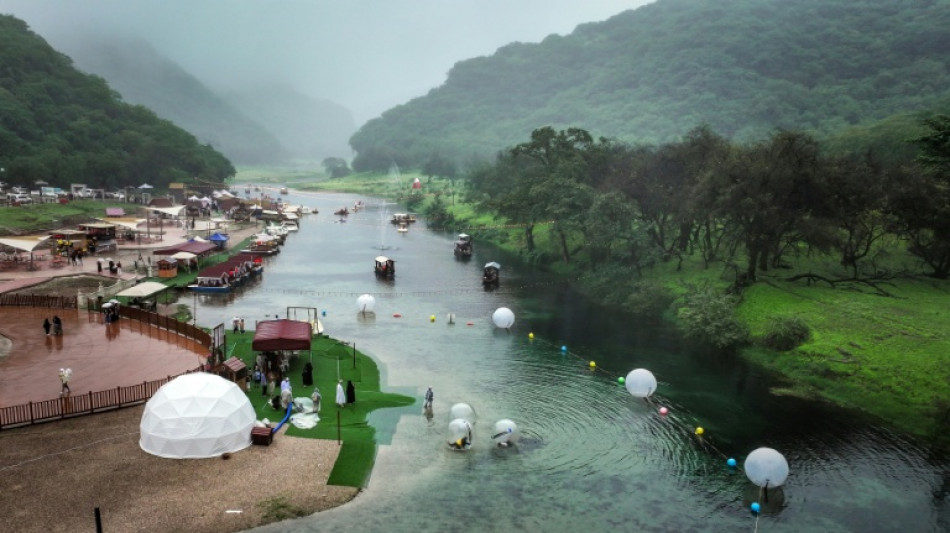
With poetry and chants, Omanis strive to preserve ancient language / Photo: - - AFP

 Braves clinch division title as Red Sox reach MLB playoffs
 Bordeaux-Begles hammer Stade Francais despite Jalibert injury

 Milan and Juventus end blips with home wins

 Bridgeman wins PGA Biltmore title with sizzling 61

 Williams injured as Bears shut down by Vikings

 US warns of rapid escalation in Middle East war

 Germany's far-right AfD celebrates another state election win

 Russia vows revenge for election-day attacks as poll shows ruling party win

 Spaun late shows snatches PGA Championship win

 Conceicao strikes as Juventus beat Atalanta

 Britain, Zverev-inspired Germany, Spain complete Davis Cup finals

 Man Utd salvage Fulham draw as pressure mounts on Carrick

 Spanish civil war drama 'The Black Ball' wins at Toronto festival

 Germany's Merz shaken by far-right and far-left gains in state votes

 Macron welcomes Canada's Carney to French Atlantic territory

 Fiorentina frustrate Napoli with Serie A draw, Como upset

 Five-star Man City top Premier League after Sunderland thriller

 Ukrainian drones hit Moscow on last day of Russian elections
 Multi-Asset Trading Venue Monochrome Exchange Announces IEO of Its Native Token, $MCR

 South Korea break Japan hearts to win Asian Games basketball gold
 Acosta takes first victory at Austrian MotoGP

 PSG president Nasser al-Khelaifi under investigation in France for conflict of interest

 China swim sensation, 13, sets Games record after Japan win early

 Drones hit Moscow as Russians go to the polls

 New England boss Fleming says 'wrong' to ask Stokes to end retirement

Against the backdrop of southern Oman's lush mountains, men in traditional attire chant ancient poems in an ancient language, fighting to keep alive a spoken tradition used by just two percent of the population.
Sitting under a tent, poet Khalid Ahmed al-Kathiri recites the verses, while men clad in robes and headdresses echo back his words in the vast expanse.
"Jibbali poetry is a means for us to preserve the language and teach it to the new generation," Kathiri, 41, told AFP.
The overwhelming majority of Omanis speak Arabic, but in the mountainous coastal region of Dhofar bordering Yemen, people speak Jibbali, also known as Shehri.
Researcher Ali Almashani described it as an "endangered language" spoken by no more than 120,000 people in a country of over five million.
- 'Protected by isolation' -
While AFP was interviewing the poet, a heated debate broke out among the men over whether the language should be called Jibbali -- meaning "of the mountains" -- or Shehri, and whether it was an Arabic dialect.
Almashani said it was a fully-fledged language with its own syntax and grammar, historically used for composing poetry and proverbs and recounting legends.
The language predates Arabic, and has origins in Semitic south Arabian languages, he said.
He combined both names in his research to find a middle ground.
"It's a very old language, deeply rooted in history," Almashani said, adding that it was "protected by the isolation of Dhofar".
"The mountains protected it from the west, the Empty Quarter from the north, and the Indian Ocean from the south. This isolation built an ancient barrier around it," he said.
But remoteness is no guarantee for survival.
Other languages originating from Dhofar like Bathari are nearly extinct, "spoken only by three or four people," he said.
Some fear Jibbali could meet the same fate.
Thirty-five-year-old Saeed Shamas, a social media advocate for Dhofari heritage, said it was vital for him to raise his children in a Jibbali-speaking environment to help keep the language alive.
Children in Dhofar grow up speaking the mother-tongue of their ancestors, singing along to folk songs and memorising ancient poems.
"If everyone around you speaks Jibbali, from your father, to your grandfather, and mother, then this is the dialect or language you will speak," he said.
- Not yet documented -
The ancient recited poetry and chants also preserve archaic vocabulary no longer in use, Shamas told AFP.
Arabic is taught at school and understood by most, but the majority of parents speak their native language with their children, he said.
After the poetry recital, a group of young children nearby told AFP they "prefer speaking Jibbali over Arabic".
But for Almashani, the spectre of extinction still looms over a language that is not taught in school or properly documented yet.
There have been recent efforts towards studying Jibbali, with Oman's Vision 2040 economic plan prioritising heritage preservation.
Almashani and a team of people looking to preserve their language are hoping for support from Dhofar University for their work on a dictionary with about 125,000 words translated into Arabic and English.
The project will also include a digital version with a pronunciation feature for unique sounds that can be difficult to convey in writing.
Th.Gonzalez--AT