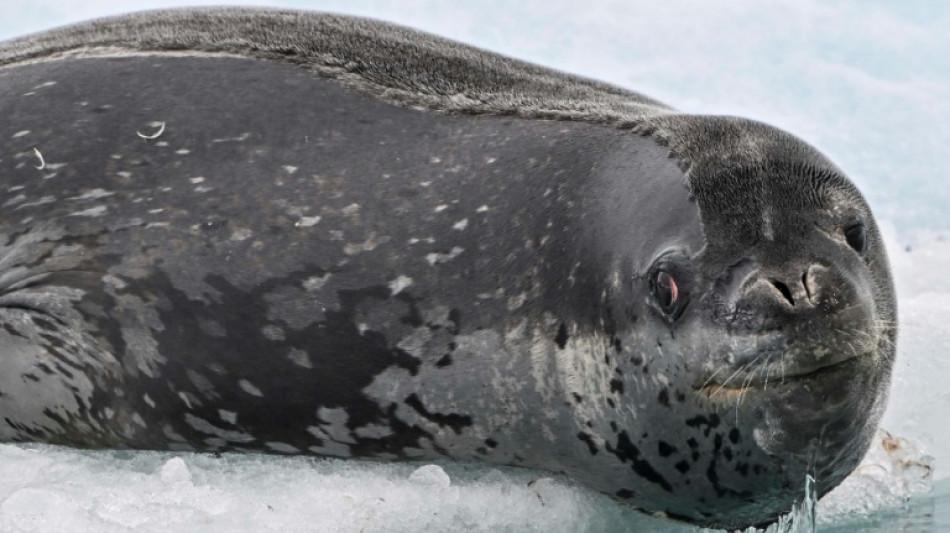
Seals sing 'otherworldly' songs structured like nursery rhymes / Photo: Juan BARRETO - AFP/File

 Braves clinch division title as Red Sox reach MLB playoffs

 Bordeaux-Begles hammer Stade Francais despite Jalibert injury

 Milan and Juventus end blips with home wins

 Bridgeman wins PGA Biltmore title with sizzling 61

 Williams injured as Bears shut down by Vikings

 US warns of rapid escalation in Middle East war

 Germany's far-right AfD celebrates another state election win

 Russia vows revenge for election-day attacks as poll shows ruling party win

 Spaun late shows snatches PGA Championship win

 Conceicao strikes as Juventus beat Atalanta

 Britain, Zverev-inspired Germany, Spain complete Davis Cup finals

 Man Utd salvage Fulham draw as pressure mounts on Carrick

 Spanish civil war drama 'The Black Ball' wins at Toronto festival

 Germany's Merz shaken by far-right and far-left gains in state votes

 Macron welcomes Canada's Carney to French Atlantic territory

 Fiorentina frustrate Napoli with Serie A draw, Como upset

 Five-star Man City top Premier League after Sunderland thriller

 Ukrainian drones hit Moscow on last day of Russian elections

 Multi-Asset Trading Venue Monochrome Exchange Announces IEO of Its Native Token, $MCR

 South Korea break Japan hearts to win Asian Games basketball gold

 Acosta takes first victory at Austrian MotoGP

 PSG president Nasser al-Khelaifi under investigation in France for conflict of interest

 China swim sensation, 13, sets Games record after Japan win early

 Drones hit Moscow as Russians go to the polls

 New England boss Fleming says 'wrong' to ask Stokes to end retirement

When male leopard seals dive down into icy Antarctic waters, they sing songs structured like nursery rhymes in performances that can last up to 13 hours, scientists said Thursday.
The Australian-led team of researchers compared the complexity of the songs composed by the big blubbery mammals to those of other animals -- as well as human musicians like the Beatles and Mozart.
Lucinda Chambers, a bioacoustics PhD student at Australia's University of New South Wales, told AFP that people are often surprised when they hear the "otherworldly" hoots and trills sung by leopard seals.
"It kind of sounds like sound effects from an '80s sci-fi" movie, said the lead author of a new study in the journal Scientific Reports.
During the spring breeding season, male leopard seals dive underwater and perform their songs for two minutes before returning to the surface for air. They then repeat this performance for up to 13 hours a day, according to the study.
The researchers determined that all leopard seals share the same set of five "notes" which are impossible to distinguish between individuals.
However each seal arranges these notes in a unique way to compose their own personal song.
"We theorise that they're using that structure as a way to broadcast their individual identity, kind of like shouting their name out into the void," Chambers said.
The researchers believe the males use these songs to woo potential female mates -- and ward off rivals.
- 'Songbirds of the ocean' -
The team studied recordings of 26 seals captured by study co-author Tracey Rogers off the coast of Eastern Antarctica throughout the 1990s.
"They're like the songbirds of the Southern Ocean," Rogers, who is also from the University of New South Wales, said in a statement.
"During the breeding season, if you drop a hydrophone into the water anywhere in the region, you'll hear them singing."
The team analysed how random the seals' sequences of notes were, finding that their songs were less predictable than the calls of humpback whales or the whistles of dolphins.
But they were still more predictable than the more complex music of the Beatles or Mozart.
"They fall into the ballpark of human nursery rhymes," Chambers said.
This made sense, because the songs need to be simple enough so that each seal can remember their composition to perform it every day, she explained.
She compared it to how "nursery rhymes have to be predictable enough that a child can memorise them".
But each seal song also needs to be unpredictable enough to stand out from those of the other males.
Leopard seals, which are the apex predator in Antarctic waters, swim alone and cover vast distances. They likely evolved their particular kind of song so that their message travels long distances, the researchers theorised.
Varying pitch or frequency might not travel as far in their environment, Chambers said.
Female seals also sing sometimes, though the scientists do not know why.
Chambers suggested it could be to teach their pups how to sing -- exactly how this talent is passed down is also a mystery. But she added that this behaviour has never been observed in the wild.
The females could also just be communicating with each other, she said.
N.Mitchell--AT

