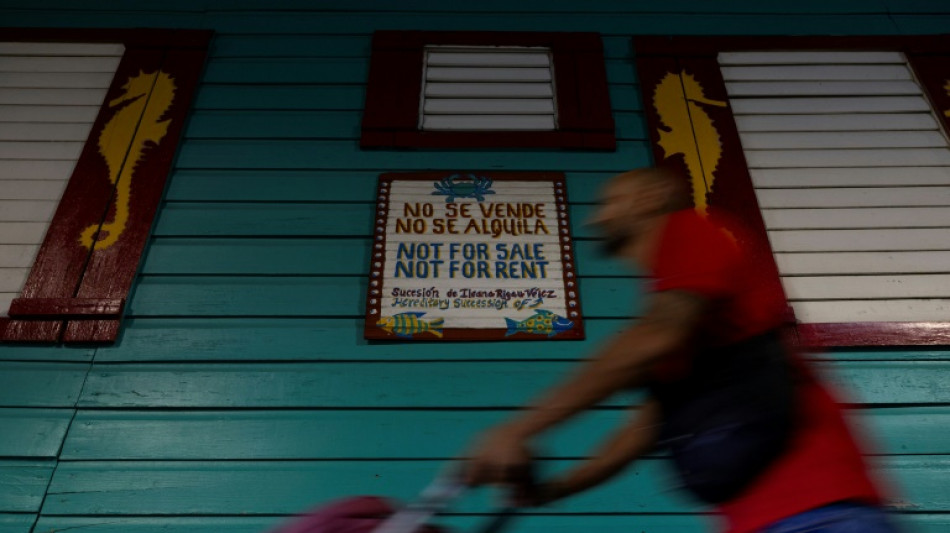
'Class war': outsiders moving to Puerto Rico trigger displacement / Photo: Ricardo ARDUENGO - AFP

 'I live in fear': 1.5 million Pakistani children sexually exploited online

 Cowboys beat Commanders, Vikings down Bears as star QBs injured
 Braves clinch division title as Red Sox reach MLB playoffs

 Bordeaux-Begles hammer Stade Francais despite Jalibert injury

 Milan and Juventus end blips with home wins

 Bridgeman wins PGA Biltmore title with sizzling 61

 Williams injured as Bears shut down by Vikings

 US warns of rapid escalation in Middle East war

 Germany's far-right AfD celebrates another state election win

 Russia vows revenge for election-day attacks as poll shows ruling party win

 Spaun late shows snatches PGA Championship win

 Conceicao strikes as Juventus beat Atalanta

 Britain, Zverev-inspired Germany, Spain complete Davis Cup finals

 Man Utd salvage Fulham draw as pressure mounts on Carrick

 Spanish civil war drama 'The Black Ball' wins at Toronto festival

 Germany's Merz shaken by far-right and far-left gains in state votes

 Macron welcomes Canada's Carney to French Atlantic territory

 Fiorentina frustrate Napoli with Serie A draw, Como upset

 Five-star Man City top Premier League after Sunderland thriller

 Ukrainian drones hit Moscow on last day of Russian elections

 Multi-Asset Trading Venue Monochrome Exchange Announces IEO of Its Native Token, $MCR

 South Korea break Japan hearts to win Asian Games basketball gold

 Acosta takes first victory at Austrian MotoGP

 PSG president Nasser al-Khelaifi under investigation in France for conflict of interest

 China swim sensation, 13, sets Games record after Japan win early

Gloria Cuevas thought she would live forever in her pink, century-old house on Puerto Rico's west coast -- but then her landlord decided to transform the home into an Airbnb.
Cuevas left her home -- now purple and split in two -- and her beloved city for another further south, forced out by the rising cost of living and an explosion of short-term rentals on the US Caribbean island territory.
Puerto Rico -- long a draw for sun-worshipping tourists -- is also a hotspot for foreign investment and offers tax incentives to attract outsiders.
"At first, I couldn't come back here," Cuevas, 68, told AFP, gazing at the home she once made her own. "It made me feel sad and angry at the same time."
Cuevas's experience is becoming an all too familiar tale across the island, where signs promote mansions for sale, and the Airbnb logo is plastered on homes where locals once lived.
Intensifying Puerto Rico's gentrification are laws that encourage primarily wealthy mainland Americans to move there in exchange for preferential tax treatment.
The program originally enacted in 2012 was meant to spur economic growth and attract investment on the island, an unincorporated territory under US control since 1898.
Those relocating must acquire residency and buy property to keep the significant incentives -- but many Puerto Ricans as well as some US lawmakers say this is driving up housing prices and encouraging tax evasion.
"Colonialism kills us, it suffocates us," Cuevas said. "It's a global theme. It's a class war."
- 'Unfair' -
Ricki Rebeiro, 30, moved to San Juan more than a year ago, bringing his packaging and marketing business that services cannabis companies with him.
He told AFP that basing his work in Puerto Rico saves his company millions of dollars annually, and that he pays zero personal income tax -- what amounts to the equivalent of "a whole second income" that he says he tries to reinvest locally.
"I believe that the locals are probably upset that they're not reaping the same benefits of somebody like me," said the entrepreneur, whose family is based in Pennsylvania and Oklahoma.
The system is "unfair," Rebeiro said, "but I also don't believe that I should be the one to blame for that. I didn't structure the program."
Puerto Ricans in recent years have slammed their government for what they say is a hyperfocus on outsiders at the expense of locals, as the rich -- including people like the famous content creator-turned-boxer Jake Paul -- move in.
- 'This is ours' -
In Cabo Rojo, a seaside city about an hour's drive south of Rincon on the island's western coast, some residents are taking the matter into their own hands.
During a recent canvassing effort, a group of activists urged their neighbors to protest a massive development project called Esencia, which would transform more than 2,000 acres (810 hectares) of recreational land and more than three miles of beaches into a $2 billion luxury resort and residential development.
Dafne Javier's family goes back generations in this area -- her great-grandfather was the last mayor in the municipality under Spanish occupation, and the first under US rule.
The 77-year-old said the Esencia project would "totally change the landscape," creating a gated town within a town.
Protesters say it would destroy the natural habitat of some endangered species, while exacerbating problems with potable water, electricity supply and trash pick-up.
Project investors have called Puerto Rico "one of the most promising growth markets in the world" and vowed Esencia would create "thousands of jobs."
But those jobs will be minimum wage, Javier predicted, and the wealthy newcomers "won't mix with us."
Christopher Powers is married to a Puerto Rican with whom he has children, and has lived in Cabo Rojo for 20 years.
"They have no idea what they're destroying, and if they do have an idea what they're destroying, then they should be ashamed," he told AFP of the developers.
"Not only is it ecologically destructive, not only will it be an economic disaster for those of us who live here, but it's also against the sort of spirit or values of the Caborojinos."
Cuevas is hopeful her story and others like it will crystallize for her fellow Puerto Ricans what they stand to lose.
"We have to keep fighting. We have to educate our youth. Have you heard of Bad Bunny?" she said, referring to the Puerto Rican global superstar whose music and current residency in San Juan has amplified discussion of gentrification and cultural dilution, on the island and beyond.
"This is ours," Cuevas said. "We're not going to leave."
F.Wilson--AT

