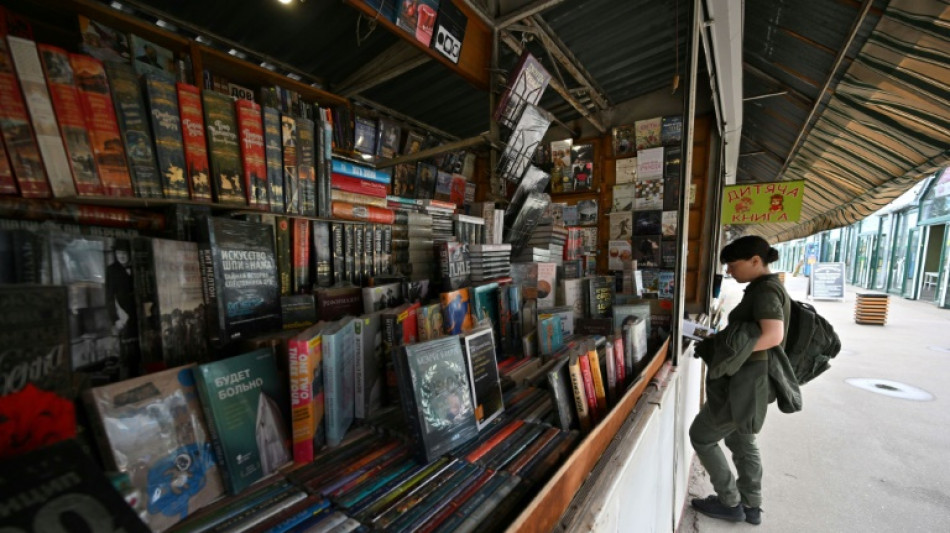
Kyiv's plans to ban works in Russian divide book lovers / Photo: Sergei SUPINSKY - AFP

 Germany defender Rudiger announces international retirement
 Musk defends AI data centers, slams EU rules at G20

 Activists blame Kenya for Ugandan opposition figure's plight

 Iran president offers US olive branch, hails Russian support
 TrustFinance Community Choice Awards 2026 Opens Global Voting
 Nepal disaster a climate 'warning signal': foreign minister

 France winger Diaby returns to Leverkusen until 2031

 Barcelona confirm Jesus arrival from Arsenal

 EU official says it's not time to 'normalize' Russia at G20 finance talks

 RedHill Announces Transformational Acquisition of Commercialization Rights to Ferring’s Rebyota® and Clenpiq®

 TrendEadvisor Launches Global Multi-Asset Platform Combining Online Investing with Social Trading
 India's top court drops criminal cases against protesters
 Philippine couple married in hip-deep floodwaters
 Villa sign Senegal winger Mbaye from PSG
 Former Peru minister last-minute contender for UN labour agency helm

 Messi legacy will 'live forever', says Beckham

 'Literally tasting the smoke': Malaysians suffer as haze worsens

 Kyiv's defences, 'hybrid' threat from Moscow headline EU talks
 Oil extends gains, stocks mostly down as Trump issues fresh Iran warning
 ThinkMarkets Expands Weekend Trading Offering, Launches Weekend League Competition

 Tibet activists accuse China of downplaying floods
 Afghanistan war victims left 'without justice', UN says
 Iran president offers US olive branch before Putin meeting
 China-Nepal flood toll tops 1,000 as tunnel rescue offers last hope
 Japan to relax overtime regulation under workaholic PM
Ukraine plans to ban many books in Russian as part of a wartime battle against propaganda, but the new law has divided both literature fans and booksellers alike.
"We must not confuse Russian fascism with Russian culture," said Olexander Drobin, a bookseller at the massive Petrivka book market in the capital, Kyiv.
"They made this law but nobody knows how to apply it. Should we take these books, pile them up in the street and burn them?"
Anatoli Gounko, another bookseller at the market, whose wares are almost all in Ukrainian, said the law was "necessary".
However, he said that even he finds it "a bit harsh to say you should speak Ukrainian and not Russian".
"Why should Russian only belong to Russia? Three hundred million people around the world speak Russian."
Ukraine's parliament approved several bills on June 19 aimed at "protecting culture from Russian propaganda".
The new laws will enter into force once they are signed by President Volodymyr Zelensky.
They ban all books published in Russia and Belarus, Moscow's close ally in the war against Ukraine -- regardless of the author.
Anyone breaking the law faces a fine.
The use on television and in public venues of Russian music composed after 1991 is also outlawed.
But enforcing the laws could be tricky.
Books printed in Russian but published in Ukraine or countries other than Russia and Belarus would theoretically still be allowed -- as long as they were originally written in Russian and the author is not considered "hostile" to Ukraine.
Major classics of Russian literature, such as works by Pushkin and Tolstoy, would also be spared.
- 'Concentrate on defending the country' -
Four months after Russia invaded Ukraine on February 24, the new texts strengthen the legislative arsenal built up over recent years to "de-communise" and "de-Russify" the former Soviet republic and promote the Ukrainian language.
But Drobin is unconvinced.
"These (latest) laws go too far. Some people probably wanted to show they were true patriots but this is not the way to do it.
"Half the population are Russian speakers and Russian culture is important. There are lots of good things in Russia's history," he said.
He said the government should "concentrate on defending the country".
Gounko begged to differ.
"To quote the Romans: 'The law may be tough but still law'," he said.
Nadia, a bookseller who did not wish to give her surname, also defended the new laws.
"When the war started, people began reading books in Ukrainian. We have plenty of excellent writers," she said.
"It (the ban) is more something that concerns people who sell recently published books," she said.
- 'Dead to me' -
Book lovers also appear divided.
"There are more pressing problems. This is infantile," sniffed Natasha Sikorska, a customer at the market.
"I don't agree at all with banning Russian literature. It's not Russian propaganda. It's history. It's education," she said.
Her friend, who declined to be identified, disagreed.
"I've read a lot of Russian literature. I liked it then and I like it now. But honestly, since February 24 it's dead to me," she said.
H.Romero--AT