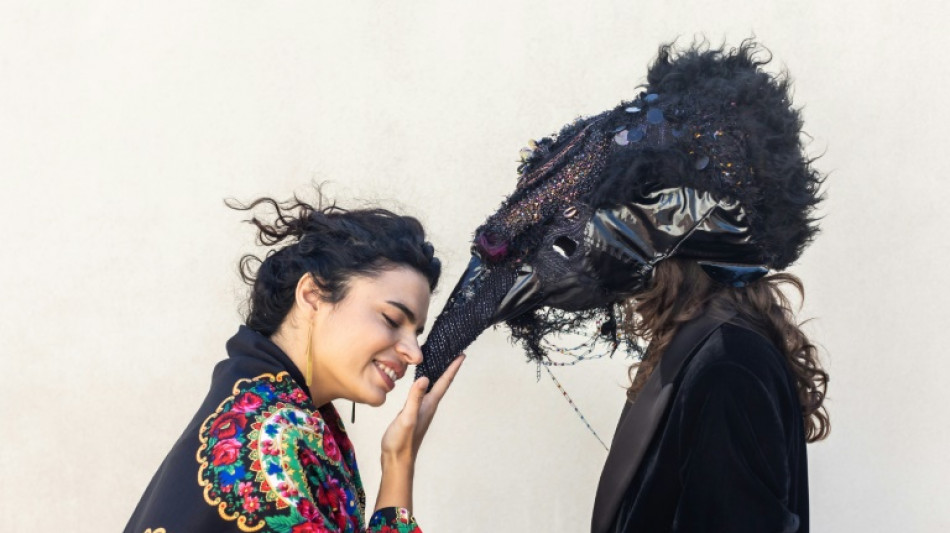
'Let the light in': Romanian Roma actress smashes stigma with new play

 Martin wins Austrian MotoGP sprint after Acosta crash

 Japan edge Fiji to win Pacific Nations Cup

 Black smoke, flames rising near Riyadh airport: residents to AFP

 UK actor Naomi Watts honoured at Spain film festival

 Japan emperor declares Asian Games open after turbulent build-up

 Asian Games open with unity message after troubled build-up

 Denmark hails 'binding' Greenland deal with Trump

 We don't want Games host Japan losing money, says Asian Olympic official

 Ed Sheeran returns to stage after Palestinian controversy

 Asian Games to open in Japan after troubled build-up

 Drone owners rush to offload devices ahead of Beijing ban

 Trump's beef policies irk Texas ranchers, testing their loyalty

 Kennedy Center: future unclear for iconic Washington arts hub

 Trump claims 'infinite' Greenland security deal with Denmark

 Helicopters battle wildfire threatening Ecuador's capital

 Brentford batter Chelsea to undo Alonso's promising start
 Kane hits Bundesliga century as Bayern rout Union
 Trump says CNN, MS NOW, Politico banned from White House
 Hushing and hedging: US companies retreat on climate

 Springboks to face Fiji before 2027 Rugby World Cup

 Nigeria miners struggled to breathe in cell before 37 died: survivors

 McIlroy on the charge at PGA Championship as Reed withdraws
 McIlroy on the charge at PGA Championship

 Crisis-wracked Volkswagen warns of 10-bn-euro hit to profits

 Costa Rica's Grynspan tops third informal poll for UN chief: diplomat

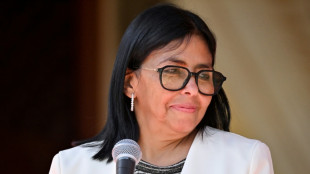
As a child, Roma actress and playwright Alina Serban didn't see herself represented on television, in movies or books, her stigmatised community shunned from the cultural mainstream.
She has dedicated her career to changing that, and last month became the first Roma to stage her work at Bucharest's National Theatre.
"I grew up in this country, but I've never been able to recognise myself in the stories," the 34-year-old told AFP.
"That's why it's important for me to crack open the door and let the light in. It's like I'm planting a flag," she adds, speaking between rehearsals.
Her show, called "Cel mai bun copil din lume" (The Best Child in the World) and based on her life, opened on January 21 to sold out audiences.
It is a moving and at times funny story about a girl who triumphs against all odds, but can't escape the stigma she faces as a Roma.
"This is the first time that a Roma story, written, staged and performed by a Roma artist has been welcomed on the national scene," she says.
- 'She's a gypsy' -
Romania, one of the poorest countries in the European Union, has the largest Roma minority in Europe, around two million strong, according to NGOs.
But many Roma are reluctant to identify themselves as such for fear of discrimination. Officially they are only 621,000 out of Romania's population of 19 million.
Serban says she started to realise her Roma identity at age nine when she and her parents, beset by financial difficulties, had to leave their apartment in a working-class Bucharest district.
They settled in a cob house without running water, alongside her aunts and uncles.
That's when she heard a remark at school that will haunt her forever: "She's not Romanian, she's a gypsy".
The pejorative word "gypsy" is often replaced by "crow" in Romanian.
It's a reference Serban uses in her play: she wears a black feather crow mask that she cannot shake off.
Tired of having to hide where she lived, she promised herself she would get out of the "slum".
She became the first in her family to graduate from high school and was then admitted to Bucharest's prestigious Academy of Theatre and Cinema.
She followed up with studies in New York and London financed by grants.
Serban won acclaim on the international stage, including for her roles in the 2019 movie "Gipsy Queen" about a struggling single mother who fights in the ring, and the 2018 Belgian film "Alone at My Wedding".
- Overcoming self-hate -
But "that was not enough", she says. She continued to be shaken by self-doubt.
"The problem with racism is that the hate that others project on you becomes self-hate. And you end up suffering from impostor syndrome," Serban says.
Among her many projects is a feature film on Roma slavery -- a dark page in Romania's history which Serban has already explored in a play "Marea rusine" (The Great Shame).
For centuries, the traditionally nomadic minority was reduced to slavery -- until that was abolished in 1856 -- and then subjected to forced assimilation under communism.
Even today, racism continues, and Roma access to employment and housing is difficult.
According to opinion polls published in 2018 and 2020, seven in 10 Romanians say they "do not trust the Roma".
- 'Change the world' -
Despite everything, the artist sees reasons for hope as Roma culture becomes "cool" among the younger generation.
More open to diversity, they are interested in Roma music and fashion, while school textbooks have started mentioning the enslavement of Roma, according to sociologist Adrian Furtuna.
"There is beginning to be an awareness" of what the Roma have endured, he told AFP.
Holding back tears, Serban says that by openly talking about her Roma identity she "endangered" her mother, who could have lost her job as a cleaner or been evicted.
"If I continue, it's because at the end of the films or plays in which I act, I see a gleam in the eyes of the spectators," Serban says.
"I am convinced that I can change the world with the stories I tell".
P.Hernandez--AT