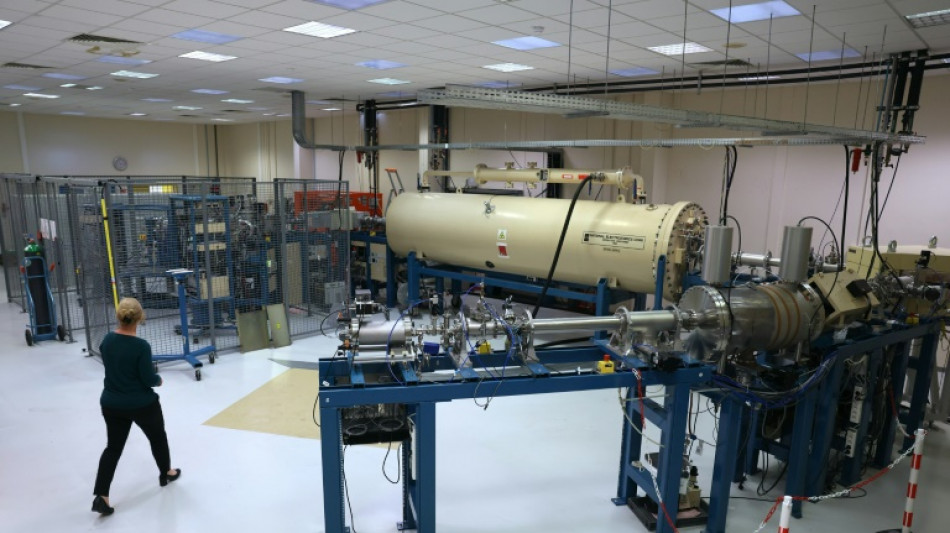
Time machine: How carbon dating brings the past back to life / Photo: Thomas SAMSON - AFP

 New Zealanders pick endangered black robin as Bird of the Year

 Asia stocks rise on AI, US-China trade talks optimism

 Malaysia's 'elephant whisperer' fights to save Borneo's endangered giants

 'I live in fear': 1.5 million Pakistani children sexually exploited online

 Cowboys beat Commanders, Vikings down Bears as star QBs injured
 4 Hacks for Yearlong Savings on Your Kids' Wardrobes

 Forest fire threatens tourist town in Colombian Andes

 Torres on target again as PSG beat 10-man Marseille in Ligue 1

 Germany's Merz vows to stay course despite new election defeats

 Carrick demands Man Utd response after 'pathetic' jibes

 Liverpool boss Iraola urges Isak to raise his level

 Evenepoel wins record 4th straight world time-trial title

 France's Macron, Canada's Carney announce closer ties
 Carrick defends troubled Man Utd after Fulham escape

 Horror movie 'Resident Evil' tops N. American box office

 Germany's Merz vows to stay course despite new vote losses

 Man City outgun Sunderland despite Brobbey hat-trick, Man Utd rescue Fulham draw

 Mourinho blames ref committee for Real Madrid derby defeat

 Maresca craves a 1-0 win after eight-goal Man City thriller

 Atletico Madrid beat Real Madrid in tense derby clash

 Reusser retains world time-trial title

 Man City outgun Sunderland despite Brobbey hat-trick, Liverpool win at Bournemouth

 Top US, Chinese economic officials meet ahead of Trump-Xi summit
 Erdogan's LGBTQ crackdown 'first step of election campaign': activist
 Mass drone barrage on Moscow kills two

From unmasking art forgery to uncovering the secrets of the Notre-Dame cathedral, an imposing machine outside Paris can turn back the clock to reveal the truth.
It uses a technique called carbon dating, which has "revolutionised archaeology", winning its discoverer a Nobel Prize in 1960, French scientist Lucile Beck said.
She spoke to AFP in front of the huge particle accelerator, which takes up an entire room in the carbon dating lab of France's Atomic Energy Commission in Saclay, outside the capital.
Beck described the "surprise and disbelief" among prehistorians in the 1990s when the machine revealed that cave art in the Chauvet Cave in France's southeast was 36,000 years old.
The laboratory uses carbon dating, also called carbon-14, to figure out the timeline of more than 3,000 samples a year.
- So how does it work? -
First, each sample is examined for any trace of contamination.
"Typically, they are fibres from a jumper" of the archaeologist who first handled the object, Beck said.
The sample is then cleaned in an acid bath and heated to 800 degrees Celsius (1,472 Fahrenheit) to recover its carbon dioxide. This gas is then reduced to graphite and inserted into tiny capsules.
Next, these capsules are put into the particle accelerator, which separates their carbon isotopes.
Isotopes are variants of the same chemical element which have different numbers of neutrons.
Some isotopes are stable, such as carbon-12. Others -- such as carbon-14 -- are radioactive and decay over time.
Carbon-14 is constantly being created in Earth's upper atmosphere as cosmic rays and solar radiation bombard the chemical nitrogen.
In the atmosphere, this creates carbon dioxide, which is absorbed by plants during photosynthesis.
Then animals such as ourselves get in on the act by eating those plants.
So all living organisms contain carbon-14, and when they die, it starts decaying. Only half of it remains after 5,730 years.
After 50,000 years, nothing is left -- making this the limit on how far back carbon dating can probe.
By comparing the number of carbon-12 and carbon-14 particles separated by the particle accelerator, scientists can get an estimate of how old something is.
Cosmic radiation is not constant, nor is the intensity of the magnetic field around Earth protecting us from it, Beck said.
That means scientists have to make estimations based on calculations using samples whose ages are definitively known.
This all makes it possible to spot a forged painting, for example, by demonstrating that the linen used in the canvas was harvested well after when the purported painter died.
The technique can also establish the changes in our planet's climate over the millennia by analysing the skeletons of plankton found at the bottom of the ocean.
- Notre-Dame revealed -
Carbon dating can be used on bones, wood and more, but the French lab has developed new methods allowing them to date materials that do not directly derive from living organisms.
For example, they can date the carbon that was trapped in iron from when its ore was first heated by charcoal.
After Paris's famous Notre-Dame cathedral almost burned to the ground in 2019, this method revealed that its big iron staples dated back to when it was first built -- and not to a later restoration, as had been thought.
The technique can also analyse the pigment lead white, which has been painted on buildings and used in artworks across the world since the fourth century BC.
To make this pigment, "lead was corroded with vinegar and horse poo, which produces carbon dioxide through fermentation," Beck explained.
She said she always tells archaeologists: "don't clean traces of corrosion, they also tell about the past!"
Another trick made it possible to date the tombs of a medieval abbey in which only small lead bottles had been found.
As the bodies in the tombs decomposed, they released carbon dioxide, corroding the bottles and giving scientists the clue they needed.
"This corrosion was ultimately the only remaining evidence of the spirit of the monks," Beck mused.
E.Rodriguez--AT

