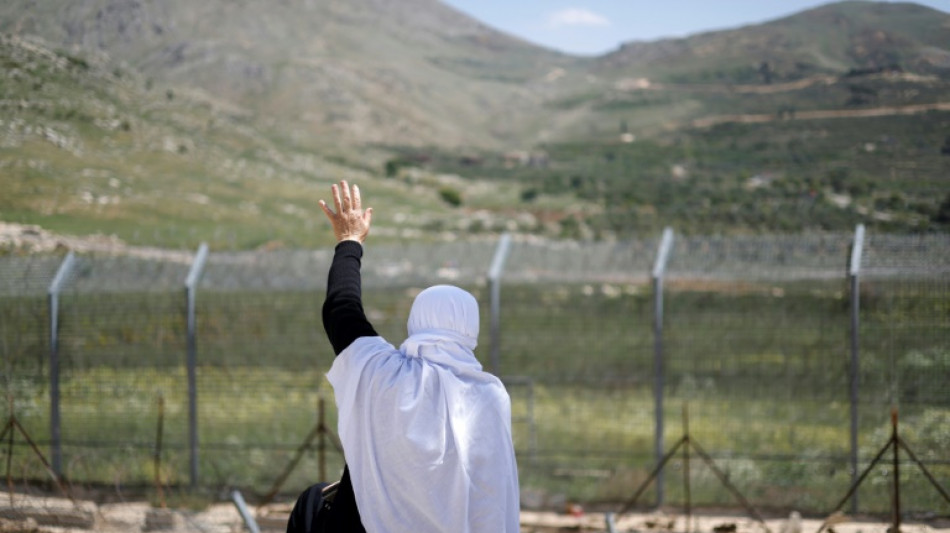
Who are the Middle East's Druze religious community? / Photo: Jalaa MAREY - AFP

 Sbírka Haupt: Co o nás lidech prozrazují peníze

 China confirms Xi to visit US this week for Trump talks

 مجموعة هاوبت: ما يكشفه المال عنا نحن البشر

 Colecția Haupt: Ce ne dezvăluie banii despre noi, oamenii

 Sisters of jailed Pakistan ex-PM Imran Khan arrested

 African players in Europe: Semenyo brace helps City top table

 'For my family': India boxer beats hardship, injury to go for Games gold

 Indonesia doing 'everything' but still struggling to curb fires
 Once decried as 'human cockfighting', MMA wants Olympic spot

 China's Yu, 13, great for swimming says multiple Olympic medallist

 Putin's party set to retain power after Russia vote hit by cyberattacks, drones

 Germany's Merz under pressure after bruising state election losses

 Messi, Miami frustrated in 2-2 draw with San Diego

 Thousands march in France against 'licence to kill' draft law

 4 Hacks for Yearlong Savings on Your Kids' Wardrobes

 InterContinental Hotels Group PLC Announces Transaction in Own Shares - September 21

 EB5 United's Cormont at Deer Valley East Village Achieves $224.8 Million Target EB-5 Raise; Offering Remains Open Toward $524.8 Million Maximum Raise

 Forest fire threatens tourist town in Colombian Andes

 Torres on target again as PSG beat 10-man Marseille in Ligue 1

 Germany's Merz vows to stay course despite new election defeats

 Carrick demands Man Utd response after 'pathetic' jibes

 Liverpool boss Iraola urges Isak to raise his level

 Evenepoel wins record 4th straight world time-trial title

 France's Macron, Canada's Carney announce closer ties

 Carrick defends troubled Man Utd after Fulham escape

The Druze are a prominent religious community of more than a million people spread mainly across Syria, Lebanon and Israel, who for centuries have sought to preserve a distinct identity.
In Syria, Druze fighters recently clashed with forces loyal to the country's new Islamist rulers, highlighting the struggles they and other minority groups have faced with shifts in regional power dynamics.
"The Druze are a kind of an ultra-tribe which transcends space and geography," said Makram Rabah, assistant professor of history at the American University of Beirut.
Despite being a minority in a majority Sunni Muslim region, the Middle East's Druze have played "a very important role", Rabah said.
Here is a look at the community:
- Religion and customs -
The Druze emerged in Egypt in the early 11th century as a branch of the Ismaili sect of Shiite Islam.
They are monotheistic and call themselves "muwahhidun", or unitarians.
The sect is highly secretive and includes mystical elements like reincarnation.
It does not allow new converts and marriage outside the community is strongly discouraged.
A source familiar with Druze rituals, requesting anonymity to discuss matters considered sensitive, said the faith's emergence was influenced by other religious and philosophical teachings, including those of Greek philosopher Plato.
Some Druze religious occasions align with those of other Islamic sects.
Traditional Druze garb is black, with men wearing white caps or turbans and women covering their heads and part of their faces with a flowing white scarf.
- Where are they? -
"The Druze don't really recognise borders," Rabah said.
"You have marriages and you have standing relationships between the Druze across the region," he said, adding that "clerics play a very important role in keeping this relationship alive."
Before Syria's civil war erupted in 2011, the community was estimated at around 700,000 people.
According to "The Druze Faith" by historian Sami Makarem, Druze have been migrating to southern Syria since the 16th century, to an area now known as Jabal al-Druze, meaning Druze Mountain, in Sweida province.
Syria's Druze are now mainly concentrated in their Sweida heartland, as well as nearby Quneitra province, with smaller pockets in the Damascus suburbs, notably Jaramana and Sahnaya, which recently saw sectarian violence.
In Lebanon, an estimated 200,000 Druze are concentrated in the mountainous centre as well as in the south near Israel and Syria.
In Israel, some 153,000 Druze are Israeli citizens, living mainly in the north. Unlike other Arab Israelis, Druze serve in the Israeli army.
In the Israeli-annexed Syrian Golan Heights, more than 22,000 Druze hold permanent resident status. Only around 1,600 have become Israeli citizens, while others remain attached to their Syrian identity.
Israel seized much of the Golan from Syria in 1967, annexing the area in 1981 in a move largely unrecognised internationally.
The move separated extended families, though Druze in the annexed Golan were often able to cross into Syria to study, attend weddings or sell produce.
Some Druze from southern Syria also settled in neighbouring Jordan, where the community is estimated at 15,000 to 20,000.
Two delegations of Syrian Druze clerics have made pilgrimages to a holy site in Israel this year, even though the two countries are technically at war with each other.
Outside the Middle East, Druze have migrated to regions including the Americas and Australia.
Well-known Druze include prominent human rights lawyer Amal Alamuddin Clooney and Jordanian Foreign Minister Ayman Safadi.
- Leading role -
Despite their minority status, Druze "have filled an important and sometimes a leading role in the political and social life" of the Middle East, according to historian Makarem.
In Syria, Druze Sultan Pasha al-Atrash led a nationalist revolt against the French mandatory power which had established a Druze statelet in southern Syria during the 1920s and 1930s.
In Lebanon, Druze leader Kamal Jumblatt played a key role in politics from the 1950s until his 1977 assassination, and his son Walid is a powerful politician.
Jumblatt last month urged Syria's Druze to reject "Israeli interference", after Israel warned the Islamist authorities who ousted president Bashar al-Assad against harming the minority.
Druze leaders have declared their loyalty to a united Syria, though some have called for international protection following recent sectarian violence.
Israeli Druze spiritual leader Sheikh Mowafaq Tarif has urged Israel to protect Syria's Druze.
Rabah said there was a Druze "power struggle across three states", adding that he believes Syria's community does not aspire to statehood.
The Druze largely stayed on the sidelines of Syria's war after it erupted in 2011, focusing on defending their heartland.
Most Druze armed groups have yet to reach a settlement with the new authorities.
R.Lee--AT