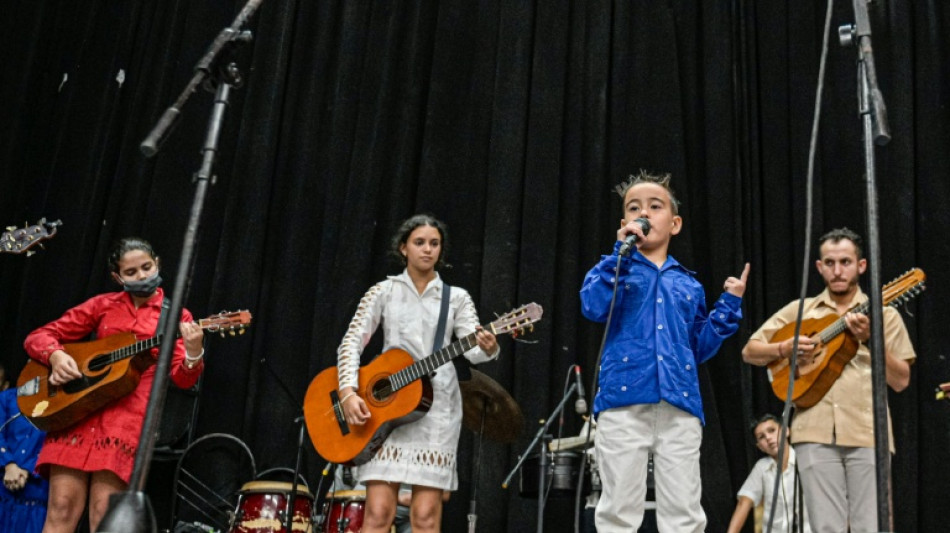
Cuban kids resist reggaeton, one verse at a time / Photo: ADALBERTO ROQUE - AFP

 US media outlets to sue Trump administration after White House ban

 Global stocks rally on lower oil prices, US-China hopes

 EU proposes energy rating for data centres

 Schoolgirl Yu scorches to second gold as doping case rocks Games

 Putin's party secures record score in Russia election

 Haupt Koleksiyonu: Paranın Biz İnsanlar Hakkında Anlattıkları

 Spanish PM says unregulated AI could be 'devastating'

 Yu, 13, smashes record again with second Asian Games gold

 Switzerland to play without Xhaka over fake Covid certificate

 From Korean Chipmakers to Leveraged Semiconductor ETFs: STARTRADER Launches 49 New 24/7 Stock and ETF CFDs

 Thai badminton player first doping case at Asian Games: testers

 Колекція Гаупта: Що гроші розповідають про нас, людей

 German far-right AfD poll winner says Merz 'twilight' has begun

 Flights scrapped, evacuations urged as Typhoon Dujuan nears Japan

 China confirms Xi to visit US this week for Trump talks

 مجموعة هاوبت: ما يكشفه المال عنا نحن البشر

 Colecția Haupt: Ce ne dezvăluie banii despre noi, oamenii

 Sisters of jailed Pakistan ex-PM Imran Khan arrested

 African players in Europe: Semenyo brace helps City top table

 'For my family': India boxer beats hardship, injury to go for Games gold

 Indonesia doing 'everything' but still struggling to curb fires

 Once decried as 'human cockfighting', MMA wants Olympic spot

 China's Yu, 13, great for swimming says multiple Olympic medallist

 Putin's party set to retain power after Russia vote hit by cyberattacks, drones

 Germany's Merz under pressure after bruising state election losses

Forget reggaeton or rap: for children in rural Cuba the epitome of cool is writing and singing a ten-line poem -- a art form honed by farmers and preserved over generations.
Improvised oral poetry, known as "repentismo" or "punto cubano" when set to music, was introduced to Latin America by Spanish colonists in the 16th century, and remains an integral part of Cuba's culture.
Poets known as "repentistas" compose ten-verse, octosyllabic stanzas with a fixed rhyming scheme called "decimas" which they perform to music at provincial festivals.
In 2017, the United Nations added the art form to its Intangible World Heritage list.
Aficionados have been battling to keep the tradition alive amid a youthful flight to reggaeton -- the blend of reggae, dancehall and Latino music sweeping the region.
A theatre in the town of Guines, in Cuba's western agricultural heartland, is at the forefront of the battle to keep repentismo alive.
Some 200 budding poets aged between four and 20 recently converged on the town recently to take part in a series of repentismo workshops and verbally joust on stage.
- 'Peasant dream' -
The contestants were dressed smartly -- cotton dresses for the girls, shirts and pants for the boys -- in the red, white and blue colors of the Cuban flag.
Emir Amador, a five-year-old with slicked-back hair, was the picture of poise as he took to the stage and performed his piece, accompanied by a guitar, a lute, a "tres" (a Cuban guitar with three pairs of double strings) and a "clave" (two wooden sticks acting as a percussion instrument).
"I am from a generation that has just begun its journey, with a peasant dream beating in my heart," Amador sang in a high vocal register.
"And here I am like a pigeon between verse and loyalty to tradition, doing with a desire as mighty as the Andes what my elders didn't do when they were my age," he crooned.
Amador's performance ended with a flourish, rhyming "lealtad" (loyalty) with "mi edad" (my age).
"I like singing a lot," Amador told AFP at the theatre, standing in front of a giant photograph of late Cuban folk queen Celina Gonzalez, whose hit "Yo Soy El Punto Cubano" spoke of the "hope and joy" that folk poetry imparts.
Six-year-old Liliet Oliver, who wore white bows in her plaited black hair, said she loved being put to the test in the improv duels that mark the high point of any "guateque" or festival of rural culture.
"I am Liliet, a star in the improvisation sky, and everyone has noticed that I am playful, and that I am beautiful," she sang, her clear voice echoing through the theatre.
- Antithesis of reggaeton -
Lazaro Palenzuela runs one of several schools where children learn the basics of rhyming structures and improvisation.
Very few manage to master the art form.
"Out of 20 children, only two succeed," he said, citing the need to ad lib as the principal hurdle.
Children from farming families where repentismo has been practised around kitchen tables for generations have a distinct advantage.
Brayan Gutierrez, 17, comes from what he calls a dynasty of singer poets.
But the 2024 repentismo youth champion, 20-year-old Brayan Iglesias, said he learned his craft solely through "long years of sacrifice, reading and practice."
These young lovers of verse see themselves as a bulwark against the seemingly unstoppable rise of reggaeton, with its hyper-sexualized, sometimes misogynistic lyrics.
"We are the antithesis of that," said Palenzuela.
Gutierrez said he believed the two musical forms were irreconcilable.
A good stanza is "a marvelous artistic creation," he enthused, contrasting it with the "obscene" lyrics of some reggaeton hits.
Palenzuela and his students conceded, however, that their craft lacked visibility, both on the national and international stage.
"The children and young people of this project will never stop fighting until the decima has been given the recognition it deserves," vowed Iglesias.
R.Chavez--AT