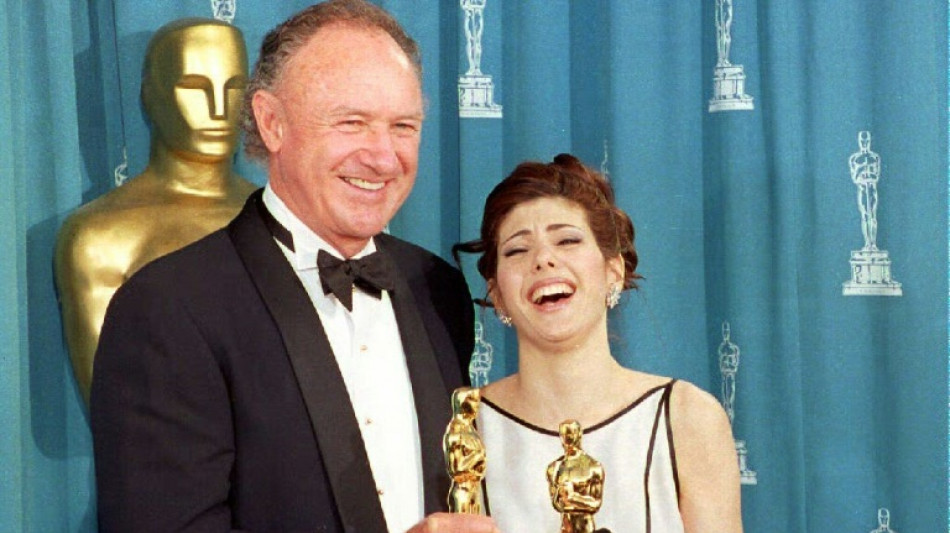
Gene Hackman, intense, 'uncommon' everyman actor / Photo: SCOTT FLYNN - AFP/File

 US media outlets to sue Trump administration after White House ban

 Global stocks rally on lower oil prices, US-China hopes

 EU proposes energy rating for data centres

 Schoolgirl Yu scorches to second gold as doping case rocks Games

 Putin's party secures record score in Russia election

 Haupt Koleksiyonu: Paranın Biz İnsanlar Hakkında Anlattıkları

 Spanish PM says unregulated AI could be 'devastating'

 Yu, 13, smashes record again with second Asian Games gold

 Switzerland to play without Xhaka over fake Covid certificate

 From Korean Chipmakers to Leveraged Semiconductor ETFs: STARTRADER Launches 49 New 24/7 Stock and ETF CFDs

 Thai badminton player first doping case at Asian Games: testers

 Колекція Гаупта: Що гроші розповідають про нас, людей

 German far-right AfD poll winner says Merz 'twilight' has begun

 Flights scrapped, evacuations urged as Typhoon Dujuan nears Japan

 China confirms Xi to visit US this week for Trump talks

 مجموعة هاوبت: ما يكشفه المال عنا نحن البشر

 Colecția Haupt: Ce ne dezvăluie banii despre noi, oamenii

 Sisters of jailed Pakistan ex-PM Imran Khan arrested

 African players in Europe: Semenyo brace helps City top table

 'For my family': India boxer beats hardship, injury to go for Games gold

 Indonesia doing 'everything' but still struggling to curb fires

 Once decried as 'human cockfighting', MMA wants Olympic spot

 China's Yu, 13, great for swimming says multiple Olympic medallist

 Putin's party set to retain power after Russia vote hit by cyberattacks, drones

 Germany's Merz under pressure after bruising state election losses

Gene Hackman, who has been found dead in his home in New Mexico at the age of 95, was once voted as likely to flop in showbiz but instead went on to enjoy a storied, Oscar-winning career as an everyman actor who mined personal pain to give intense, edgy performances.
Hackman is perhaps best known for his portrayal of the tough and vulgar New York cop Jimmy "Popeye" Doyle in the 1971 crime thriller "The French Connection."
Its five-and-a-half-minute car chase scene -- in which Doyle crashes his way through bustling city streets, grunting, grimacing and honking as he pursues a bad guy who has commandeered an elevated train -- is the stuff of Tinseltown legend.
Hackman won his first best actor Oscar for that film. He won another golden statuette two decades later for best supporting actor for his portrayal of the brutal small-town sheriff "Little Bill" Daggett in the 1992 western "Unforgiven."
He earned three more Oscar nominations during a five-decade career in which he appeared in 80-odd films.
"He's incapable of bad work," Alan Parker, who directed Hackman in the 1988 civil rights drama "Mississippi Burning," told Film Comment magazine that year.
"Every director has a short list of actors he'd die to work with, and I'll bet Gene's on every one."
- Midwestern roots -
Hackman was a native Midwesterner, born during the Great Depression in Illinois.
He came from a broken family -- his father left when he was 13, waving enigmatically as he drove away one day. Hackman said he knew right then that the man was never coming back.
Hackman's mother died in a fire before he had established himself as an actor.
He also served an unpleasant stint in the US Marines, which he joined at 16 by lying about his age.
He used his personal turmoil as fuel to flesh out his characters.
"Dysfunctional families have sired a number of pretty good actors," Hackman told The Guardian in 2002.
Arthur Penn, who directed Hackman in "Night Moves" (1975) and "Target" (1985), called him an "extraordinarily truthful actor."
"He has the skill to tap into hidden emotions that many of us cover over or hide -- and it’s not just skill but courage," Penn said.
- 'An actor, not a star' -
Hackman was an unlikely star -- he came to acting relatively late after dabbling in a series of jobs, and only attracted attention in his 30s.
In fact after his enrollment at the Pasadena Playhouse in California in the late 1950s, Hollywood legend tells that he and a fellow student, one Dustin Hoffman, were voted the "least likely to succeed."
Later, they would pal around with Robert Duvall in New York when all three were struggling actors.
Not blessed with leading man good looks, Hackman instead drew on his talents and versatility, taking on gritty roles and delivering thoughtful, intelligent performances.
"I wanted to act, but I'd always been convinced that actors had to be handsome. That came from the days when Errol Flynn was my idol. I'd come out of a theater and be startled when I looked in a mirror because I didn't look like Flynn. I felt like him," Hackman once said.
After studying journalism at the University of Illinois, he first tried television production, before going to acting school in Pasadena.
Upon graduation, Hackman moved back to New York, where he worked off-Broadway and began to turn heads.
In 1964, he was cast on Broadway in the play "Any Wednesday," which led to a small role in the film "Lilith" starring Warren Beatty.
A few years later, Beatty was casting for "Bonnie and Clyde" and chose Hackman as Clyde's brother Buck Barrow.
That landmark 1967 film won Hackman his first Oscar nomination for best supporting actor, and put him firmly on track for stardom.
A second Academy Award nomination came for "I Never Sang For My Father" (1970), in which he played a professor who feels he has never won his father's approval.
"I was trained to be an actor, not a star. I was trained to play roles, not to deal with fame and agents and lawyers and the press," Hackman said.
Hackman notched up dozens of film credits in his career, working well into his 60s and 70s although he stayed out of the limelight, living with his second wife in Santa Fe, writing and painting. His wife was found dead with him at their home.
Into the 21st century, he starred in "The Heist" and "The Royal Tenenbaums" in 2001, the latter winning him his third competitive Golden Globe, before announcing his retirement in 2008.
"It really costs me a lot emotionally to watch myself on screen," Hackman once said.
"I think of myself, and feel like I'm quite young, and then I look at this old man with the baggy chins and the tired eyes and the receding hairline and all that."
R.Chavez--AT