Tech weary Brits revive apple tree 'wassailing' tradition
/ Photo: Paul ELLIS - AFP

 Berlin's far-left vote winners reject anti-semitism charges

 Mancini eager for 'new adventure' on Italy return

 Mbappe says having Zidane as France coach 'like a film'

 Palmer, Rice out of England Nations League squad
 German auto workers stage mass protests in bid to save jobs
 Embattled Merz vows to keep ruling for 'democratic future' of Germany

 Merz vows to keep ruling coalition together for 'democratic future' of Germany
 Spain coach De la Fuente gets new deal after World Cup success

 Pressure grows on Germany's Merz after election defeats

 China's Zhang beats Japan rivals to Asian Games gymnastics gold

 Samlingen Haupt: Vad pengar avslöjar om oss människor
 Tens of thousands of German auto workers protest to save jobs

 हॉप्त् कलेक्शन: पैसा हमारे बारे में एक इंसान के रूप में क्या प्रकट करता है

 Συλλογή Haupt: Τι αποκαλύπτει το χρήμα για εμάς τους ανθρώπους

 TradersYard Shifts Focus to Futures Trading

 ハウプト・コレクション:お金が人間について明かすこと

 하우프트 컬렉션: 돈이 우리 인간에 대해 드러내는 것
 Indonesia doing 'everything' but struggling to curb fires

 Sbírka Haupt: Co o nás lidech prozrazují peníze
 North and South Korea fight out draw in niggly Asian Games clash

 Officials say man shot, wounded by ICE agent in Texas
 豪普特收藏:金錢如何揭露人類的本質
 Kolekcja Haupta: Co pieniądze mówią o nas, ludziach

 The Haupt Collection: What Money Reveals About Us as Human Beings

 Barcelona enter new era aiming to retain Women's Champions League crown

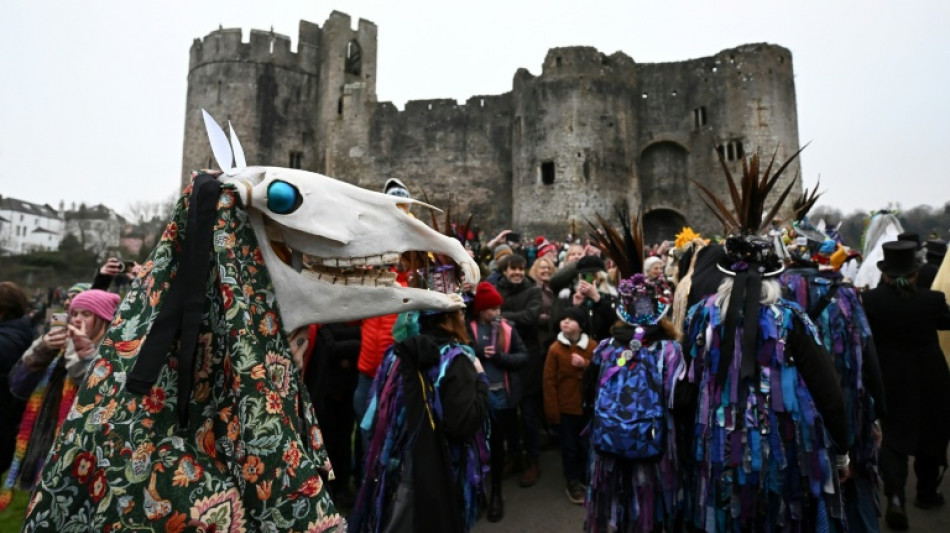
"Wassail!" yelled the crowd. "Cider for everyone!" In an orchard by a Welsh castle, hundreds of people gathered to wish good health to the apple trees in a centuries-old tradition enjoying a revival.
As mulled cider -- a warm alcoholic drink made from fermented apple juice -- was handed around, a dozen hobby horses swayed eerily to folk music.
Made from real horses' skulls mounted on poles and carried by someone cloaked in a bed sheet, they are bedecked in ribbons with shiny baubles glinting in the eye sockets.
Singing, drinking, banging saucepans and hanging toasted bread on tree branches are all part of wassailing, along with the colourful horses' heads, which are a Welsh variation.
"It's a celebration of life, nature and the community," said amateur folk dancer Richard Worrin who helped organise this year's wassail in the Welsh border town of Chepstow.
The tradition, which has Pagan roots, is a far cry from Worrin's day job as a murder squad detective.
"You need an antidote," he laughed, stressing participants did not need to be a folklore expert to join in.
Wassailing was for everybody, he said, a mid-winter opportunity to get together and have fun.
"I just love the feel to it all, lots of drinking, meeting people and having a laugh. Simple as that," he told AFP.
- 'Collective heritage' -
Traditionally held on Twelfth Night, the Christian festival on the last night of the 12 days of Christmas, wassailing is intended to ward off bad spirits from orchards, ensuring a bountiful crop of fruit.
In decline for many decades, it has made a comeback in recent years, especially among people tired of living their lives online, some modern-day wassailers told AFP.
"Basically, we're missing the connection to our ancestry and the land itself," said Kerry Milburn, a 32-year-old IT analyst from Swansea, in Wales. "There's too much technology today."
Radiographer Catherine Perry, 46, from Glastonbury in southwestern England, put the revival down to people "craving a deeper connection with nature".
People were also "frightened of AI and multi-billionaires from massive conglomerates", she said.
The word wassail comes from the Old English "waes hael" meaning "be in good health".
This year, over 70 public wassails were listed on the English folklore website Tradfolk.co "and we're aware of dozens more happening across the country", editor James Merryclough told AFP.
"People are rediscovering the joy of shared traditions that connect us with nature, our communities, and our collective heritage," he said.
Wassailing would have once been the highlight of the winter season in cider producing areas of the UK.
But as the urban middle classes in the late 19th century began to adopt Christmas, rather than Twelfth Night, as the main festival of the winter season, wassailing and other regional celebrations were gradually swept away.
The revival has seen wassailing gain popularity even in urban areas with no history of cider making.
Eight wassails were being held right across London in January and February this year.
- 'Modern twist' -
Around 100 people gathered in eastern Hackney, London, in a small community orchard overlooked by factories and a hulking electricity pylon.
Started 14 years ago "it used to be about 20 people every year but it's grown and grown", said co-organiser Annie Moreton.
"There's a lot of younger people who are massively concerned about the planet, the climate, they want to connect to green spaces and wellbeing and to be able to do something that isn't online or in a social media space."
Marine biologist Cordelia Roberts, 29, said she took part in wassails while living in the southern English city of Portsmouth, but was delighted to find them in the capital too.
"I'm a scientist so I really like the nurturing of the Earth, the cycle of life aspect to it," she said.
From small beginnings in 2010, Chepstow's wassail has grown to become a day-long family-friendly event including dancing by three different "sides" or teams of Morris dancers.
Also included is the Mari Lwyd, the Welsh wassailing ritual involving hobby horses. It used to be carried from house to house by groups of men who would eventually be invited to share food and drink with householders.
Dan de la Bedoyere, 47, also an IT worker from Glastonbury, said he was delighted the pagan traditions he "loved to honour" were re-establishing themselves.
"The wonderful thing about folk traditions -- if we can revive them and give them a modern twist -- is that they are such fun," he said.
J.Gomez--AT