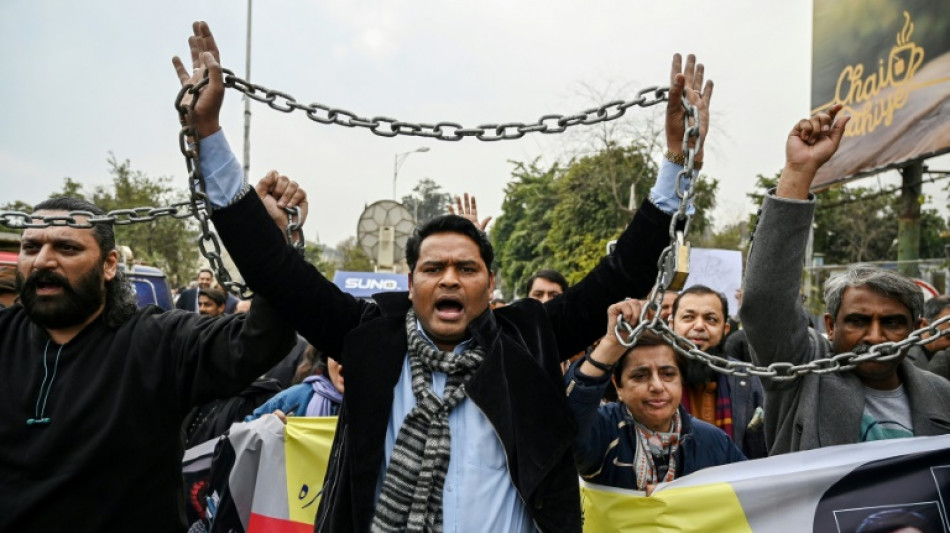
Pakistan outlaws disinformation with 3-year jail term / Photo: Aamir QURESHI - AFP

 Berlin's far-left vote winners reject anti-semitism charges
 Mancini eager for 'new adventure' on Italy return

 Mbappe says having Zidane as France coach 'like a film'

 Palmer, Rice out of England Nations League squad
 German auto workers stage mass protests in bid to save jobs
 Embattled Merz vows to keep ruling for 'democratic future' of Germany

 Merz vows to keep ruling coalition together for 'democratic future' of Germany
 Spain coach De la Fuente gets new deal after World Cup success

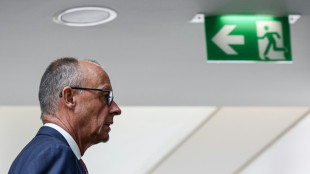 Pressure grows on Germany's Merz after election defeats

 China's Zhang beats Japan rivals to Asian Games gymnastics gold
 Samlingen Haupt: Vad pengar avslöjar om oss människor

 Tens of thousands of German auto workers protest to save jobs

 हॉप्त् कलेक्शन: पैसा हमारे बारे में एक इंसान के रूप में क्या प्रकट करता है

 Συλλογή Haupt: Τι αποκαλύπτει το χρήμα για εμάς τους ανθρώπους

 TradersYard Shifts Focus to Futures Trading

 ハウプト・コレクション:お金が人間について明かすこと

 하우프트 컬렉션: 돈이 우리 인간에 대해 드러내는 것

 Indonesia doing 'everything' but struggling to curb fires
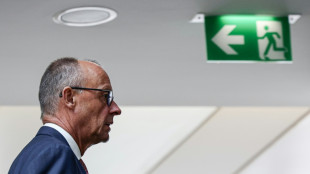
 Sbírka Haupt: Co o nás lidech prozrazují peníze

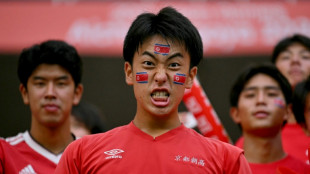 North and South Korea fight out draw in niggly Asian Games clash
 Officials say man shot, wounded by ICE agent in Texas

 豪普特收藏:金錢如何揭露人類的本質

 Kolekcja Haupta: Co pieniądze mówią o nas, ludziach
 The Haupt Collection: What Money Reveals About Us as Human Beings

 Barcelona enter new era aiming to retain Women's Champions League crown

Pakistan criminalised online disinformation on Tuesday, passing legislation dictating punishments of up to three years in jail and prompting journalist protests accusing the government of quashing dissent.
The law targets anyone who "intentionally disseminates" information online that they have "reason to believe to be false or fake and likely to cause or create a sense of fear, panic or disorder or unrest".
It was rushed through the National Assembly with little warning last week before being approved by the Senate on Tuesday as reporters walked out of the gallery in protest.
Pakistan media workers have reported rising state censorship in recent years and the public has shifted to consuming much of its news from social media.
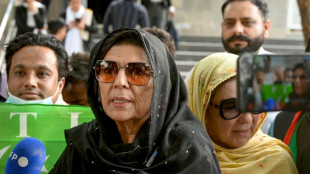
"The mainstream media is already compromised. That's the reason why many journalists turned to YouTube," YouTube journalist Asad Ali Toor told AFP in the capital Islamabad, where more than 150 journalists rallied against the bill.
"The state wants the same control of social media as it is controlling the mainstream media," Toor said.
Around 50 journalists also protested the bill outside the press club of the southern city of Karachi on Tuesday afternoon.
- 'Highly undemocratic' -
Analysts say the government is struggling with legitimacy after elections last February plagued by rigging allegations, and with popular former prime minister Imran Khan jailed on corruption charges he insists are politically motivated.
Khan's supporters and senior lieutenants in his Pakistan Tehreek-e-Insaf (PTI) party have faced a severe crackdown, with thousands rounded up and Khan's name censored from television.
Much of PTI's campaigning has moved online where the party's young tech-savvy base has continually called for protests.
PTI senator Syed Shibli Faraz called the new law "highly undemocratic" and said it would "fuel the political victimisation" of their supporters.
Facebook, TikTok and WhatsApp are among the most popular social media platforms in Pakistan, where low digital literacy fuels the spread of false information, conspiracy theories and deepfakes.
Some YouTube journalists blur the line between reporting and heavily partisan commentary tailored to their millions of followers.
Many lack proper fact-checking skills and contribute to spreading false information, sometimes garnering thousands of views.
"I am sure that in the future, the anarchy caused in society through social media will be controlled," government minister Tanveer Hussain said as the bill was approved.
It will now be passed to the president to be rubber-stamped.
- 'Controlling the narrative' -
The new law says social media platforms must register with a newly established regulatory body, with non-compliance potentially leading to temporary or permanent bans.
It also grants Pakistan's intelligence agencies the authority to investigate disinformation and allows any citizen to file a case.
Senior journalist Asif Bashir Chaudhry, a member of the Pakistan Federal Union of Journalists, told AFP the government had assured reporters they would be consulted but they were "betrayed and backstabbed".
"We genuinely wanted a law against misinformation, but if it's not being done through open discussion but rather through fear and coercion, we will challenge it on every available platform," Chaudhry said.
"Even under dictatorships, legislation was not forcefully rammed through parliament the way this government is doing now."
Social media site X was shut down in the wake of February's election, as posts alleging vote tampering spread on the platform.
Digital rights activist Nighat Dad told AFP there has been "one restrictive law after another, introduced under the guise of public interest or national security".
The real intent is "consolidating power and controlling the narrative," she said.
Pakistan is ranked 152 out of 180 countries in a press freedom index compiled by Reporters Without Borders.
At least 239 cases against journalists accused of spreading "fake news" have been recorded in South and Southeast Asia since 2018, according to the Anti-Fake News Lawfare online database.
In Pakistan, even before the new legislation, journalists have faced arrest under terrorism legislation which civil rights monitors say is used as a cudgel on dissent.
S.Jackson--AT