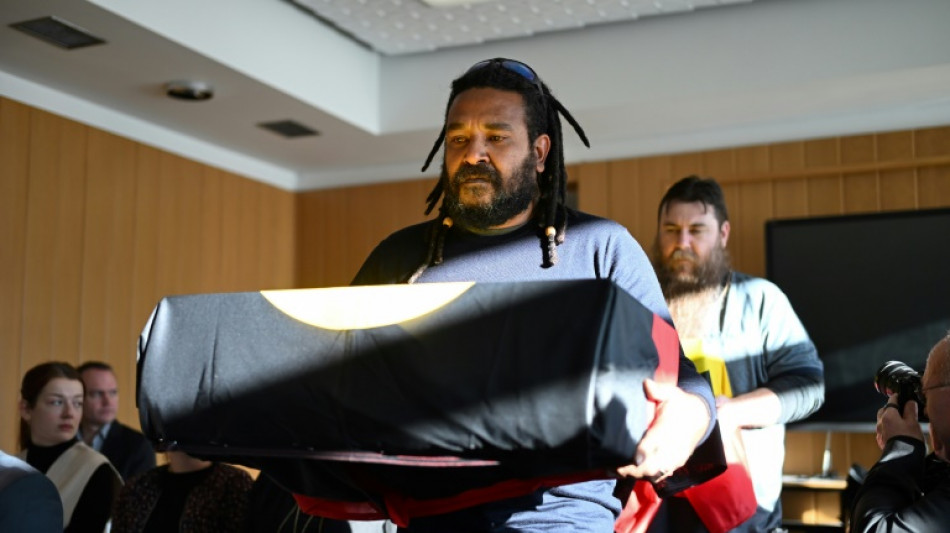
Germany repatriates colonial-era remains of indigenous Australians / Photo: RALF HIRSCHBERGER - AFP

 Bardot auction in Paris fetches nearly one million euros

 No timeline on Daniels injury return, says Commanders coach

 British Columbia sues OpenAI in US court over Canada school shooting
 French star Batum retires after 18-year NBA career
 Zidane leads first France training session
 Man shot by ICE agent in Texas detained with bullet inside him: lawyer

 California declares state of emergency ahead of El Nino
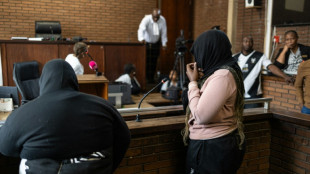 South Africa arrests three more suspects, after nine women murdered
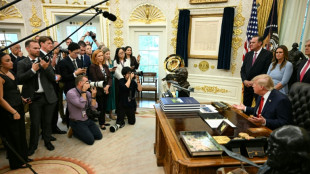
 Carse needs time away from England, says captain Brook

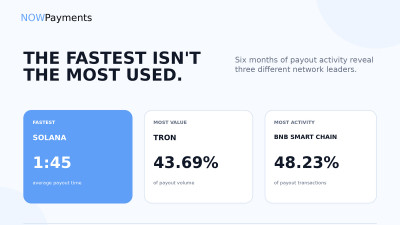 NOWPayments Releases Cross-Chain Payout Data Revealing Key Performance Benchmarks Across TRON, BNB Chain, and Solana

 British Museum bans photos of Bayeux Tapestry as crowds linger
 COP31 host says AI climate footprint to be a summit priority

 Berlin's far-left vote winners reject anti-semitism charges

 Mancini eager for 'new adventure' on Italy return

 Mbappe says having Zidane as France coach 'like a film'

 Palmer, Rice out of England Nations League squad
 German auto workers stage mass protests in bid to save jobs
 Embattled Merz vows to keep ruling for 'democratic future' of Germany

 Merz vows to keep ruling coalition together for 'democratic future' of Germany
 Spain coach De la Fuente gets new deal after World Cup success

 Pressure grows on Germany's Merz after election defeats

 China's Zhang beats Japan rivals to Asian Games gymnastics gold
 Samlingen Haupt: Vad pengar avslöjar om oss människor
 Tens of thousands of German auto workers protest to save jobs

 हॉप्त् कलेक्शन: पैसा हमारे बारे में एक इंसान के रूप में क्या प्रकट करता है

Traditional funeral rites were held in Berlin Thursday for five indigenous Australians whose remains are to be sent home almost 150 years after they were pillaged during the colonial era.
The two mummified bodies, two skulls and one traditional "burial bundle" were taken from Aboriginal and Torres Strait Islands burial sites and brought to Germany around 1880, researchers said.
Berlin's Ethnological Museum and the State Museum for Nature and Man in Oldenburg will now send them back as part of ongoing efforts to atone for crimes committed during Germany's colonial era.
Representatives of Australia's indigenous communities sang and played traditional drums at the service in Berlin, with five boxes containing the remains draped in traditional flags.
Australian ambassador Natasha Smith said the funeral service was "deeply important" and that "such repatriations are an extremely high priority for Aboriginal and Torres Strait Islander communities in Australia, and for the government."
Berlin's museums and their storage sites are filled with millions of artefacts and items brought there by scientific expeditions that roamed the globe from the mid-19th century to explore non-European cultures.
"These ancestral remains were never meant to be here," said Hermann Parzinger, president of the Prussian Cultural Heritage Foundation which runs the Berlin Ethnological Museum.
"We are very happy that today your ancestors are beginning their journey home and we fully acknowledge that this should have happened long ago."
- 'Facing up to legacy' -
The two mummified bodies are of Torres Strait Islanders and the skulls and burial bundle are the mortal remains of Aboriginals, according to the community representatives.
The remains are of three women, one man and one person of unknown gender.
The repatriations will bring the total number of human remains returned from Germany to Australia to 162, said Smith.
Over the past 20 years, Germany has been gradually starting to talk more about the crimes it committed before World War II and the Holocaust, during the colonial era.
It has returned skulls and other human remains to Namibia and has also started to return looted cultural artefacts.
In 2022, Germany began returning items from its collections of Benin Bronzes, ancient sculptures from the Kingdom of Benin, to Nigeria.
Berlin's Museum of Prehistory and Early History has also been carrying out research on around 1,100 skulls from what was known as German East Africa, with the aim of eventually returning the remains to the relevant countries.
"In recent years there has been a noticeable shift in our approach to certain issues," Parzinger said, noting that the Nazi period "for a long time obscured our view of Germany's role in colonialism".
"I am glad to say that this has changed now... and we are fully committed to facing up to this legacy."
O.Brown--AT