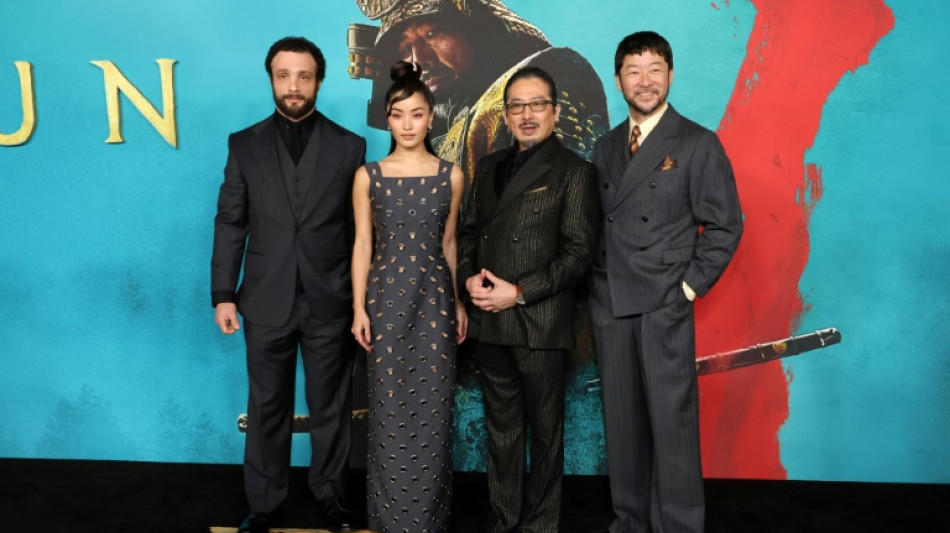
'Groundbreaking' realism key to 'Shogun' success / Photo: Matt Winkelmeyer - GETTY IMAGES NORTH AMERICA/AFP/File

 Swimming prodigy Yu, 13, says 'interviews way harder than racing'

 Star coaches make their bows as Nations League returns
 Rams bounce back as Giants reel from Dart injury
 In Bangladesh, Pakistan's Jinnah photo stirs anger

 Two New Zealand naval ships transit Taiwan Strait
 Zidane gets down to work as France start new era
 Inside the Venezuelan prison meant to 'drive you insane'
 UK king braces as memoir by Diana's brother goes on sale

 Akkodis and Hamburg Public Transport Association Showcase hvv mia at InnoTrans 2026, Demonstrating the Future of AI-Powered Mobility

 Macron says talks with Trump on Red Sea, Ukraine 'constructive'

 Green policies just good politics, says UK minister

 Bardot auction in Paris fetches nearly one million euros

 No timeline on Daniels injury return, says Commanders coach

 British Columbia sues OpenAI in US court over Canada school shooting

 French star Batum retires after 18-year NBA career

 Zidane leads first France training session

 Man shot by ICE agent in Texas detained with bullet inside him: lawyer
 California declares state of emergency ahead of El Nino

 South Africa arrests three more suspects, after nine women murdered
 Carse needs time away from England, says captain Brook

 NOWPayments Releases Cross-Chain Payout Data Revealing Key Performance Benchmarks Across TRON, BNB Chain, and Solana

 British Museum bans photos of Bayeux Tapestry as crowds linger
 COP31 host says AI climate footprint to be a summit priority

 Berlin's far-left vote winners reject anti-semitism charges

 Mancini eager for 'new adventure' on Italy return

The samurai in "Shogun" don't swing their arms as they walk -- just one of many authentic historical details that have helped make the hit television drama this year's top Emmys contender.
The period drama, praised for its meticulous approach to accuracy, made TV history with 25 Emmy nominations, and has already swept up 14 prizes in minor categories ahead of Sunday's gala.
Set in early 17th-century feudal Japan, "Shogun" makes a break from decades of cliched and often bungled depictions of the country in Western-made film and television.
An army of experts including several wig technicians from Japan worked behind-the-scenes to make the series realistic, poring over sets, costumes and the actors' movements.
Kyoto-based historian Frederik Cryns advised on everything from the types of kimonos to the position of tatami mats.
"My comments were compiled, and to my surprise, became a 2,100-page manual" that was followed almost to the letter, Cryns -- a professor at the International Research Center for Japanese Studies -- told AFP.
Cryns said he had often felt a "sense of discomfort" when watching Japan-themed Hollywood movies because of their inaccuracy.
But "Shogun" -- made by Disney-owned FX and co-produced by Japanese actor Hiroyuki Sanada, who also stars in the series -- is the most realistic production of its kind, according to Cryns.
"Honestly, tears welled up in my eyes after watching the show" for the first time, he said.
- 'Independent' women -
"Shogun," which means general in Japanese, was adapted from a popular novel by James Clavell, and filmed in Canada.
Some characters are inspired by real historical figures, including the protagonist Lord Toranaga (Sanada), who is based on Japan's famous warlord Tokugawa Ieyasu.
In the show, Toranaga fights for his life against his enemies with his allies British sailor John Blackthorne (Cosmo Jarvis) and noblewoman Lady Mariko (Anna Sawai).
In one scene, instead of a regular sword, Mariko wields a naginata -- a long pole with a curved blade on one end, used by women in Japanese warrior families.
"Women in medieval Japan were independent," said Cryns, who recommended that weapon be used.
"Samurai went into battle, of course, but women would also fight with naginata when they had to protect their castle."
As a movement supervisor, Japanese dancer and kabuki actor Hannojo trained some of the show's main actors in Japan for three months.
He was also in Vancouver during filming to advise on "shosa" -- stylised movements from kabuki, a traditional Japanese form of theatre.
"There are correct ways to walk, sit and stand in a kimono, but it's difficult for young actors" who don't have regular experience wearing such outfits, Hannojo said.
"For example, samurai don't swing their arms when walking. They glide without moving the upper body."
Some of the cast struggled with more graceful motions, such as when noblewomen would stand up straight from the floor without crouching, he said.
"It looks beautiful" and "Japanese people used to have muscles for that -- but not anymore, because we sit on chairs!" he quipped.
- '120 percent' -
Japanese is spoken in 70 percent of "Shogun" -- a choice producer Eriko Miyagawa described as "groundbreaking".
Even though most people might not notice, the crew strived to make even the props authentic because they "wanted to do 120 percent", she said.
For example, the writing on the scrolls was done by a Vancouver-based Japanese calligrapher using the handwriting of the historical figures on whom the characters are based.
Commitment to authenticity "came from the very top" within FX, according to Miyagawa.
"They chose Justin Marks (as showrunner)... who has an insatiable curiosity and respect for Japanese culture," she said.
"They brought Hiroyuki Sanada and myself on as producers from the beginning," she added. "That's a big deal."
FX is now working to develop more seasons of "Shogun" -- but not everything in the first instalment is true to life.
Unlike the other samurai, Toranaga's hair was not shaved in the middle -- a creative decision made for visual reasons.
Miyagawa, who began her career as a translator for "Kill Bill" in 2003 and worked as a co-producer for Martin Scorsese's "Silence", said the team "probably couldn't have pulled off" the series 10 years ago.
A previous TV mini-series adaptation of the novel made in 1980 was centred on Blackthorne's perspective. And yes, the samurai did swing their arms.
"The world has changed and the market has evolved," which "paved the way" for the show's success, said Miyagawa.
"I like to think 'Shogun' pushed this evolution forward."
A.Ruiz--AT