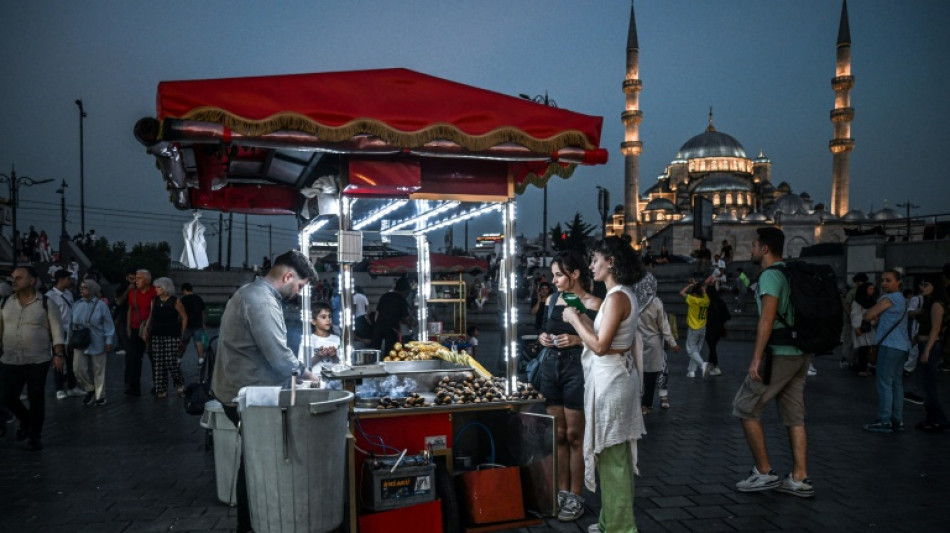
Hungry times for Istanbul's street food sellers / Photo: Ozan KOSE - AFP

 Swimming prodigy Yu, 13, says 'interviews way harder than racing'

 Star coaches make their bows as Nations League returns
 Rams bounce back as Giants reel from Dart injury

 In Bangladesh, Pakistan's Jinnah photo stirs anger

 Two New Zealand naval ships transit Taiwan Strait

 Zidane gets down to work as France start new era

 Inside the Venezuelan prison meant to 'drive you insane'

 UK king braces as memoir by Diana's brother goes on sale
 Akkodis and Hamburg Public Transport Association Showcase hvv mia at InnoTrans 2026, Demonstrating the Future of AI-Powered Mobility

 Macron says talks with Trump on Red Sea, Ukraine 'constructive'

 Green policies just good politics, says UK minister

 Bardot auction in Paris fetches nearly one million euros
 No timeline on Daniels injury return, says Commanders coach

 British Columbia sues OpenAI in US court over Canada school shooting

 French star Batum retires after 18-year NBA career

 Zidane leads first France training session
 Man shot by ICE agent in Texas detained with bullet inside him: lawyer

 California declares state of emergency ahead of El Nino

 South Africa arrests three more suspects, after nine women murdered

 Carse needs time away from England, says captain Brook

 NOWPayments Releases Cross-Chain Payout Data Revealing Key Performance Benchmarks Across TRON, BNB Chain, and Solana

 British Museum bans photos of Bayeux Tapestry as crowds linger

 COP31 host says AI climate footprint to be a summit priority

 Berlin's far-left vote winners reject anti-semitism charges

 Mancini eager for 'new adventure' on Italy return

The enticing smell of grilled corn and chestnuts wafted from Hakan Deniz's red and gold food cart near a mosque in Istanbul's old city. But local customers are hard to come by these days.
With Turkey mired in sky-high inflation, Istanbul's ubiquitous street vendors, who have been part of the cityscape since the Ottoman Empire, are worried about their future.
"Our tomorrows are uncertain," said Deniz, 18, after pushing his cart past the Rustem Pasha mosque.
"I have lost almost half of my customers because of inflation," Deniz said as he weighed and handed a bag of chestnuts to an American tourist.
He wondered aloud if vendors like him would "still exist in the future".
Inflation rose across the world after the Covid pandemic and soared further after Russia invaded Ukraine in 2022, but it has been particularly bad in Turkey.
Officially, it rocketed to 85 percent in October 2022 before slowing and rising again to reach 75 percent in May this year. Inflation has since fallen, with data on Tuesday showing it at 52 percent in August.
- 'Ottoman tradition' -
The streets of Istanbul, a metropolis of 16 million people, would not be the same without its street vendors.
At night, mobile stalls with bright neon signs form constellations of light along the picturesque city's streets.
They fill the air with an array of smells -- from stuffed mussels to simit, rings of delicious sesame-encrusted bread.
The merchants enjoy a "positive image" in general, said Osman Sirkeci, a researcher at the Izmir University of Economics.
Some, such as sellers of the sweet toffee paste known as macun, are seen as heirs of an "Ottoman tradition", Sirkeci said.
Their ranks grew after the Covid pandemic, with one million people becoming street vendors, the researcher said.
Turkey now counts seven million street vendors, working legally or illegally, he said.
Inflation, however, has hit professions already known for low wages and small margins very hard.
"The expenses of mobile merchants are much lower than those of traditional shops because they don't have rent or electricity bills to pay," Sirkeci said.
But they have other high costs such as raw materials that they get from intermediaries who pass on the cost of inflation, instead of buying them directly from producers.
"The price of sesame has skyrocketed. Same for flour. Everything is too expensive," said Nuri Geyik, a 54-year-old simit seller.
He used to sell his bread for one lira a piece a few years ago.
"Now I'm forced to sell them for 15 lira," he said.
Mithat Atilgan sells fruits and vegetables that are grown in Bursa, a region around 150 kilometres (90 miles) south of Istanbul.
"The cost of transport has also increased," Atilgan said.
"Sales are bad," he added, noting that Turkish customers cannot keep up with the price increases.
"Only the rich can buy my fruits today," said Atilgan, who sells figs from his cart.
- 'I'm ashamed' -
Mustafa Demir wondered for how much longer his usual Turkish customers would buy his jars of pickles.
"I'm ashamed of selling the jars for 40 liras to my loyal customers," he said, recalling how he used to sell them for 15 cents.
Deniz said his customers were mostly Turkish in the past.
"It's not the case anymore. Now 70 percent are tourists," Deniz admitted.
While Sirkeci, the researcher, believes that street vendors will survive, Deniz is not so sure.
"This job will disappear," he said. "Look at the sellers of boza (a fermented cereal drink). There are almost none of them left in Istanbul."
T.Wright--AT