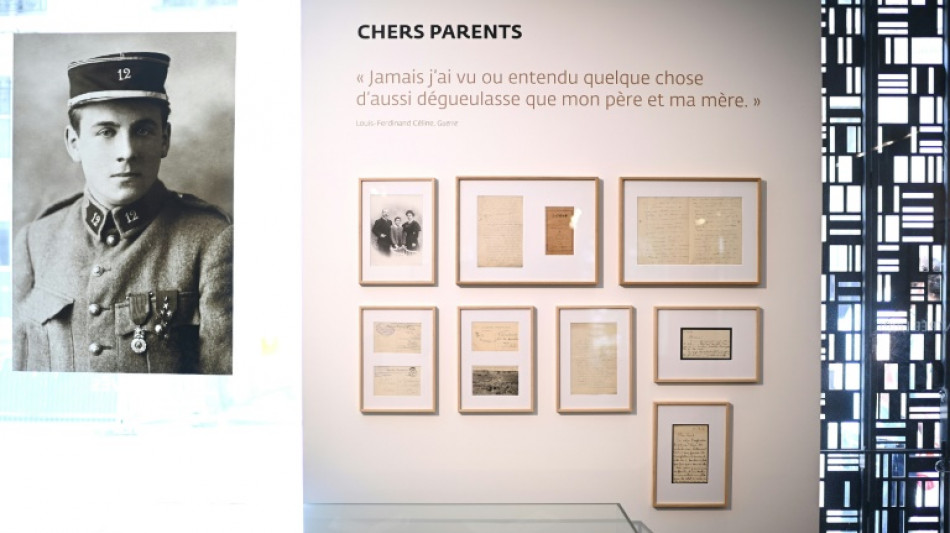
France's famed pro-Nazi writer returns 78 years on / Photo: Christophe ARCHAMBAULT - AFP

 Nepal flood death toll rises as rescuers scour tunnels

 France's Mistral sees value soar with 3 bn euro cash infusion

 Nepal glacier saw exceptional heat before collapse caused deadly floods: researcher

 Ethiopia boosts drone production to fight rebels

 Yemen rebels hit Saudi Arabia with wave of strikes, wounding 73

 Nepalis mark a year since deadly protests that toppled government

 Rubio launches Latin America tour to cement US influence

 France tries 14 over deadliest Channel migrant crossing disaster

 Australia threatens hefty fines if big tech fails 'duty of care'

 Zverev romps into quarter-finals as Darderi downed

 Kauai on tornado watch as Hurricane Lowell nears Hawaiian islands

 Pakistan roll the dice in search of consolation win over England

 Yen extends gains as traders eye rate hike, tech rallies again

 'The ber months': Christmas arrives early in the Philippines

 N. Korea calls Russia bridge a sign of tighter ties

 US sanctions threaten to crush Iranian students' dreams

 Former champ Gauff holds off Jovic to reach US Open quarter-finals

 Battery X Metals to Appoint Accomplished Technology and Consumer Brands Executive Nicholas Reichenbach to Board of Directors
 Equitech-Bio Expands Reagent Portfolio with New IgG Offering and Publication-Backed Product Validation from Bioz

 CPG Life Fund I Launches $20 Million Operator-Led CPG Fund

 Who is the Best Female Cosmetic Surgeon in Florida?

 CANEX Metals Announces C$6.5 Million Strategic Financing Led By C$3 Million Investment by Eric Fier

 Helio Sets September Roadshow Across Austin, Houston, Phoenix, Scottsdale
 Gaming Realms PLC Announces Interim Results

 Universal Edge Technologies Establishes Senior Advisory Committee, Names Mark Powell and Mark P. Mills as Founding Members
It is a rare thing when the story of a book's publication is as fascinating as the plot of the novel itself.
But that might be said of "Guerre" (War) by one of France's most celebrated and controversial literary figures, Louis-Ferdinand Celine, which arrives in bookstores on Thursday, some 78 years after its manuscript disappeared.
Celine's reputation has somehow survived the fact that he was one of France's most eager collaborators with the Nazis.
Already a superstar thanks to his debut novel "Journey to the End of the Night" (1932) -- which is still taught in schools -- Celine became one of the most ardent anti-Semitic propagandists even before France's occupation.
In June 1944, with the Allies advancing on Paris, the writer was forced to abandon a pile of his manuscripts in his Montmartre apartment.
Celine expected rough treatment, having spent the war carousing with the Gestapo, fingering Jews and foreigners to the authorities and publishing racist pamphlets about Jewish world conspiracies.
For decades, no one knew what happened to his papers, and he angrily accused resistance fighters of burning them.
But at some point in the 2000s, they ended up with retired journalist Jean-Pierre Thibaudat, who passed them -- completely out of the blue -- to Celine's heirs last summer.
- 'A miracle' -
Despite this unsettling history, the reviews of the resulting 150-page novel, published by Gallimard, have been unanimous in their praise.
"The end of a mystery, the discovery of a great text," writes Le Point; a "miracle," says Le Monde; "breathtaking," gushes Le Journal du Dimanche.
Gallimard is expecting blockbuster sales: 80,000 copies have been printed for Thursday's release.
The publishing house has yet to say whether there will be translations.
Like much of Celine's work, "Guerre" is deeply autobiographical, recounting his terrible experiences during World War I.
It opens with 20-year-old Brigadier Ferdinand finding himself miraculously alive after waking up on a Belgian battlefield, and follows his treatment and hasty departure for England -- all based on Celine's real experiences.
His time across the Channel is the subject of another newly discovered novel, "Londres" (London), to be published this autumn.
If French reviewers seem strangely reluctant to focus on Celine's anti-Semitism, it is partly because his early writings ("Guerre" is thought to date from 1934) show little sign of it.
"Journey to the End of the Night" was actually a hit among progressives for its anti-war message, as well as a raw, slang-filled style that stuck two fingers up at bourgeois sensibilities.
Celine's attitude to the Jews only revealed itself in 1937 with the publication of a pamphlet, "Trifles for a Massacre", which set him on a new path of racial hatred and conspiracy-mongering.
He never back-tracked. After the war, he launched a campaign of Holocaust-denial and sought to muddy the waters around his own war-time exploits -- allowing him to worm his way back into France without facing any repercussions.
- 'Divine surprise' -
Many in the French literary scene seem keen to separate early and late Celine.
"These manuscripts come at the right time -- they are a divine surprise -- for Celine to become a writer again: the one who matters, from 1932 to 1936," literary historian Philippe Roussin told AFP.
Other critics say the early Celine was just hiding his true feelings.
They highlight a quote that may explain the gap between his progressive novels and reactionary feelings: "Knowing what the reader wants, following fashions like a shopgirl, is the job of any writer who is very financially constrained," Celine wrote to a friend.
Despite his descent into Nazism, he was one of the great chroniclers of the trauma of World War I and the malaise of the inter-war years.
An exhibition about the discovery of the manuscripts opens on Thursday at the Gallimard Gallery and includes the original, hand-written sheets of "Guerre".
They end with a line that is typical of Celine: "I caught the war in my head. It is locked in my head."
In the final years before his death in 1961, Celine endlessly bemoaned the loss of his manuscripts.
The exhibition has a quote from him on the wall: "They burned them, almost three manuscripts, the pest-purging vigilantes!"
This was one occasion -- not the only one -- where he was proved wrong.
W.Nelson--AT