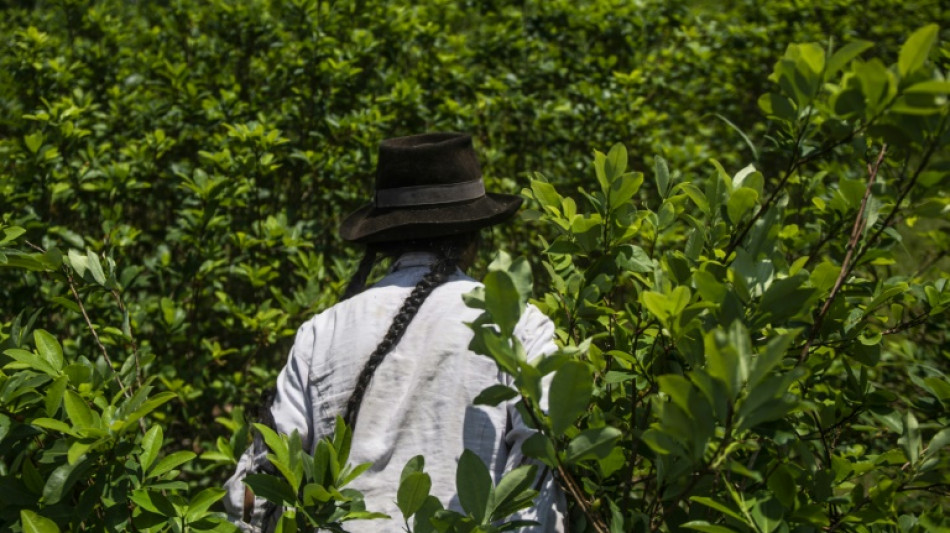
Peru to buy illegal coca crops to battle drug trafficking / Photo: ERNESTO BENAVIDES - AFP

 Real Madrid win Champions League opener as Haaland stars for Man City
 Gambian leader vows power boost after violent blackout protests

 Newcastle battle past Millwall to reach League Cup fourth round

 Mourinho's Real Madrid make winning start against Inter Milan

 Villa take 'big step forward' with win over Brugge

 Yaya Toure hails 'new era' for African coaches ahead of Champions League bow

 Lawes and Marchant told to prove themselves in quest for England recalls

 Smithsonian secretary to retire as Trump exerts control over institution

 Atletico have work to do to reach home Champions League final: Simeone

 Villa end goal drought to beat Brugge in Champions League opener

 McIlroy says 'we'll keep our heads down and play' in event of Trump golf visit

 Sabalenka holds of Noskova to reach US Open semi-finals

 Netanyahu under fire over report UAE warned of October 7 attack

 Wasim Akram urges 'fair treatment' for jailed Imran Khan

 No. 1 in reach as Rybakina battles for US Open semi-final spot

 Putin and Trump discuss Ukraine in 'extremely frank' call

 French police hunt Renoir thieves after lightning museum heist

 World Cup final scorer Torres leads Ballon d'Or nominees

 Carney touts Canada 'pivot' away from US as tariffs rise

 Spanish stars Cruz, Bardem play strained on-screen couple in new film

 The "Everlasting Battery" Inside Your Joints:UConn Professor's Self-Powered Healing Material just Got Acquired

 Visionary or conman? Elon Musk enigmatic star of Venice documentary

 Trial opens in France over deadliest Channel migrant crossing disaster

 England skipper Root says it's wrong to accuse Pakistan of lacking fight

 Owen Wilson leaves tough action work to Alan Ritchson in 'Runner'

Peru's government has announced a plan to buy the nation's entire supply of illegal coca leaf -- the primary ingredient in cocaine -- for at least a year, as part of its battle against drug trafficking.
The South American country is one of the world's three largest producers of cocaine, alongside neighbors Colombia and Bolivia, according to the United Nations.
Peru currently produces an estimated 160,000 tons of coca leaf a year with 62,000 hectares of land dedicated to the crop.
But the vast majority of that, some 95 percent, is produced illegally and sold to drug-traffickers who turn it into about 400 tons of cocaine a year.
All legally grown coca must be sold to the state coca company ENACO but that amounts to only 2,500 tons a year.
Legal coca leaf producers are on a register that includes 95,000 growers. However, the government wants to create a new register for the other 400,000 unregistered producers.
"It is imperative, for at least a year, to buy coca leaf from existing registered producers and from those that will make up the newly created register," Cabinet Chief Anibal Torres said on Wednesday when presenting the initiative.
The plan would also see the demilitarization of Peru's main coca leaf growing valley, known by the acronym VRAEM.
Soldiers have been stationed in the south-central area since 2006, due to the continued presence of the Shining Path Maoist guerrilla movement, which is allied with drug trafficking groups.
Government opponents have criticized the new plan, saying it will increase drug trafficking.
"The message from the government is that it is legalizing coca leaf and it will buy illegal coca leaf. The message is grow coca, and that's very dangerous because we are talking about a primary material used in drug trafficking," former interior minister Ruben Vargas told AFP.
The coca leaf bought by ENACO is used to make sweets, herbal infusions, flour and for chewing like gum, which is an Andean tradition to help combat fatigue.
"By promoting the growing of coca leaf peasants will obviously have two markets: the state and drug traffickers," added Vargas.
"It will cause immeasurable damage not just to the environment but also the governability of the country."
Peru created the register of coca leaf producers in 1978 as part of a state policy to combat drug trafficking that also included the destruction of illegal crops.
Earlier this month, authorities began a weeks-long process of incinerating the 16.3 tons of illegal drugs already seized this year.
M.White--AT