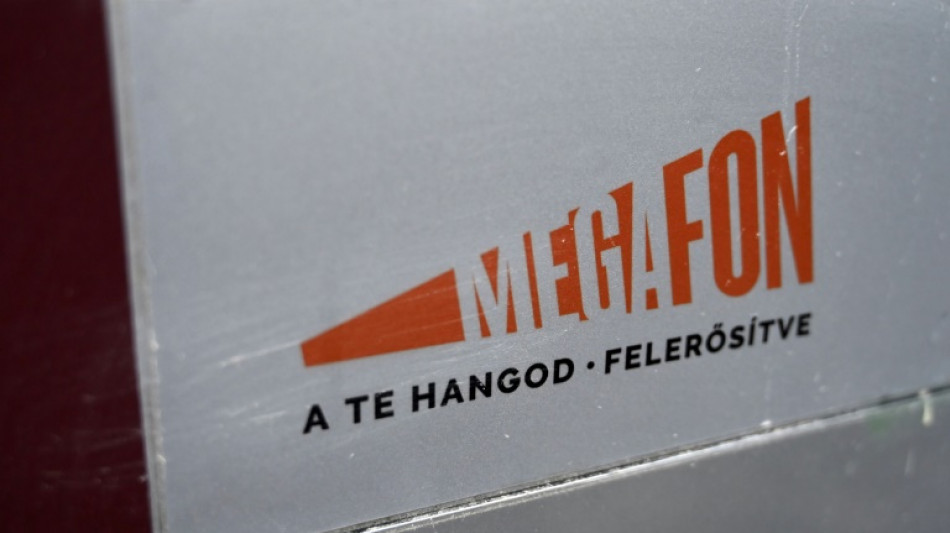
Orban's social media mouthpiece zeroes in on EU ahead of vote / Photo: ATTILA KISBENEDEK - AFP

 Memoir by Diana's brother goes on sale after rocking UK monarchy
 Newcomers South Korea face holders Italy in Davis Cup finals
 Japan's Kojima sounds Marchand warning with Asian Games gold

 England rugby star Pollock signs new Northampton deal

 STARTRADER Expands Its Chinese Equity CFD Range with CXMT and Unitree Robotics

 MEXC Expands Opportunity Compass with Stock Trading Handbook to Help Crypto Users Build Investment Knowledge

 England paceman Wood retires from international cricket
 Magnificent Mandhana's 79 helps India to Asian Games cricket gold

 Marchand 'stressed' about racing Japanese rivals at LA Olympics

 Mobile boat clinics bring healthcare to India's remote islands

 Former India paceman Zaheer Khan named Chennai coach in IPL

 Six-year-old Chinese girl sets world record with Rubik's Cube

 Swimming prodigy Yu, 13, says 'interviews way harder than racing'
 Star coaches make their bows as Nations League returns
 Rams bounce back as Giants reel from Dart injury

 In Bangladesh, Pakistan's Jinnah photo stirs anger
 Two New Zealand naval ships transit Taiwan Strait

 Zidane gets down to work as France start new era

 Inside the Venezuelan prison meant to 'drive you insane'
 UK king braces as memoir by Diana's brother goes on sale
 Silver X Increases Measured and Indicated Resources 173% to 10.4 Mt at 213 g/t AgEq (70.8 Moz AgEq) and Inferred Resources 43% to 21.6 Mt at 252 g/t AgEq (180.9 Moz AgEq)

 SLAM Uncovers Antimony, Gold and Silver on Its Moose Lake Trenching Program

 Arrive AI to Demonstrate Autonomous Delivery Infrastructure at Investor Showcase

 Amber Book Expands California Supplemental Exam Prep with New Practice Tools Designed for How Architects Learn
 Jaguar Mining Commences New Underground Drilling Program Targeting Untested High-Grade Zones at Turmalina Mine, Brazil
Ahead of EU elections on June 9, a deluge of misinformation amplifying the Hungarian government's key talking points on the war in Ukraine has flooded the country's social media platforms.
Content creators affiliated with Hungary's opaque Megafon Centre have been behind a tide of well-crafted video clips distributed online.
Megafon was created in 2020 with a mission "to amplify the voice of the right and counterbalance the dominance of the left-wing mainstream on the internet", according to its website.
But critics say it has become the latest mouthpiece for nationalist Prime Minister Viktor Orban's Fidesz party, amplifying its narratives while slamming those critical of the government and most recently the EU.
Since the beginning of the year, Megafon has poured more than 650 million forints ($1.8 million) into promoting its content on Facebook, according to estimates by the platform's owner Meta.
No other political party in the EU has spent as much as Megafon over the same period, according to AFP.
While some clips accuse European leaders of "wanting nuclear war", others suggest that women might soon be forced to produce weapons in factories and children may be sent to the front lines.
Several videos also featured remarks by French President Emmanuel Macron on the possibility of sending Western troops to Ukraine and his proposed debate on the role of the country's nuclear arsenal in Europe.
But Macron's remarks were taken out of context and skewed to portray European leaders as wanting "a third world war".
An advocate for peace talks between Ukraine and Russia and the Kremlin's closest EU ally, Orban has characterised the upcoming European Parliament elections as a referendum on the war, saying he was now "fighting for peace alone" in the bloc.
- 'Seemingly infinite' funding -
During Orban's 14 years in power, Hungary's media landscape has been transformed, with public media long a government mouthpiece and large swathes of the private media sector owned by pro-government allies.
But the nationalist leader still had to win over the electoral support of younger, urban citizens, who had increasingly been turning online including for news.
In the wake of the opposition's surprise win in the capital Budapest and other larger cities in 2019, Megafon was born.
"Immense amounts of money were poured into dominating social media platforms" as if Megafon had "seemingly infinite" resources, Kata Horvath of the Mertek Media Monitor watchdog told AFP.
Unlike other influencers with "grassroots support", Megafon's content creators "owe the majority of their views to advertising", she explained.
The source of Megafon's funding remains unclear.
In recent weeks, Megafon "has spent so much money that I can't imagine a Hungarian who hasn't seen them in their Facebook feed", said analyst Robert Laszlo of the Political Capital think-tank.
Megafon says it is financed by private donors, rejecting allegations by independent media that taxpayers' money funnelled through various organisations was involved.
In the past, Megafon's director Istvan Kovacs, a former Fidesz candidate, said the centre has "no formal relations" with any political party.
Megafon did not respond to an interview request by AFP.
- 'Digital freedom fighter' -
According to expert Laszlo, Megafon is simply "another tool for the government" to "convey the key messages of the ruling party louder, and more simplistically".
"Pieces from real speeches and videos are manipulatively edited to appeal to emotions" in order to forge "hostile narratives, where there is always someone to blame", he said.
Through Megafon's clips, Orban's Fidesz aims to reach more Hungarians who do not follow politics closely "but can still be persuaded to lean towards the party", Laszlo added.
In addition to its costly political campaigns, Megafon offers free four-day training courses to anyone who seeks to become a "right-wing digital freedom fighter".
More than a thousand people have already taken the training courses, according to the centre.
Among them are dozens of Fidesz candidates standing in local elections on June 9, an investigation from AFP partner Lakmusz recently revealed.
In early May, Foreign Minister Peter Szijjarto praised Megafon's efforts at a public event organised by the centre, calling on them to "fight a fierce online battle" in the coming weeks.
R.Lee--AT