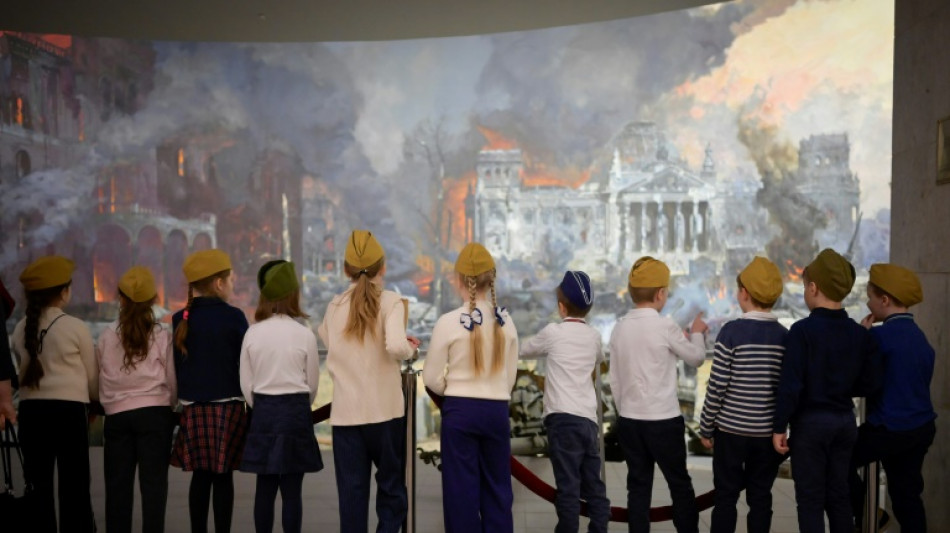
Moscow children celebrate 'victory' amid patriotic education drive / Photo: Natalia KOLESNIKOVA - AFP

 Trump rejects international regulation of AI
 How is the EU approaching record fuel prices?

 Sri Lanka's Colombage strikes on debut as England dismissed for 265 in first ODI
 Hurricane Polo strengthens to top category 5 off Mexico
 11 hurt as teen opens fire outside school in western Turkey

 UN chief says 'Big Oil' treats atmosphere as open sewer
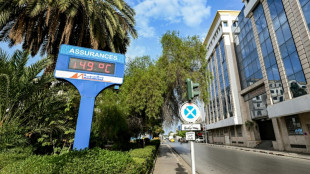 Tunisia says 2026 summer hottest on record
 England's Rashid out of Sri Lanka ODIs with hand injury
 Houthis accuse Saudi Arabia of deadly strikes as thousands flee
 Stocks climb as oil slides, AI buzz returns
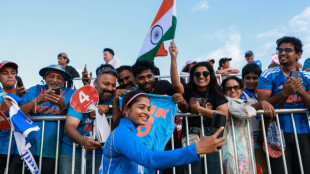 India cricketers win in style as Afghan savours 'special' Games silver
 La Liga president hits out at Real Madrid refereeing 'conspiracy' claims

 MEXC Launches “Real Stocks, Real Friends” with Rewards for Bringing Friends to Wall Street

 Mbappe continues media push for Ballon d'Or recognition
 Stocks rise on AI buzz, oil prices cool
 India narrowly survive huge scare against minnows Japan

 Missing F-35 fighter parts 'not sensitive', says Australia minister
 Cambodia showcases scams crackdown with global conference
 Afghan cyclist who disguised herself as man wins Asian Games silver
 Typhoon Dujuan leaves four dead in Japan, 45,000 houses without power
 G7 leaders condemn Houthi strikes on Saudi Arabia
 Google data centre sparks protests in Austria
 Shin Ohashi: Junk food-loving teen and Japan's next big swimming hope
 Stocks rise on AI buzz, drop in oil prices
 China's robot dancers limber up for America's Got Talent final
Outside Moscow's patriotic Victory Museum, 11-year-old Saveliy beamed with excitement: "I've seen real machine guns!".
Standing with his younger brother and mother, Arina, under a grey Moscow sky, the child was well versed in weaponry.
"I'm really interested in all this. I know about old German weapons, Soviet weapons," he said.
The family visited the museum ahead of the Victory Day holiday, which Russia has always marked with pomp but which has become even more patriotic during the dragging Ukraine offensive.
The museum is dedicated to the Soviet Union's victory over Nazi Germany in World War II, a conflict that claimed around 30 million Soviet lives.
The Great Patriotic War -- as it is known in Russia -- is a source of immense pride in the country and an essential pillar of a fervent military patriotism advanced by President Vladimir Putin during his quarter-century in power.
The Kremlin has marshalled this historical narrative to justify its offensive on Ukraine, casting its military campaign as an existential struggle against "neo-Nazis".
With its troops fighting in Ukraine, that message has become an increasingly important part of how Russia's young children are raised.
Outside the museum, Saveliy was holding a wooden rifle almost as tall as him. He had requested it as a gift for his birthday a day earlier.
Like many Muscovites, the family were visiting ahead of May 9 Victory Day celebrations, a national holiday when Russia marks its military victory with an imposing parade of tanks, weapons, missiles and soldiers on Moscow's Red Square.
"Both my grandfathers fought in the war," said 36-year-old Arina, who declined to give her surname.
She said it was not the first time she had taken her two sons to visit.
"We've come... to honour the memory of our ancestors. And to look at the 'trophy' equipment," she said, referring to displays of captured NATO military hardware from the battlefield in Ukraine.
- 'I'm a soldier' -
Inside the imposing white building, several classes of primary school children walked in columns, wearing military caps and orange-and-black Saint George's ribbons, a symbol of the Red Army's victory in 1945.
The children listened attentively to the story told by the guide.
"Kyiv was recaptured in November 1943, then in May 1945, the army went on the liberate Berlin from the Nazis," she said.
Behind her was a giant murial depicting the Soviet army's capture of the Reichstag.
"Hurrah," the seven-year-olds shouted together, before clamouring over each other to take photos in front of a model tank.
"I'm a soldier," said one boy.
Further along, in a majestic "Hall of Glory", the names of hundreds of fallen soldiers are inscribed on the walls.
"Without the past, there is no future," reads a homage.
Since sending troops into Ukraine, the Kremlin has ramped up the prominence of its official historical narrative in school classes and official textbooks.
The annual federal budget allocated to so-called "patriotic education" jumped 14-fold between 2021 and 2024 to 50 billion roubles ($540 million).
- 'Our history' -
Alexander Soskov, 69, came to the museum on Wednesday with his daughter, Polina, and two of his grandchildren.
"This is our history. It's in our blood," he told AFP.
Like the Kremlin, he sees parallels with Russia's current fight in Ukraine.
"We don't have a conflict with Ukraine. We have a conflict with the fascists who are in Ukraine," he said.
Moscow's claims that it is fighting to "de-Nazify" Ukraine have been repeatedly rejected by Kyiv and the West, as well as independent historians and analysts.
Soskov's eight-year-old grand-daugther, Daria, was listening closely. In school she had studied the Siege of Leningrad, she said.
For many Russians -- including Putin, who was born in the city -- the seige of Leningrad, now Saint Petersburg, is the central event of Russia's sacrifices on the home front.
More than 800,000 people died from starvation, disease and bombardment during an 872-day encirclement by German forces.
Not far away was Igor, six, visiting the museum with his mum, Marina.
Agreeing enthusiastically with his mother calling him a "patriot", Igor declared: "Russia is freedom!"
On Thursday morning the pair will watch Putin oversee the military parade on Red Square.
At his inauguration for another Kremlin term earlier this week, Putin said his mission was to "educate the young generations who will strengthen Russia's power."
The young Saveliy, wooden gun at the ready, said he was prepared to defend "the Fatherland".
"I was born here, I've lived here for a long time and I don't want to abandon it," the 11-year-old said.
Even if that means taking up real arms?
"Yes."
R.Lee--AT