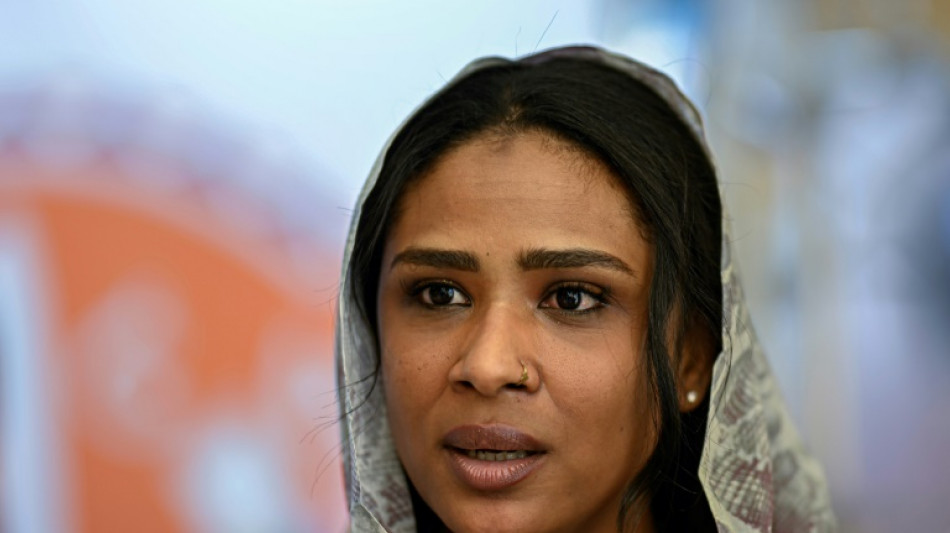
Sudanese filmmakers shine light on war's 'silent problems' / Photo: Khaled DESOUKI - AFP

 Trump rejects international regulation of AI

 How is the EU approaching record fuel prices?

 Sri Lanka's Colombage strikes on debut as England dismissed for 265 in first ODI
 Hurricane Polo strengthens to top category 5 off Mexico

 11 hurt as teen opens fire outside school in western Turkey

 UN chief says 'Big Oil' treats atmosphere as open sewer

 Tunisia says 2026 summer hottest on record
 England's Rashid out of Sri Lanka ODIs with hand injury

 Houthis accuse Saudi Arabia of deadly strikes as thousands flee

 Stocks climb as oil slides, AI buzz returns

 India cricketers win in style as Afghan savours 'special' Games silver

 La Liga president hits out at Real Madrid refereeing 'conspiracy' claims

 MEXC Launches “Real Stocks, Real Friends” with Rewards for Bringing Friends to Wall Street

 Mbappe continues media push for Ballon d'Or recognition

 Stocks rise on AI buzz, oil prices cool

 India narrowly survive huge scare against minnows Japan

 Missing F-35 fighter parts 'not sensitive', says Australia minister

 Cambodia showcases scams crackdown with global conference
 Afghan cyclist who disguised herself as man wins Asian Games silver

 Typhoon Dujuan leaves four dead in Japan, 45,000 houses without power

 G7 leaders condemn Houthi strikes on Saudi Arabia
 Google data centre sparks protests in Austria

 Shin Ohashi: Junk food-loving teen and Japan's next big swimming hope
 Stocks rise on AI buzz, drop in oil prices

 China's robot dancers limber up for America's Got Talent final

Sudanese directors and actors were in Egypt this week hoping to use the power of cinema to shine a light on the war devastating their country and on world indifference.
Fighting broke out in mid-April last year between Sudan's regular army, headed by the country's de facto leader Abdel Fattah al-Burhan, and the paramilitary Rapid Support Forces (RSF) led by his former deputy Mohamed Hamdan Daglo.
The war has killed tens of thousands of people and forced millions more to flee their homes, triggering acute food shortages and a dire humanitarian crisis in the already impoverished country.
This desperation was highlighted at the Aswan International Women Film Festival through five Sudanese short films.
"We must speak about ourselves and our silent problems, even through a simple artistic production," Sudanese actress and human rights activist Eiman Yousif told AFP.
"Now there is a certain degree of freedom that was not present before," she said of the pro-democracy protests that overthrew autocratic president Omar al-Bashir.
During the 30-year iron-fisted rule of the Islamist strongman, which ended in 2019, the industry in Sudan suffered, with numerous cinemas forced to close.
Bashir's ouster ushered in a civilian-led transition that saw an outpouring of hope among the Sudanese people, but it all came to an end amid the violent power struggle between the rival generals.
- 'The result of suffering' -
Sudanese filmmakers and actors say they are determined to restore that hope.
"We are doing everything possible to ensure that film production does not stop again," said Sudanese director Mohammed al-Tarifi on the sidelines of the Aswan festival.
The film industry in Sudan "is the result of suffering first and foremost", he said, referring to decades of conflict in the northeastern African country.
Among the short films shown at Aswan was director Razan Mohammed's "A Brick for Them", which recounts the fate of women displaced to a refugee camp in 2003 during the war in Sudan's Darfur region.
"As we speak, they have been displaced a second time to an unknown location, but life goes on," Tarifi said.
Another movie, "Women of War" from director Algaddal Hassan, reflected on the impact of conflict on the women of the Blue Nile state in southern Sudan, also shattered by the war.
The conflict between the army and the RSF, now in its second year, has killed tens of thousands and displaced 6.7 million people internally. An estimated 1.8 million have fled the country, among them 500,000 to neighbouring Egypt.
"The diaspora generates creativity... the Sudanese presence in Cairo is accompanied by a very active artistic movement which will allow more productions to see the light of day," said Tarifi, who now lives in the Egyptian capital.
"Wars and crises are exhausting", but they are also sources of "dreams and new ideas", said Yousif, who played the main role in "Goodbye Julia" -- the first ever feature-length Sudanese movie presented in the Cannes Film Festival official selection in 2023.
In a Sudan hungry for change, a new cinema style has emerged, fed by the energy of the revolution that ousted Bashir.
After the dictator's overthrow in 2019, director Amjad Abu Alala's film "You Will Die at 20" became the first Sudanese movie selected for the Oscars and at the Venice Film Festival, where it received the Lions of the Future award for best first feature film.
And even if cinemas are now rare in Sudan, Yousif believes that "all you need is a projector and a white wall to show people films".
"The most important thing is to watch."
R.Garcia--AT