'Titanic' task of finding plundered African art in French museums / Photo: STEPHANE DE SAKUTIN - AFP/File

 Chile's Atacama Desert blossoms with life after El Nino rains

 Sri Lanka hands 220-year jail terms to 15 convicted of Easter bombings
 Typhoon Dujuan leaves 7 dead in Japan from landslides, flooding: media

 Ganna and Borghini lead Italy to mixed relay gold at cycling worlds

 Drug cocktail killed former child star Hayden Panettiere: coroner

 Moldova declares energy, water emergency

 French Holocaust denier jailed for eight months

 Oil prices slide, AI stock buzz fades

 Trump threatens to 'annihilate' Iran in bombastic UN speech

 Prada's skirts take centre stage as Milan Fashion Week begins

 Quoin Pharmaceuticals Announces FDA Fast Track Designation for QRX003 for the Treatment of Peeling Skin Syndrome
 Brazil's Flavio Bolsonaro turns scandal into poll gains
 Republican senator seeks probe of Trump Jr Russian-funded wedding

 Memoir by Diana's brother goes on sale after rocking UK monarchy

 Newcomers South Korea face holders Italy in Davis Cup finals

 Japan's Kojima sounds Marchand warning with Asian Games gold

 England rugby star Pollock signs new Northampton deal

 STARTRADER Expands Its Chinese Equity CFD Range with CXMT and Unitree Robotics

 MEXC Expands Opportunity Compass with Stock Trading Handbook to Help Crypto Users Build Investment Knowledge

 England paceman Wood retires from international cricket

 Magnificent Mandhana's 79 helps India to Asian Games cricket gold

 Marchand 'stressed' about racing Japanese rivals at LA Olympics

 Mobile boat clinics bring healthcare to India's remote islands

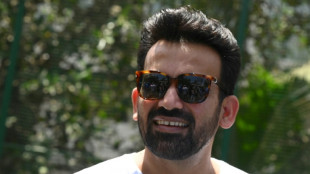 Former India paceman Zaheer Khan named Chennai coach in IPL

 Six-year-old Chinese girl sets world record with Rubik's Cube
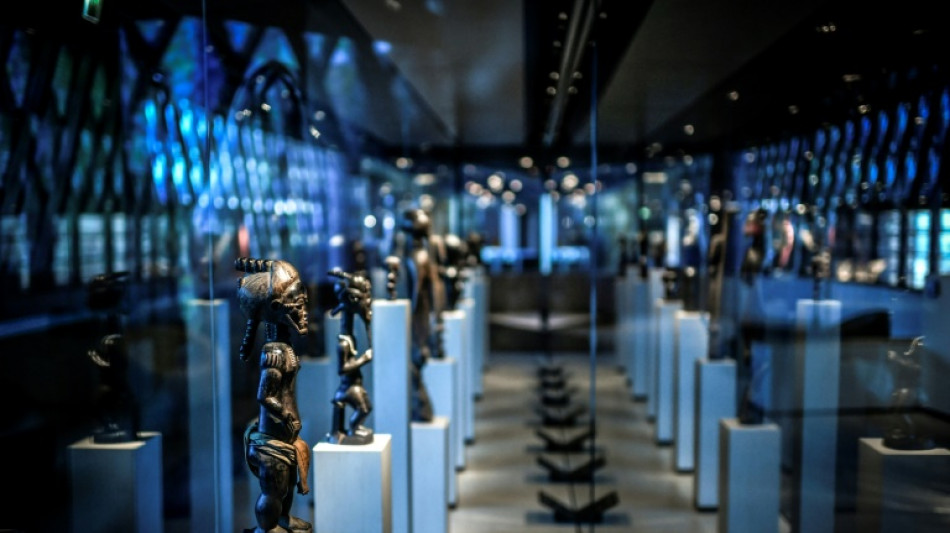
With tens of thousands of African artworks in French museums, curators face a huge task in trying to identify which of these were plundered during colonial rule in the 19th and 20th centuries and should be returned.
During a visit to Burkina Faso in 2017, French President Emmanuel Macron pledged to return "African heritage to Africa" within five years, pushing other former colonial powers, including Belgium and Germany, to launch similar initiatives.
In 2021, France repatriated 26 royal treasures its soldiers took from Benin during colonial rule.
The effort has stalled, and in March the government indefinitely postponed a bill authorising the return of African and other cultural artefacts following right-wing resistance in the Senate.
French museums are nonetheless studying the origins of some 90,000 African objects in their archives.
Most -- 79,000 -- are in the Quai Branly museum in Paris dedicated to indigenous art from Africa, Asia, Oceania and the Americas.
The task is "titanic and exhilarating", said Emilie Salaberry, head of the Angouleme Museum, which houses around 5,000 African objects.
"It's turned upside down how we understand our collections," she told AFP.
- 'Real investigative work' -
Identifying an object's provenance is becoming central to museum work, but tracking down the necessary information is hard and time-consuming.
France's Army Museum began its inventory in 2012 but has only been able to study around a quarter of its 2,248 African pieces.
And while it says there is a "reasonable hypothesis" that many are spoils of war, it has struggled to establish definitive conclusions.
"The main difficulty... is the relative lack of sources," a museum spokesperson told AFP.
Emilie Giraud, president of ICOM France, which oversees 600 museums, said: "It's real investigative work which requires cross-checking clues and finding sources that may be scattered, sometimes abroad, or might not even exist at all."
It is hoped the task will grow easier as this type of research becomes commonplace.
The University of Paris-Nanterre introduced a course dedicated to provenance in 2022, and the Louvre School at the heart of the famed museum followed suit in 2023.
Germany and France launched a three-year, 2.1-million-euro ($2.2 million) fund for provenance research in January.
"We need to be transparent about everything, including the inadequacies of our catalogues, our dating, and our designations," said Katia Kukawka, chief curator of the Aquitaine Museum, calling the job an "ethical imperative".
– Frustrated efforts -
To ease the cost burden, the Aquitaine Museum, which has 2,500 African objects, is pooling resources with other organisations, including museums in Gabon and Cameroon.
But without the proposed law, it remains uncertain what criteria will determine when an object must be returned to Africa.
If it was illegally acquired, that might be sufficient, said Salaberry, of the Angouleme Museum, but the lack of clear historical records will continue to frustrate restitution efforts.
"There will be an enormous number of objects for which light can never be shed," she said.
Loans and long-term retainers could be an alternative to full restitution -- as Britain recently did for items from the Ashanti, or Asante, royal court in Ghana.
But not everyone was impressed with that.
As Nana Oforiatta Ayim, a culture adviser to Ghana's government, told the BBC: "Someone comes into your home and steals something, keeps it in their house, and then X amount of years later comes up and says 'I'm going to lend you your things back'.
"It doesn't make any sense."
J.Gomez--AT