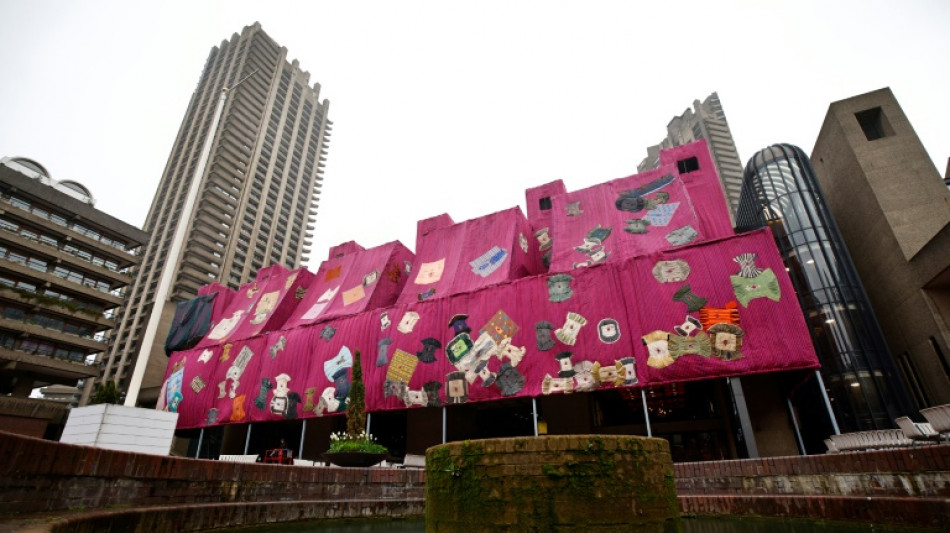
Ghanaian artist Ibrahim Mahama adds splash of colour to London complex / Photo: BENJAMIN CREMEL - AFP

 Chile's Atacama Desert blossoms with life after El Nino rains

 Sri Lanka hands 220-year jail terms to 15 convicted of Easter bombings

 Typhoon Dujuan leaves 7 dead in Japan from landslides, flooding: media

 Ganna and Borghini lead Italy to mixed relay gold at cycling worlds

 Drug cocktail killed former child star Hayden Panettiere: coroner

 Moldova declares energy, water emergency

 French Holocaust denier jailed for eight months

 Oil prices slide, AI stock buzz fades

 Trump threatens to 'annihilate' Iran in bombastic UN speech

 Prada's skirts take centre stage as Milan Fashion Week begins

 Quoin Pharmaceuticals Announces FDA Fast Track Designation for QRX003 for the Treatment of Peeling Skin Syndrome

 Brazil's Flavio Bolsonaro turns scandal into poll gains
 Republican senator seeks probe of Trump Jr Russian-funded wedding

 Memoir by Diana's brother goes on sale after rocking UK monarchy

 Newcomers South Korea face holders Italy in Davis Cup finals

 Japan's Kojima sounds Marchand warning with Asian Games gold

 England rugby star Pollock signs new Northampton deal

 STARTRADER Expands Its Chinese Equity CFD Range with CXMT and Unitree Robotics

 MEXC Expands Opportunity Compass with Stock Trading Handbook to Help Crypto Users Build Investment Knowledge

 England paceman Wood retires from international cricket

 Magnificent Mandhana's 79 helps India to Asian Games cricket gold

 Marchand 'stressed' about racing Japanese rivals at LA Olympics

 Mobile boat clinics bring healthcare to India's remote islands
 Former India paceman Zaheer Khan named Chennai coach in IPL

 Six-year-old Chinese girl sets world record with Rubik's Cube

An installation by Ghanaian artist Ibrahim Mahama wrapping part of a brutalist central London cultural complex in pink-purple woven cloth and urine-stained robes was unveiled Tuesday.
The public commission at the Barbican Centre's Lakeside Terrace, named "Purple Hibiscus" after Chimamanda Ngozi Adichie's eponymous 2003 novel, has been hand-sewn in collaboration with hundreds of craftspeople in Ghana.
The 2,000 square metres (2,1528 square feet) of brightly coloured fabric panels feature scores of traditional robes, known as "batakaris", previously worn and cherished by everyone from Ghanaian royals to everyday people.
Passed down from generation to generation, Mahama began collecting them more than a decade ago for eventual use in his artworks.
Known internationally for creating massive installations that clad buildings, "Purple Hibiscus" is his first large-scale UK public commission.
For it, he worked with networks of female weavers in his native Ghana to embroider the robes onto the striking fabric now draped over a sliver of the famously grey concrete Barbican complex.
"I've always been interested in labour, the conditions of labour, the history of labour, and also how labour is inflicted on bodies," Mahama told AFP about conceptualising the artwork.
Some of the robes have been urinated on or had "other things" doused on them by their previous owners, because "the idea is to break the soul away from the material," he explained.
"They somehow believe that their soul, of the family, is somehow contained within the cloth," the artist added, noting it had often been difficult to convince people to hand over the valued items.
Sometimes adorned with amulets, they were once mythically thought of as armour to protect against the bullets of colonial soldiers.
On display in the Barbican until mid-August, the exhibit resonates with the district's history of mass destruction during World War II and as a one-time home to the cloth trade.
The light and bright purple and pink fabric, stitched with the history-laden fragile robes, deliberately contrast with the hard-edged surroundings and typically grey London sky overhead.
"It's supposed to somehow allow us... to reflect on the human condition, and beyond the human condition, also into the question of life," said Mahama.
The artist appears unconcerned by the potential impact of London's notoriously wet weather on his painstakingly assembled installation.
"It will last as long as it can last," he said.
"Once you produce any art piece that is supposed to be in the public, the artist has to be ready to accept the fact that anything can happen to it."
K.Hill--AT