Poland shows colourful Ukraine art of hope and resistance / Photo: Wojtek Radwanski - AFP

 Chile's Atacama Desert blossoms with life after El Nino rains

 Sri Lanka hands 220-year jail terms to 15 convicted of Easter bombings

 Typhoon Dujuan leaves 7 dead in Japan from landslides, flooding: media
 Ganna and Borghini lead Italy to mixed relay gold at cycling worlds

 Drug cocktail killed former child star Hayden Panettiere: coroner

 Moldova declares energy, water emergency

 French Holocaust denier jailed for eight months

 Oil prices slide, AI stock buzz fades

 Trump threatens to 'annihilate' Iran in bombastic UN speech

 Prada's skirts take centre stage as Milan Fashion Week begins
 Quoin Pharmaceuticals Announces FDA Fast Track Designation for QRX003 for the Treatment of Peeling Skin Syndrome
 Brazil's Flavio Bolsonaro turns scandal into poll gains
 Republican senator seeks probe of Trump Jr Russian-funded wedding

 Memoir by Diana's brother goes on sale after rocking UK monarchy
 Newcomers South Korea face holders Italy in Davis Cup finals

 Japan's Kojima sounds Marchand warning with Asian Games gold

 England rugby star Pollock signs new Northampton deal

 STARTRADER Expands Its Chinese Equity CFD Range with CXMT and Unitree Robotics

 MEXC Expands Opportunity Compass with Stock Trading Handbook to Help Crypto Users Build Investment Knowledge

 England paceman Wood retires from international cricket

 Magnificent Mandhana's 79 helps India to Asian Games cricket gold

 Marchand 'stressed' about racing Japanese rivals at LA Olympics

 Mobile boat clinics bring healthcare to India's remote islands
 Former India paceman Zaheer Khan named Chennai coach in IPL

 Six-year-old Chinese girl sets world record with Rubik's Cube
Days after invading Ukraine, Russian forces fired rockets at a museum housing colourful paintings by the late Ukrainian folk artist Maria Prymachenko, admired by Pablo Picasso and Marc Chagall. The building burned down but her joyful work survived.
Residents of the northern town of Ivankiv managed to rescue the pictures, turning the imaginative painter into a symbol of endurance and hope.
Prymachenko's light through darkness approach despite a lifetime of hardships can be appreciated starting Friday in Poland's capital, now home to thousands of refugees from neighbouring Ukraine.
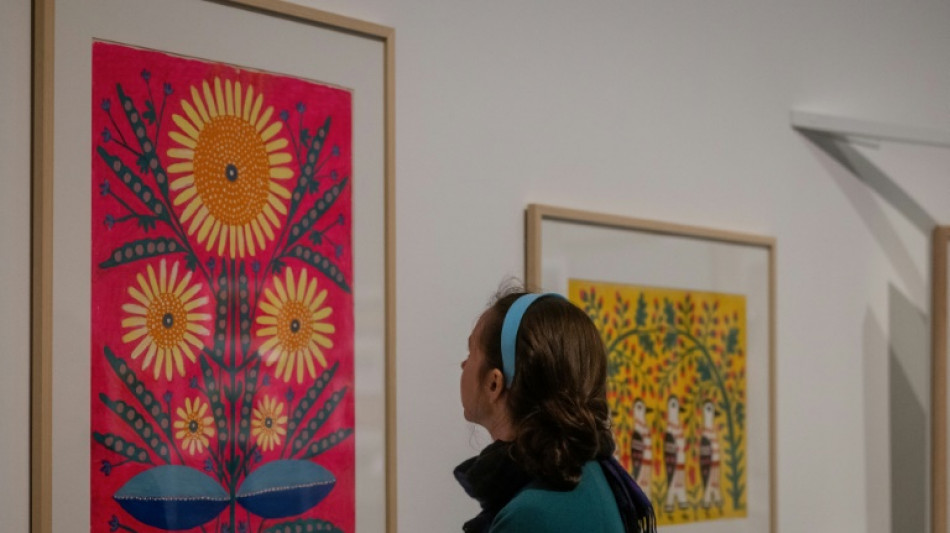
The exhibition features dozens of gouache paintings of rural life and fantastical creatures in a childlike style and a palette resplendent with flamboyant tones of highlighter pink, sunflower yellow and blood orange.
"Beyond being a famous painter, Maria Prymachenko is also a great symbol of Russia's failure to erase Ukrainian identity and culture," said Vitalii Bilyi, counsellor at the Ukrainian embassy in Warsaw.
"And thanks to this exhibition we can spread the word," he told AFP at a press preview of the show entitled "A tiger came into the garden", which runs until June at the Museum of Modern Art in Warsaw.
- 'Bouquet to the Unknown Soldier' -
Prymachenko was born in the village of Bolotnya in 1909 and over nearly nine decades survived polio, the Ukrainian famine, both world wars -- losing her husband to the second -- and the Chernobyl nuclear disaster.
"She showed strength of spirit and painted all her life. The paintings, while colourful, show different aspects of life and the Ukrainian tragedy," said Myroslava Keryk, head of the Ukrainian House Foundation which promotes the country's culture in Poland.
"And they provide hope of victory, that we will persevere and the war will end," she told AFP.
Prymachenko produced her commentary on everyday life by pairing images of animals or nature with little poems, often with grammatical mistakes because of her lack of education, Keryk said.
An example from the exhibition is a meditation on hunger featuring a cheery yellow and pink depiction of a billy goat and the title "Dear little goat, have you eaten, have you drunk?"
Another shows bright pink ornamental tulips against a sombre background with a caption that begins: "A bouquet to the Unknown Soldier. Honour and glory to you, dear warriors!"
- 'Live like flowers bloom' -
The war widow painted a whole series dedicated to fighting men, which several decades later "has an incredible topical anti-war message", said co-curator Szymon Maliborski.
"These are works that allow Prymachenko to, on the one hand, avoid having to directly depict war, but on the other hand show a grappling with loss, the death of a loved one," he told AFP.
A sunny painting of exotic blue birds is offset by the poem, "Four parrots sit in a cherry tree humming. The boys go to the army and the girls see them off -- wishing them luck".
This contrast between optimism and trauma was typical for the painter who had wished for "people to live like flowers bloom", according to Maliborski.
She often "mixed the solemn with the comical, adding a dash of humour or acceptance to her criticism," he said.
"There's a kind of coming to terms with the world and wanting to change it simultaneously. The awareness that human nature is what it is yet fighting for it to be better."
Y.Baker--AT