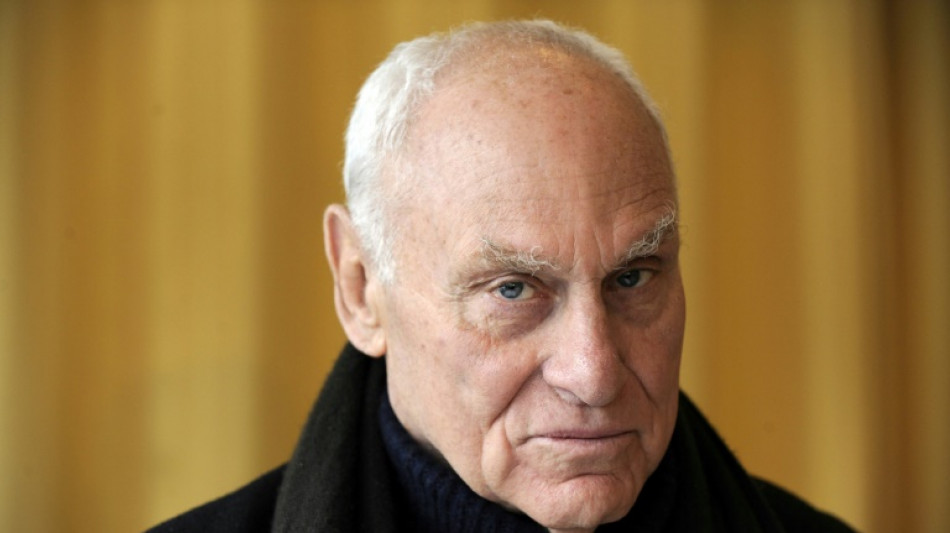
US sculptor Richard Serra, known for towering minimalism, dies at 85 / Photo: BERTRAND GUAY - AFP

 Oil prices retreat as markets welcome US-Iran talks

 US refusing to give Sudan's de facto leader visa for UN: diplomatic sources, UN

 Macron urges world to choose UN over 'law of the jungle'

 All-rounder Jacks stars as England beat Sri Lanka in 1st ODI

 Man City peg back Bayern to start Women's Champions League

 Trump beats 'America first' drum at UN as allies tread carefully

 Snedeker backs Spaun for Ryder Cup after Presidents snub

 French prosecutors probe secret filming of women with smart glasses

 Trump renames AI "super intelligence," rejects international oversight

 Trump rejects international regulation of AI

 How is the EU approaching record fuel prices?

 Sri Lanka's Colombage strikes on debut as England dismissed for 265 in first ODI

 Hurricane Polo strengthens to top category 5 off Mexico

 11 hurt as teen opens fire outside school in western Turkey

 UN chief says 'Big Oil' treats atmosphere as open sewer

 Tunisia says 2026 summer hottest on record

 England's Rashid out of Sri Lanka ODIs with hand injury

 Houthis accuse Saudi Arabia of deadly strikes as thousands flee

 Stocks climb as oil slides, AI buzz returns

 India cricketers win in style as Afghan savours 'special' Games silver

 La Liga president hits out at Real Madrid refereeing 'conspiracy' claims

 MEXC Launches “Real Stocks, Real Friends” with Rewards for Bringing Friends to Wall Street

 Mbappe continues media push for Ballon d'Or recognition

 Stocks rise on AI buzz, oil prices cool

 India narrowly survive huge scare against minnows Japan

Contemporary American artist Richard Serra, known for his massive yet minimalist steel sculptures, died Tuesday at age 85, US media reported.
His strikingly large pieces are installed all over the world, from Paris museums to the Qatari desert, and have sometimes sparked controversy over their imposing nature.
Serra died of pneumonia Tuesday at his home on Long Island, New York, his lawyer John Silberman told The New York Times.
Born in San Francisco in 1939 to a Spanish father and a mother of Russian Jewish origin, Serra studied English literature at the University of California before going on to study visual arts at Yale.
When asked in an early 2000s interview about what memory from his childhood might suggest who he would become, Serra said: "A little kid walking along the beach for a couple of miles, turning around, looking at his footprints and being amazed at what was on his right one direction, when he reversed himself was now on its left."
He says it "startled him and he never got over it."
His signature giant scale was present in the off-kilter reddish-brown rectangles installed in Paris's Grand Palais for his 2008 "Monumenta" exhibit, and in the swirling and twirling steel plates enveloping visitors in their curves seen in the Guggenheim Museum in Bilbao, Spain.
Serra, who credited influences from France, Spain and Japan on his artistic style and his evolution from painting to sculpting, moved to New York in the late 1960s, operating a furniture removal business to make ends meet. He even employed the composer Philip Glass as his assistant.
That was also the period in which Serra composed a manifesto detailing the ways he could create a work of art: he listed 84 verbs, such as "roll" and "cut," and 24 elements, including "gravity" and "nature," which he could employ to forge a composition.
Serra did not begin to work predominantly in steel until the 1970s, in an echo of the summer steel mill jobs of his youth.
He designed sculptures specifically for the spaces they were destined to occupy, and said he was interested in examining how his works interacted with their environments.
"Certain things... stick in your imagination, and you have a need to come to terms with them," Serra told US interviewer Charlie Rose in the early 2000s.
"And spatial differences: what's on your right, what's on your left, what it means to walk around a curve, looking at a convexity and then looking at a concavity -- just asking fundamental questions about what you don't understand, those things have always interested me," he said.
That exploration of sculpture in its environment is visible in one of Serra's most controversial works, titled "Tilted Arc," which was installed in New York in 1981.
The 12-foot (4-meter)-high rust-coated metal plate curved its way through the Federal Plaza in Manhattan for 120 feet, set at an angle that made it look like it could topple over at any second. The structure so disturbed local residents that it was removed in 1989 following a long legal battle.
O.Ortiz--AT