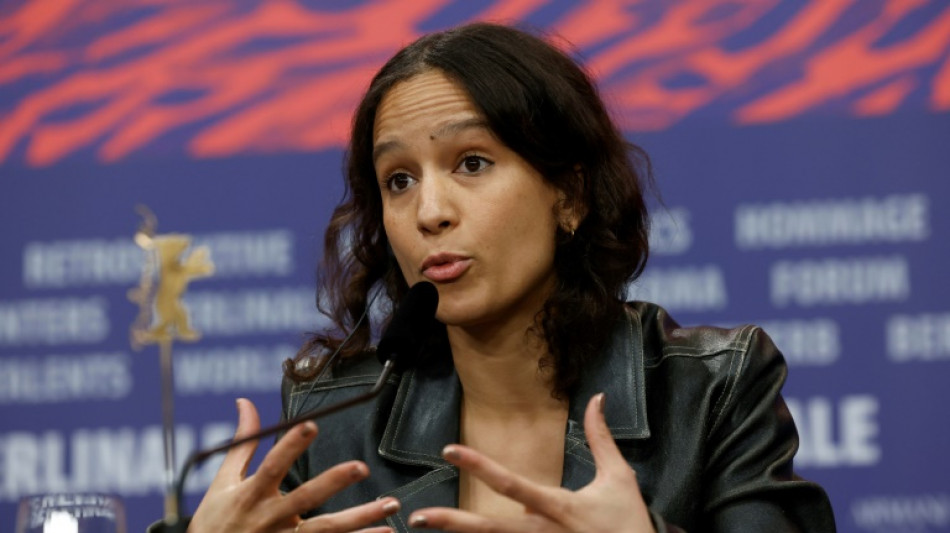
Restitution in focus as Africa takes Berlin fest spotlight / Photo: Odd ANDERSEN - AFP

 Voting opens in Alaska's annual Fat Bear Week

 MLS coach axed for telling female ref 'It's a man's game'
 US refuses to give Sudan's de facto leader visa for UN
 Man City hold Bayern to start Women's Champions League, Arsenal win late

 Trump threatens Iran with 'hell' but reveals fresh talks
 Trump signs security deal with Greenland, Denmark at UN
 Trump threatens Iran with 'hell' but unveils fresh talks

 Chile's Atacama Desert blossoms with life after El Nino rains

 Sri Lanka hands 220-year jail terms to 15 convicted of Easter bombings

 Typhoon Dujuan leaves 7 dead in Japan from landslides, flooding: media

 Ganna and Borghini lead Italy to mixed relay gold at cycling worlds

 Drug cocktail killed former child star Hayden Panettiere: coroner
 Moldova declares energy, water emergency
 French Holocaust denier jailed for eight months

 Oil prices slide, AI stock buzz fades

 Trump threatens to 'annihilate' Iran in bombastic UN speech

 Prada's skirts take centre stage as Milan Fashion Week begins
 Quoin Pharmaceuticals Announces FDA Fast Track Designation for QRX003 for the Treatment of Peeling Skin Syndrome
 Brazil's Flavio Bolsonaro turns scandal into poll gains
 Republican senator seeks probe of Trump Jr Russian-funded wedding

 Memoir by Diana's brother goes on sale after rocking UK monarchy
 Newcomers South Korea face holders Italy in Davis Cup finals

 Japan's Kojima sounds Marchand warning with Asian Games gold

 England rugby star Pollock signs new Northampton deal

 STARTRADER Expands Its Chinese Equity CFD Range with CXMT and Unitree Robotics

African cinema has seized the spotlight at this week's Berlin film festival, probing contemporary realities while demanding attention to historical crimes.
The 74th Berlinale, as the event is known, is the most politically minded of Europe's top cinema showcases and has rolled out the red carpet for a range of high profile -- and highly charged -- new releases from the continent.
Among the most prominent is "Dahomey" by French-Senegalese director Mati Diop, whose supernatural Netflix drama "Atlantics" made her the first black woman to compete in Cannes.
Her new taut, powerful documentary recounts the 2021 journey home of 26 precious artifacts of the Dahomey kingdom to Benin from a Paris museum.
In the film, Diop has one of the statues, that of King Ghezo, recount in a Fon-language voice-over his land being pillaged by the French, the circumstances of his own exile and his ultimate repatriation in Cotonou museum.
"It was particularly important that the statue speak in a language of Benin and not in French, the language of the coloniser," the director told AFP.
While acknowledging the return's importance, Diop said she had no intention of "celebrating" the decision by French President Emmanuel Macron, noting that only 26 were restituted "against the more than 7,000 works still held captive" in Paris.
"Dahomey" is one of 20 films vying for Berlin's Golden Bear top prize, to be awarded on Saturday by Kenyan-Mexican Oscar winner Lupita Nyong'o, the festival's first black jury president.
Variety hailed the film as "superb", calling it "a striking, stirring example of the poetry that can result when the dead and the dispossessed speak to and through the living".
- 'Contribution to healing' -
Screening out of competition in Berlin, documentary "The Empty Grave" traces the mission of Tanzanian activist John Mbano to secure the return of human remains of ancestors killed by the German colonial army.
Experts say between 200,000 and 300,000 members of the indigenous population were brutally murdered by German troops during the so-called Maji Maji Rebellion.
Told through the lens of intergenerational trauma, the film describes the early 20th century racist "research" carried out on the remains of victims whose memory remains alive in their communities.
And it profiles a contemporary movement in Berlin fighting to expand Germany's vaunted culture of historical atonement beyond the Nazi period to encompass colonial-era crimes in Africa.
Directors Agnes Lisa Wegner of Germany and Tanzania's Cece Mlay said at the festival they hoped the film would serve as a "contribution to healing".
- An inflatable screen -
Mauritian-born filmmaker Abderrahmane Sissako, whose Oscar-nominated 2014 drama Timbuktu dazzled critics, joined the race in Berlin with "Black Tea", an eye-opening account of African immigrants living in China.
The love story between a young Ivorian woman and a Guangzhou tea merchant sees them having to surmount not only cultural differences but also language barriers, in a film shot in Mandarin, French, English and Portuguese.
"When Africans leave for China they learn Chinese and when Chinese people do business in Africa, they learn Wolof or Swahili," Sissako told AFP.
"Black Tea" is Sissako's first feature in a decade. In Berlin, he explained some of the challenges faced by African auteurs.
"There is no real cinema industry (at home) so we don't have the technical crews we need," Sissako told AFP.
A spotty film distribution network also poses a challenge.
"The majority of (African) countries don't have many movie theatres anymore. They were torn down to build shopping malls," Diop told AFP.
"The existing cinemas are too expensive so only a tiny elite minority can have access."
Senegalese filmmaker Mamadou Dia, whose well-received drama "Demba" explores the often taboo subject of mental illness, said he has often had to get creative to ensure his movies find their audiences.
He said he has travelled through his country "with a three-metre (10-foot) inflatable screen" to show his work in "villages, followed by debates".
International festivals can help connect African films with cinema-goers, the directors said, though there is still much work to be done.
Only one African film has won the Golden Bear in the Berlinale's 74-year history, South Africa's "Carmen In Khayelitsha" by Mark Dornford-May in 2005.
E.Flores--AT