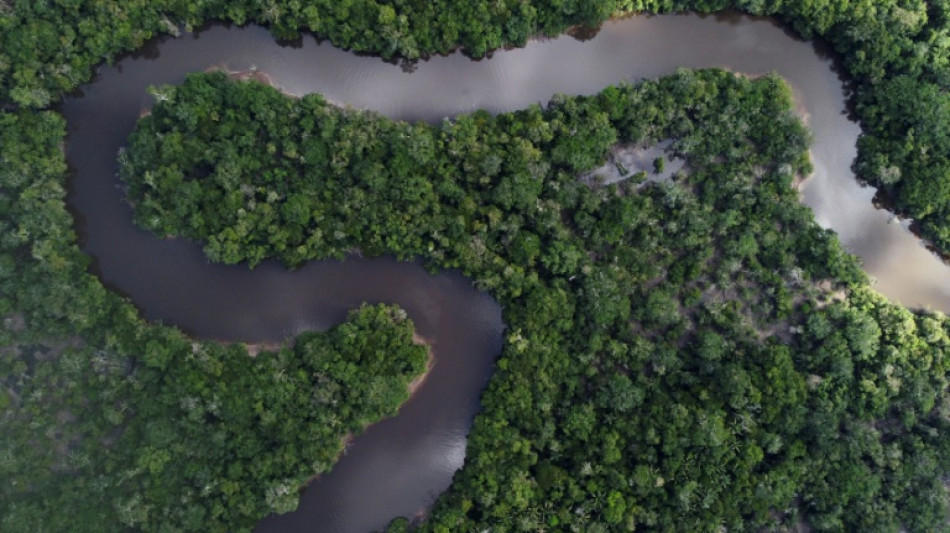
Vast network of lost ancient cities discovered in the Amazon / Photo: Pedro PARDO - AFP/File

 Italy hope for new dawn under Mancini

 Mongolian herders enlist new tech against harsher, drier climate

 Tata turmoil shines light on India succession woes

 World Cup 'not enough' as Spain begin next chapter

 Meta acts against 3.7 mn scammers' accounts with Singapore police help

 Australia PM says draft social media rules about taking back control

 Is Pet Insurance Worth the Monthly Cost?

 US-led Americas coalition backs sanctions against crime groups

 'Star Wars' fans and art lovers line up for new Lucas museum

 Trump renames AI 'super intelligence' as leaders jostle over dangers

 Oil prices retreat as markets welcome US-Iran talks

 US refusing to give Sudan's de facto leader visa for UN: diplomatic sources, UN

 Macron urges world to choose UN over 'law of the jungle'

 All-rounder Jacks stars as England beat Sri Lanka in 1st ODI

 Man City peg back Bayern to start Women's Champions League
 Trump beats 'America first' drum at UN as allies tread carefully

 Snedeker backs Spaun for Ryder Cup after Presidents snub

 French prosecutors probe secret filming of women with smart glasses

 Trump renames AI "super intelligence," rejects international oversight

 Trump rejects international regulation of AI

 How is the EU approaching record fuel prices?

 Sri Lanka's Colombage strikes on debut as England dismissed for 265 in first ODI

 Hurricane Polo strengthens to top category 5 off Mexico

 11 hurt as teen opens fire outside school in western Turkey

 UN chief says 'Big Oil' treats atmosphere as open sewer

Archaeologists have discovered the largest and oldest network of pre-Hispanic cities ever found in the Amazon rainforest, revealing a 2,500-year-old lost civilisation of farmers.
The vast site, which covers more than 1,000 square kilometres (385 square miles), was long hidden by the jungle in the Upano valley on the foothills of the Andes mountain range in eastern Ecuador.
However, a French-led team of researchers have used laser-mapping technology taken from above, as well as archaeological excavations, to uncover 20 settlements -- including five large cities -- connected by roads.
Stephen Rostain, an archaeologist at France's CNRS research centre and the lead author of a new study, told AFP it was like discovering "El Dorado".
The scale of this urban development -- which includes earthen homes, ceremonial buildings and agricultural draining -- has never been seen before in the Amazon, Rostain said.
"It is not just a village, but an entire landscape that has been domesticated," he said.
Rostain said he detected the first traces of this lost civilisation 25 years ago, when he spotted hundreds of mounds in the area.
In 2015, his team of researchers flew over the region using laser technology called Lidar, which allowed the scientists to peer through the forest canopy as "if we had cut down all the trees," Rostain said.
- 'Like New York' -
They found more than 6,000 earthen mounds, rectangular earthen platforms which served as the base of homes for the "Upano people".
On the floors, the researchers found "all the domestic remains one would see in a home -- fireplaces, large ceramic jars for beer made out of corn, grinding stones, seeds, tools," Rostain said.
Remarkably, the cities are all criss-crossed by large, straight streets -- "just like in New York," he added.
Some cities have a large central alley where people from the surrounding villages gathered, Rostain said, comparing these streets to those of the ancient Teotihuacan city in modern-day Mexico.
Rostain speculated that several thousand people could have attended such ceremonial events, though further analysis is being carried out to estimate how many people lived in the region.
Some of the mounds are up to 10 metres (33 feet) tall, suggesting they were not homes but communal areas for rituals or festivals.
The small fields show that the agrarian society "took advantage of the smallest empty space to ensure it bore fruit," Rostain said.
All these accomplishments would have needed leaders, planning, engineers to plan the roads, he suggested.
What happened to the previously unknown Upano people -- so named by the researchers -- is not known.
Construction on the first mounds is thought to have begun between 500 BC and 300-600 AD, around the time of the Roman empire.
Other large villages discovered in the Amazon date from between 500-1,500 AD, according to the study published in the journal Science on Thursday.
But this network of cities is "much older and much bigger," Rostain said.
The discovery shows that "there were not only hunter-gatherers in the Amazon, but also complex, urban populations," he added.
Rostain said that "a certain Western arrogance" had long deemed it impossible that -- prior to European colonisation -- people in the Amazon were capable of building such a complex society.
"It's time to reconsider this disparaging view of the people of the Amazon."
H.Thompson--AT