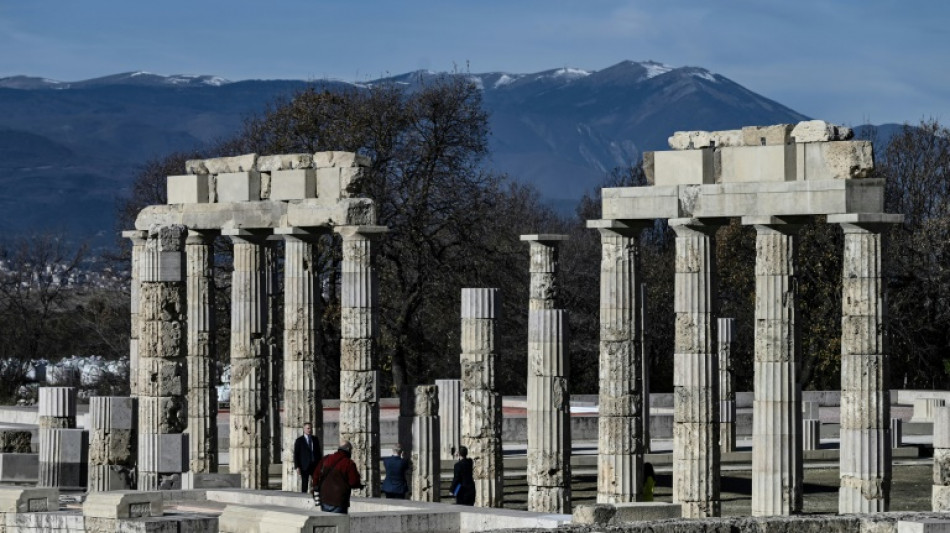
Greece revives 2,300 year-old palace where Alexander The Great was crowned / Photo: Sakis MITROLIDIS - AFP

 Black Sea drone attacks spell terror for Turkish sailors

 Canada judge to decide prison term for suicide poison seller

 Weinstein faces resentencing in New York for 2006 sex assault

 Outgoing UN chief makes climate push at New York summit
 AI risks, Iran war to take center stage at UN

 Badminton no.1 An tells dad to keep it down at Asian Games
 Runaway leader Antonelli eyeing third straight win

 Schoolgirl Yu, 13, fastest again in bid for third Asian Games gold
 Oil prices fall after Trump hails 'good' talks with Iran

 AI political ads warp reality ahead of US midterms

 Kenneth Branagh embraces action hero role -- to get in shape

 'New one' Klopp promises fresh approach as Germany reign begins
 Milne returns to New Zealand squad for India T20 series
 Warpaint London PLC Announces Interim Results
 InterContinental Hotels Group PLC Announces Transaction in Own Shares - September 23

 Is Pet Insurance Worth the Monthly Cost?

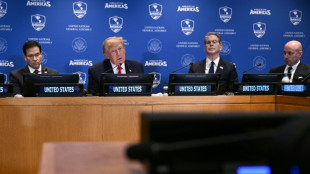 US-led Americas coalition backs sanctions against crime groups

 'Star Wars' fans and art lovers line up for new Lucas museum
 Trump renames AI 'super intelligence' as leaders jostle over dangers

 Oil prices retreat as markets welcome US-Iran talks

 US refusing to give Sudan's de facto leader visa for UN: diplomatic sources, UN
 Macron urges world to choose UN over 'law of the jungle'

 All-rounder Jacks stars as England beat Sri Lanka in 1st ODI
 Man City peg back Bayern to start Women's Champions League
 Trump beats 'America first' drum at UN as allies tread carefully

An ancient palace where Alexander The Great was crowned King of Macedonia will reopen to the public on Sunday after a 16-year 20 million euro renovation aiming to restore its past glory.
At a ceremony on Friday, Greek Prime Minister Kyriakos Mitsotakis called the Palace of Aigai a "monument of global importance."
The 4th century BC site spreads over 15,000 square meters was one of the most important in classical Greece alongside the Parthenon in Athens.
Aigai was capital of the Macedonian kingdom, the dominant military power of the time, and archeologists say the palace was the kingdom's spiritual centre.
Built by Philip II, the father of Alexander the Great, the tombs of Philip and other Macedonian kings are nearby.
After the assassination of his father, Alexander was crowned at the palace in 336 BC before launching a military campaign that created an empire stretching into modern-day India.
The palace "has a cultural and national character, because it confirms the Greek identity of Macedonia throughout the centuries," Mitsotakis said.
The site includes the royal palace and a colonnade that surrounded the palace and the agora, where ancient Macedonians debated important matters.
It was in the courtyard, with an 8,000 capacity, that Alexander was proclaimed king.
The Romans destroyed the palace in 148 BC. Excavations to uncover the site started in 1865 and continued into the 20th century.
The restoration project began in 2007 with help from the European Union.
Situated near the modern day Greek village of Vergina, the palace and the nearby tombs are listed as a World Heritage Site by UNESCO.
Greece has boosted investment in its many antique sites which have become an important source of tourist revenue.
For the past three decades, it has been demanding the return of sculptures taken from the Parthenon that are in the British Museum, saying they were looted in the 19th century when Greece was under Ottoman rule.
W.Morales--AT