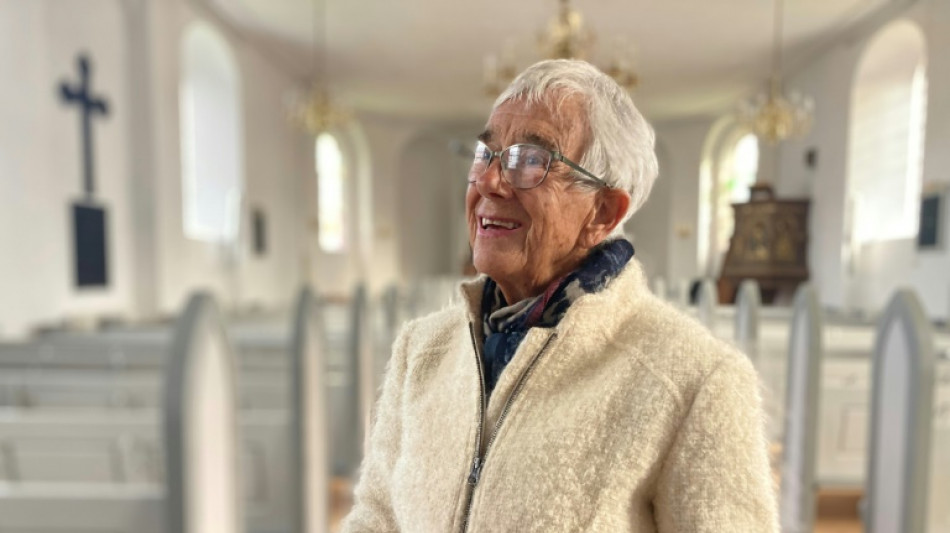
80 years on, Danish Jewish girl recalls life in hiding / Photo: Camille BAS-WOHLERT - AFP

 Blueberry Strengthens MENA Presence with CMA Category 5 License and Dubai Office Launch

 Russia probes bear attacks, as official says town under 'siege'

 Robertson tells Spurs to 'forget' past woes
 Italy police find 3 million euros stashed in mobster's house

 Renard versus Queiroz in AFCON qualifying blockbuster
 Former Mexico boss Aguirre returns to Spain with Valencia
 China swimmer, 13, seals Games hat-trick as North Korea win first gold

 China's Xi heads to US for talks with Trump: state media

 Azerbaijan pardons Frenchman after EU lifts sanctions on oligarchs
 Hadjar extends Red Bull contract for 2027 F1 season
 Black Sea drone attacks spell terror for Turkish sailors

 Canada judge to decide prison term for suicide poison seller

 Weinstein faces resentencing in New York for 2006 sex assault

 Outgoing UN chief makes climate push at New York summit
 AI risks, Iran war to take center stage at UN

 Badminton no.1 An tells dad to keep it down at Asian Games
 Runaway leader Antonelli eyeing third straight win

 Schoolgirl Yu, 13, fastest again in bid for third Asian Games gold
 Oil prices fall after Trump hails 'good' talks with Iran

 AI political ads warp reality ahead of US midterms

 Kenneth Branagh embraces action hero role -- to get in shape

 'New one' Klopp promises fresh approach as Germany reign begins

 Milne returns to New Zealand squad for India T20 series

 Abasca Announces Filing of Technical Report Regarding Positive Preliminary Economic Assessment for the Loki Flake Graphite Deposit and Private Placement of $2.25 Million

 Green Bridge Metals Corporation Announces Phase 2 Diamond Drill Program at the Titac Titanium-Copper-Vanadium Project, Minnesota, USA

In October 1943 Tove Udsholt, who had just turned three, had fled Copenhagen with her mother to escape the Gestapo. She ended up alone, but a small fishing village took her in.
Around 95 percent of Denmark's 7,000 Jews escaped deportation, either by fleeing to neighbouring neutral Sweden by boat or, for around 150 children like Udsholt, by hiding in Denmark.
Many children were reunited with their loved ones after the country was liberated at the end of World War II.
Udsholt however, chose to stay in Gilleleje, the small village north of Copenhagen that adopted her. And years later, she would return there to retire.
Occupied by Nazi Germany in April 1940, Denmark chose to collaborate with the Nazis and maintained its own institutions until the end of the summer of 1943.
Danish Jews, who did not have to wear the yellow star Jews were forced to wear by the Nazis, were not at first worried.
But everything changed at the end of September 1943, when Berlin ordered a raid on the country's Jewish community.
The information was leaked and Denmark's Jews knew they had to act.
"My mother told me she had received a message on September 30 that she would have to flee with me," Udsholt told AFP in Gilleleje.
"Since my father was Christian he didn't have to come."
It was the first of several separations, and one which was never mended.
- Gestapo raid -
Carrying just one bag, Udsholt and her mother met up with most of her mother's side of the family at Copenhagen's train station.
Together they took the train to Gilleleje, a village facing the Swedish coast, where they were hidden away in a hay barn while waiting to make the crossing to Sweden.
But Udsholt's mother was concerned that her daughter's incessant chatter would get them caught.
A local fisherman, Svend Andreasen, took a liking to the talkative little girl.
From time to time, he offered to take her home to his wife for a few hours so she could play freely and escape the confined, chilly space.
He and his wife Ketty later offered to let the little girl stay with them so her mother, Paula Mortensen, could find a place for them to live in Sweden.
The Gestapo found and arrested 86 Jews stowed away in a Gilleleje church barn, which had until then turned a blind eye to the influx of refugees in the village.
Fearing an imminent raid, Mortensen had to act quickly.
"She told herself: 'This is what is best for my daughter'," Udsholt told AFP.
"I started to cry, I still remember," recalled the vivacious 83-year-old.
"At this moment I'm totally alone. I don't really know these people."
But Andreasen and his wife, both in their 40s and with no children, quickly gained the little girl's confidence.
From their modest home, they could see the Swedish coast.
They "told me: 'You see those lights over there, that's your mother'", said Udsholt.
"Holding my cuddly toy, I looked, and ... throughout the rest of the war, in the evenings I would stand on a chair in the window and tell my mother what I did that day."
- 'Good friends' -
The weeks passed and Udsholt blossomed, protected by the villagers.
Andreasen "went around to most homes to tell them they had taken in a little fair-haired girl. That was my saving grace, because no one knew I was Jewish."
As soon as soldiers approached when she was playing outdoors, villagers would call her to come inside.
"I was afraid (of the Germans), because Svend had warned me that I was never to talk to the men dressed in green or those with long black coats because those were the people who were going after my mother," she recalled.
When Denmark was liberated in May 1945, Udsholt's mother, who had had no contact with her daughter for almost two years, returned.
She came to collect her child on August 24 -- her fifth birthday.
But back in Copenhagen, Udsholt missed the sea air and village life.
The time apart took its toll on her parents, who never reunited. Udsholt ended up living with her mother, and the two fought a lot.
Finally, when she was seven, her mother agreed to let her go live in Gilleleje with Svend and Ketty Andreasen, who formally adopted her at age 18.
"My mother and I were good friends for most of her life, but we were not mother and daughter," she said with a heavy sigh.
A.Williams--AT