
Putting the K in hip-hop: South Korea's Jay Park / Photo: Anthony WALLACE - AFP

 Iranian satire 'Head to Head' draws a veil over the men

 Archaeological 'breakthrough' could confirm origins of Paris

 Morocco elects new parliament with lowest turnout in nearly two decades

 North Korean IT contractor found remote work in New Zealand: agency

 Anthropic touts AI-led biology discovery

 Giants QB Dart to have season-ending surgery

 Venezuelan shot by ICE needs urgent surgery, mother tells AFP

 Giants QB Dart to have season-ending surgery: reports

 Judge urged to lift Trump's White House ban on media outlets

 Stocks fall on soaring bond yields, higher oil prices

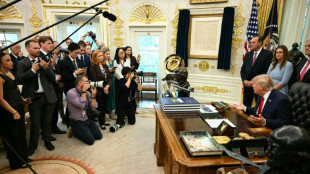 US judge weighing Trump's White House ban on media outlets

 At UN, OpenAI's Altman calls 'for extreme care' in AI
 Hamilton gives thumbs up to Gulf GPs despite Iran conflict

 Leclerc admits going 'too far' in Hamilton shunt in Italy
 Row engulfs Dolly Parton's estate as manager accuses nephew of making threats

 Mandela Digital Extends Early Access Programme to 11 February 2027 Following Strong Response

 US seeks 11th Presidents Cup win in a row over global foes

 McDonald's to boost franchisees as inflation weighs on consumers

 Trump invites Putin to G20 summit in Miami

 Archaelogical 'breakthrough' could confirm origins of Paris

 ILO financial crisis takes centre stage in leadership race
 Stocks dip, oil soars despite Trump hailing "productive" Iran talks

 China's Xi to get rare airport welcome from Trump
 Turkey reassures investors over investment fund crisis
 Saka says England still have 'scar' from World Cup semi-final loss
K-pop idol. Used tyre salesman. Hip-hop mogul. The course of true success has never run smoothly, but Korean-American entertainer Jay Park has had an unusually bumpy ride to stardom.
The 36-year-old is now one of South Korea's most recognisable entertainers: he's founded two of the country's largest hip-hop labels, released a string of hits, has his own soju liquor brand and was the first Asian-American to sign with Jay-Z's Roc Nation.
But this success was hard fought, he told AFP in an exclusive interview, with his first shot at fame -- debuting as the leader of a K-pop band -- imploding in a scandal that led him to flee Seoul for his native Seattle.
"I faced a lot of backlash," Park told AFP, adding he was once "kind of blacklisted from the industry".
The problem started with a few throwaway comments posted online by Park -- then in his late teens -- criticising the intense idol training regime, the K-pop industry and South Korea itself.
A Korean media frenzy ensued, with the fallout forcing Park to quit 2PM, a seven-member boy band under major label JYP Entertainment.
He moved back to Seattle and worked at a used tyre shop, but he kept his musical dreams alive, eventually posting a cover of "Nothin' on You" -- a B.O.B and Bruno Mars song -- on his YouTube channel.
"I just wanted to show my fans that I'm doing well, and also I wanted to show people what type of music I'm into, what type of artist I am. So I just put up a cover and it just kind of blew up," he said.
Racking up more than two million views in a day, the song catapulted him back into the music industry and marked "a new start" for Park.
It also allowed him to recalibrate his musical style and shift from pop to rap -- a move that would eventually help transform South Korea's nascent hip-hop scene.
It was not a calculated decision or grand plan, he said, but an attempt to move past restrictive labels.
"If I say I'm a rapper, then I can only rap. But I like to rap, I like to dance, I like to sing," he said, adding that he would be "always grateful to the hip-hop culture" for helping him relaunch his career.
- Struggle for survival -
Park's story is unusual: it is rare for a K-pop failure to go on to have a successful musical career after leaving one of the big agencies around which the industry is structured.
"It didn't happen overnight. Obviously it took a lot of work," Park told AFP of his musical comeback.
Hundreds of thousands of aspiring K-pop stars go through the gruelling idol training system, notorious for high stress and long hours, analysts say.
Only 60 percent of trainees make it to "debut", industry figures show, and almost all of those that do are signed to big agencies like BTS's HYBE, or its major rival SM Entertainment.
Without that backing, "the chances for survival are really low", said music critic Kim Do-heon.
"There are so many groups that disband," he said.
After Park quit 2PM, he was left to navigate the industry on his own, and has spoken of his struggles with, for example, finding musicians willing to be featured on his first solo album.
But even when the industry odds are stacked against you, Park said, it is still possible to succeed with the right mindset.
"There is a limit to what agencies can do for you, and it seems that grit and determination are what can fill in," he said.
- Change the industry -
Now Park is trying to change the industry -- or his small segment of it -- for the better.
He has already founded two of South Korea's most prominent hip-hop labels. And now his career has come full circle with his establishment of a third label aimed at producing a boy band.
But he's doing it his way: rather than the exacting training and obsessive levels of control pioneered by the major agencies, Park says he believes real relationships and "freestyling together" are the key to success.
His new trainees will have Park as a mentor -- something he says he longed for when he started in the industry at 18.
"I'm not bitter over anything. I don't hate anybody. I don't dislike anybody. I don't have time for that. I don't have time for thinking about stuff in the past," he said.
"I can't change the past, so what I can change is the future, so that's what I work on."
L.Adams--AT