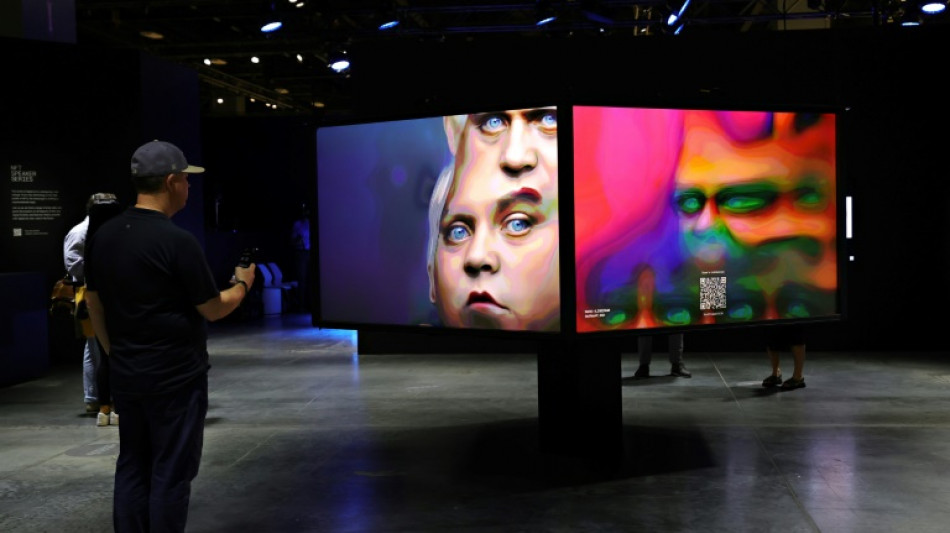
Clickbait or creativity? The art world wrestles with AI / Photo: Cindy Ord - GETTY IMAGES NORTH AMERICA/AFP/File

 Black Sea drone attacks spell terror for Turkish sailors
 Canada judge to decide prison term for suicide poison seller

 Weinstein faces resentencing in New York for 2006 sex assault
 Outgoing UN chief makes climate push at New York summit
 AI risks, Iran war to take center stage at UN
 Badminton no.1 An tells dad to keep it down at Asian Games
 Runaway leader Antonelli eyeing third straight win
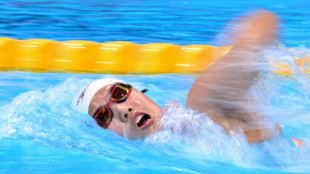 Schoolgirl Yu, 13, fastest again in bid for third Asian Games gold

 Oil prices fall after Trump hails 'good' talks with Iran

 AI political ads warp reality ahead of US midterms
 Kenneth Branagh embraces action hero role -- to get in shape
 'New one' Klopp promises fresh approach as Germany reign begins
 Milne returns to New Zealand squad for India T20 series
 Warpaint London PLC Announces Interim Results
 InterContinental Hotels Group PLC Announces Transaction in Own Shares - September 23

 Is Pet Insurance Worth the Monthly Cost?
 US-led Americas coalition backs sanctions against crime groups
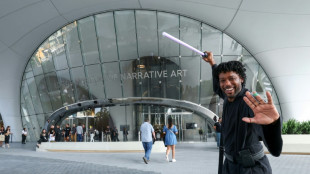 'Star Wars' fans and art lovers line up for new Lucas museum
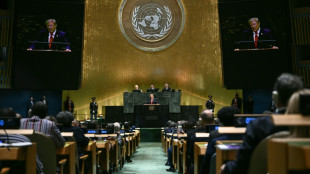 Trump renames AI 'super intelligence' as leaders jostle over dangers
 Oil prices retreat as markets welcome US-Iran talks
 US refusing to give Sudan's de facto leader visa for UN: diplomatic sources, UN
 Macron urges world to choose UN over 'law of the jungle'
 All-rounder Jacks stars as England beat Sri Lanka in 1st ODI
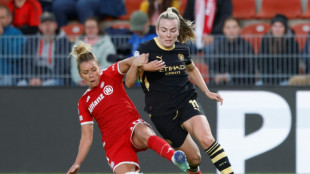 Man City peg back Bayern to start Women's Champions League

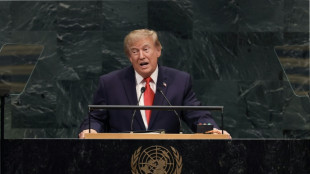 Trump beats 'America first' drum at UN as allies tread carefully

Online tools that can create wonderful, absurd and sometimes horrifying images using artificial intelligence (AI) have exploded in popularity, sparking soul-searching over the nature of art.
Tech companies tout their inventions as a liberating force of art for all, but purists argue that the artist is still the central cog in the machine.
Art historian and AI expert Emily L. Spratt, whose forthcoming book tackles the ethics and regulation of AI art, told AFP that the art world has not yet found a response to the potentially transformative technology.
Are we all artists now?
Punch a few keywords into an AI art tool -- something like "Brad Pitt in a rowing boat in space in the style of Mondrian" -- and seconds later boldly coloured line drawings will emerge of the Hollywood star, paddling in the stars.
There are plenty of fans of tools like Midjourney, Stable Diffusion and DALL-E 2 who have proclaimed this as the democratisation of art.
But Spratt reckons such tools are more about "entertainment and clickbait" than art.
"It is a way to foster engagement with platforms, which is of course going to help these companies," she said.
"The idea that it is solely a tool of empowerment or that it will democratise the space is overly simplistic -- it's naive."
Rather, she sees the boundary between AI and other technology becoming blurred, pointing to the image manipulation programs already widely used.
"I see the future of AI as being part of the omnipresent background architecture for all digital image-making processes," she said.
"It will be hard to avoid it because it seeps into all of our digital interactions, often unbeknownst to us, especially when we create, edit, or search images."
Are there AI masterpieces?
Beyond the simple online tools that anyone can use, there are plenty of artists labouring over their own algorithms with bespoke datasets.
These works sell for tens of thousands, sometimes hundreds of thousands.
A standout practitioner, said Spratt, is German artist Mario Klingemann whose "Hyperdimensional Attraction Series, Bestiary" is a high point of the genre.
"It is a video of seemingly organic forms that morph from one physical entity to another and momentarily appear as recognisable animals," she said.
"Honestly, it's a bit unnerving but it works well as a commentary on the dividing lines between the material and immaterial and the limits of generative AI to replicate the natural world."
She said his art is constantly asking questions about AI as a medium, and more widely about the nature of creativity.
What does art world make of AI?
Until relatively recently, there was very little buzz around AI outside of video installations, largely because there was no bank of digital images with clear labels.
Without the source material, there could be no AI art as we know it today.
That changed a decade ago when several projects began to supply huge quantities of digital images, sparking an explosion in creativity.
A French collective called Obvious sold a work for more than $400,000 in 2018 after keenly embracing the idea that the AI "created" the work.
That sale became hugely controversial after it emerged that they had used an algorithm written by artist and programmer Robbie Barrat.
"The reason that the Obvious artwork sold, especially at that price, was largely because it was advertised as the first AI artwork to be offered at a major auction house," said Spratt.
"It was really the art market experimenting with the offering of an AI artwork in step with long-established approaches to the sale of fine art."
At that moment, she said, there was huge interest in bringing together the tech sector and the art world.
But the tech industry has since been hit by a dramatic economic slump and investment and interest have waned.
Major auction houses like Christie's and Sotheby's have since worked hard to create separate platforms for selling AI art.
"It's like they don't want to sully fine art with these new digital explorations," Spratt said.
And critics are yet to catch up with the field and really express what is good, bad or indifferent, she reckoned.
"Unfortunately, the AI art discourse is not there yet, but I think it is on its way, and it should come from the field of art history," she insisted.
P.Smith--AT