Little-known bullfighting tradition lives on in UAE village

 Martin wins Austrian MotoGP sprint after Acosta crash

 Japan edge Fiji to win Pacific Nations Cup

 Black smoke, flames rising near Riyadh airport: residents to AFP
 UK actor Naomi Watts honoured at Spain film festival
 Japan emperor declares Asian Games open after turbulent build-up
 Asian Games open with unity message after troubled build-up
 Denmark hails 'binding' Greenland deal with Trump

 We don't want Games host Japan losing money, says Asian Olympic official

 Ed Sheeran returns to stage after Palestinian controversy

 Asian Games to open in Japan after troubled build-up
 Drone owners rush to offload devices ahead of Beijing ban

 Trump's beef policies irk Texas ranchers, testing their loyalty

 Kennedy Center: future unclear for iconic Washington arts hub

 Trump claims 'infinite' Greenland security deal with Denmark

 Helicopters battle wildfire threatening Ecuador's capital

 Brentford batter Chelsea to undo Alonso's promising start

 Kane hits Bundesliga century as Bayern rout Union

 Trump says CNN, MS NOW, Politico banned from White House
 Hushing and hedging: US companies retreat on climate

 Springboks to face Fiji before 2027 Rugby World Cup

 Nigeria miners struggled to breathe in cell before 37 died: survivors

 McIlroy on the charge at PGA Championship as Reed withdraws

 McIlroy on the charge at PGA Championship

 Crisis-wracked Volkswagen warns of 10-bn-euro hit to profits

 Costa Rica's Grynspan tops third informal poll for UN chief: diplomat

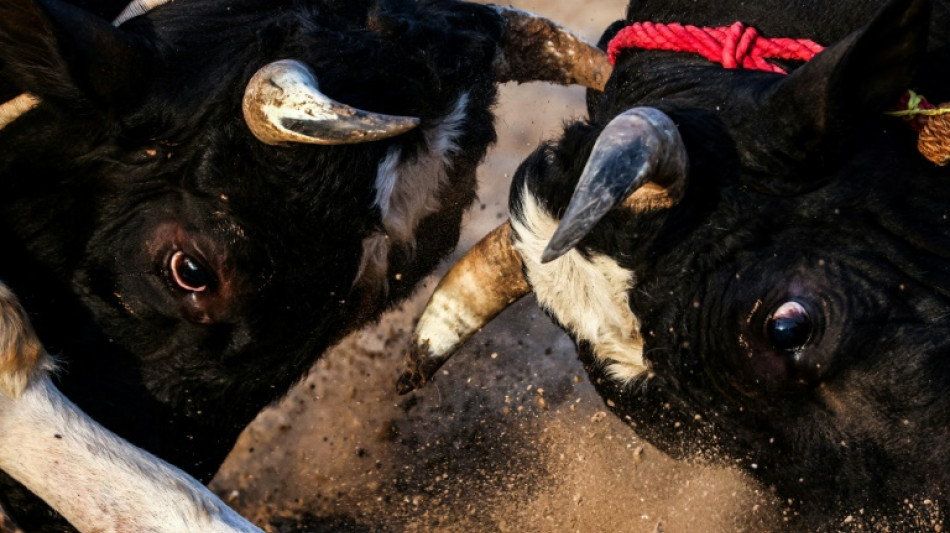
Far from Dubai's gleaming skyscrapers and renowned camel races, a bullfight is under way in the emirate of Fujairah, where the tradition continues unbeknown to most in the United Arab Emirates.
"Look at them fight!" a commentator shouts into a microphone as the first bovine battle of the day kicks off, sending up clouds of dust in the village of Al-Qurayyah.
Two bulls, each weighing in at hundreds of kilograms (pounds), charge at each other while assistants hold ropes attached to their necks or legs for safety.
Sometimes the huge animals come dangerously close to the spectators, sending them fleeing from their chairs.
About 200 men, women and children are gathered in a large field to watch, with children perched on the roofs of 4X4 vehicles and pick-ups.
Trucks carrying bulls have converged from all over the region on the arena, a dirt field wedged between rocky mountains and the Gulf of Oman.
About 50 of the beasts are scattered around, and their bellowing echoes across the area.
"There are no rules," explained Issa, 34, whose family owns a nearby farm and has been involved in bullfighting for decades.
"The winner is the one that shows the most courage and doesn't run away," added the man whose nephews stream the bouts on TikTok and Instagram.
In the better-known emirates of Abu Dhabi and Dubai, camel beauty contests and races are popular, but "here it is the bullfights", said Majid, 36, whose animal scored a draw in the fight.
- Cruel and abusive? -
Unlike the bullfights popular in Spain and Mexico, where the animals are typically slain by matadors, in Fujairah two beasts go head-to-head with far less fatal consequences.
The competition typically ends after about an hour, with each fight lasting just one or two minutes.
Animal welfare groups have however denounced the sport as cruel and abusive.
Elsayed Mohamed, the regional director of the International Fund for Animal Welfare, argued that just because something has been part of a society for so long does not make it right.
"Every culture has many bad traditions, but because it's a tradition, we have to follow?" he asked, noting that animal fights are prohibited under UAE law.
Those who promote the fights, he said, argue that "it is 'not a bloody' competition... comparing these fights to the ones in Spain that end with the killing of the animal.
"Even if they are taking precautions to prevent any harm, wounds will happen," said Mohamed.
Standing in the audience at the recent bullfight event was a German tourist couple who had learnt about it in an "alternative tourist guide book".
"We thought it would be interesting to see that -- it's unusual for us," said Gunter Beelitz, who works in theatre.
"This is a bit like the fights in Spain except that here it is just one bull against one bull and not a man," he said. "And the bull doesn't die. We don't like the Spanish bullfights."
- Family tradition -
The bulls were once imported from South Asia for agricultural work, but the emergence of new technologies has rendered them obsolete to farming.
Issa's family breed the animals or buy them for between 5,000 and 40,000 dirhams (about $1,360 to $10,900).
With help from a number of farm employees he readied about 17 beasts to fight every Friday after prayers.
He said he has been preparing bulls for battle since he was "just a child".
"We go to the animals, we check if they are okay... we take their temperatures and we feed them," he said.
He rolled up his sleeves and dipped his arm into a large pot of bovine powerfood -- a boiled mixture of wheat, dates, herbs and fish.
"This is what gives the bulls their strength," said Issa, clad in a traditional Emirati "kandoura", an ankle-length shirt.
Issa and his family said they have no intention of ending the pastime that has been passed down from generation to generation.
"People did not have much to do, and they would get the animals and get them to fight, a form of entertainment," said Issa.
"It would bring people together," he continued, adding that he plans to pass the practice down to his six children.
A.Anderson--AT