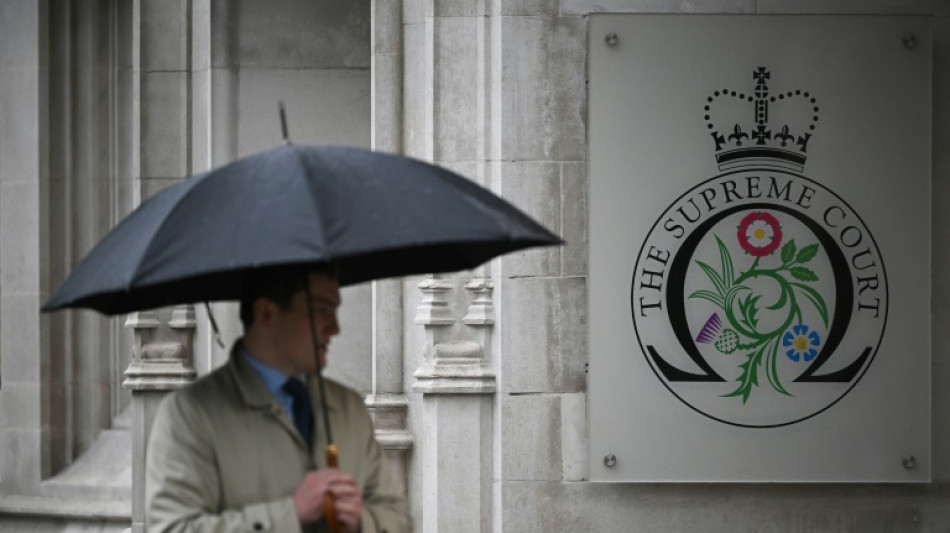
UK top court rejects Scottish independence vote plans / Photo: JUSTIN TALLIS - AFP

 Bishop Museum Races to Save Rare Megamouth Shark Specimen

 Zach Hickerson Recounts Hayden Panettiere's Final Moments in New Interview

 Luxembourg Housing Petition Passes Threshold for Parliamentary Consideration

 Raheem Sterling Receives Suspended Sentence After Lamborghini Crash

 Audience to Choose the Set List at Luxembourg's First FAMIL Jukebox Night

 Luxembourg Pay Rise Delayed as Regional and World Headlines Develop

 Chennai Urbanist Sashna Develops 'Anniki' Card Game to Gamify Tamil Nadu History

 Transport Minister Defends Land Seizure Powers for Toronto-Quebec City High-Speed Rail

Britain's highest court on Wednesday rejected a bid by the devolved Scottish government in Edinburgh to hold a new referendum on independence without London's consent.
The unanimous ruling by the Supreme Court torpedoed the Scottish nationalist government's push to hold a second plebiscite next year.
The Scottish National Party (SNP) had said that in that event, it would turn the next general election into a de-facto vote on splitting from the rest of the United Kingdom, threatening constitutional chaos.
First Minister and SNP leader Nicola Sturgeon said she respected the ruling but was "disappointed".
If Scotland cannot "choose our own future without Westminster consent", the idea of the UK as a voluntary partnership was exposed as a "myth", she tweeted.
The Supreme Court's Scottish president, Robert Reed, said the power to call a referendum was "reserved" to the UK parliament under Scotland's devolution settlement.
Therefore "the Scottish parliament does not have the power to legislate for a referendum on Scottish independence", Reed said.
Sturgeon's SNP-led government in Edinburgh wanted to hold a vote in October next year on the question: "Should Scotland be an independent country?"
The UK government, which oversees constitutional affairs for the whole country, has repeatedly refused to give Edinburgh the power to hold a referendum.
It considers that the last one -- in 2014, when 55 percent of Scots rejected independence -- settled the question for a generation.
But Sturgeon and her party say there is now an "indisputable mandate" for another independence referendum, particularly in light of the UK's departure from the European Union.
Most voters in Scotland opposed Brexit.
- Scotland not Kosovo -
Scotland's last parliamentary election returned a majority of pro-independence lawmakers for the first time.
At a hearing in the UK Supreme Court last month, lawyers for the government in London argued that the Scottish government could not decide to hold a referendum on its own.
Permission had to be granted because the constitutional make-up of the four nations of the United Kingdom was a reserved matter for the government in London.
Lawyers for the Scottish government wanted a ruling on the rights of the devolved parliament in Edinburgh if London continued to block an independence referendum.
Lord Advocate Dorothy Bain, Scotland's top law officer, said Scottish independence was a "live and significant" issue in Scottish politics.
The Scottish government was seeking to create its own legal framework for another referendum, arguing that the "right to self-determination is a fundamental and inalienable right".
But the Supreme Court rejected international comparisons raised by the SNP, which had likened Scotland to Quebec or Kosovo.
Reed said that international law on self-determination only applied to former colonies, or where a people is oppressed by military occupation, or when a defined group is denied its political and civil rights.
None of that applied to Scotland, the Supreme Court president said.
He also rejected the SNP's argument that a referendum would only be "advisory" and not legally binding.
Any such vote would carry practical political consequences regardless of its legal status, the judge said.
Without the court's approval, Sturgeon had promised to make the next UK general election, which is due by January 2025 at the latest, a campaign about independence.
Sturgeon's SNP ran in the 2021 Scottish parliamentary elections on a promise to hold a legally valid referendum after the Covid crisis subsided.
A.O.Scott--AT


