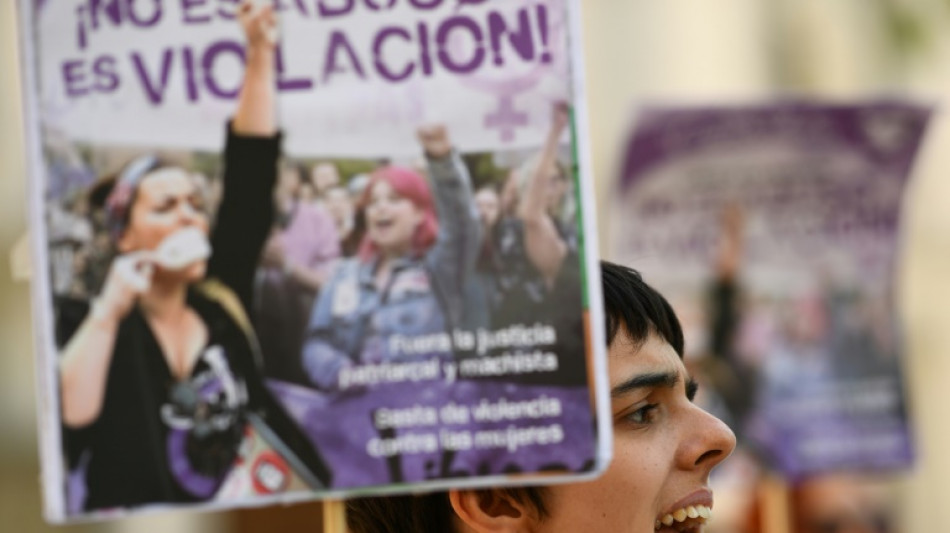
Fury as loophole in Spain rape law used to cut sentences / Photo: GABRIEL BOUYS - AFP

 EU calls Russia 'reckless' after flares fired at Danish helicopter

 US Treasury chief says to meet Chinese counterpart at weekend

 Trump slams 'horrible' Supreme Court mail-in ballot ruling

 Brazil's crisis-hit Supreme Court probes judge's ties to jailed banker

 Sterling admits dangerous driving after Lamborghini crash

 Ambassador to Thailand plays down anti-Israeli protests

 BingX Evolves into a Multi-Asset Trading Platform, Connecting Users to Global Opportunities

 Flick supporting 'self-confident' Yamal Ballon d'Or bid

 As Ballon d'Or vote nears, stars campaign for the award

 Markets on edge as US Fed meets to tackle high inflation

 International Trading Institute Expands Professional Trader Development Beyond the Master’s in Trading

 Nairobi to host 2029 world athletics championships in African first

 Ukraine winemakers defy war to make a splash at home

 Prominent Greek neo-Nazi exits prison, vows return to politics: AFP

 Saudi Arabia vows to respond 'firmly' to Houthi attacks

 'We unleashed the beast': the world's fears and hopes about AI

 Carragher sees Manchester City’s winning start as challenge to Arsenal

 Oasis fans weigh ticket costs and reunion memories ahead of 2027 tour

 EastEnders previews Kat’s grief after Zoe’s death

 US military confirms Iran war has led to munitions shortfall

 SkySail Strategies Outperforms Wall Street's 30-Year Risk Standard With Proprietary AI Inference Model

 Canada ends refugee family sponsorship exemption over integrity concerns

 Berlin's run-down public spaces at heart of election campaign

 Ribeiro and Richie among celebrity birthdays for September 20–26

 Bob Mackie, costume designer for Cher and Madonna, dies aged 87

A landmark law to fight sexual violence in Spain has come under fire over a loophole used by lawyers to get reduced sentences for some convicted offenders.
The controversy erupted barely six weeks after the law came into force when it emerged that it had led to the jail sentences of some 15 offenders being cut.
One was a man who sexually assaulted his teenage step-daughter. His jail term was reduced from eight years to six.
A teacher who paid for sex with his pupils was released after his sentence was reduced. Four men have since walked out free, according to Spanish media reports.
Known as the "Only yes means yes" law, the new legislation reformed the criminal code to define all non-consensual sex as rape.
Although the new law raises the sentence for gang rape or chemical submission, it reduces both the maximum and minimum sentences in cases with no aggravating circumstances.
Hundreds of convicted offenders have applied to have their sentences revised since the law came into effect on October 7.
In Spain, a jail term can be retroactively modified if changes to the penal code benefits the convicted offender.
Until now, rape victims had needed to prove they were subjected to violence or intimidation.
Without that the offence was considered "sexual abuse" and carried lighter penalties than rape.
The legal change was driven by the notorious 2016 gang rape of an 18-year-old woman by five men at a bull-running festival in the northern city of Pamplona.
The men were initially convicted of sexual abuse and not rape, sparking mass nationwide protests.
The Supreme Court eventually overturned the verdict in 2019 and convicted all five of rape.
- 'Male chauvinist judges' -
With the lesser charge of "sexual abuse" dropped from the reformed criminal code and a much wider range of offences grouped under "sexual assault", a broader range of penalties was required to ensure proportionality.
Anyone previously convicted of sexual assault and handed the minimum sentence of eight years, can now benefit from the minimum being reduced to six.
The result has been a major backlash -- which has put the left-wing government of Prime Minister Pedro Sanchez on the back foot with Spain's legal watchdog hitting back at the flagship legislation as fundamentally flawed.
Equality Minister Irene Montero of the hard-left Podemos party, Sanchez's junior coalition partner, has accused those judges who have rubber-stamped such reductions of "breaking the law" on grounds of "male chauvinism".
Podemos lawmaker Javier Sanchez Serna went further, calling them "fascists in robes".
The General Council of the Judiciary -- which is responsible for ensuring the judiciary's independence -- lashed out at such "intolerable attacks", saying they had warned months ago the legislation could see convictions revised.
The Judges for Democracy association accused the ministry of "not foreseeing such (an undesired) consequence" saying it "in no way justified attacking judges".
- Wolf Pack to benefit? -
The biggest concern is that the changes could affect the sentences of the Pamplona gang rapists, the case which drove efforts to toughen the law.
Known as the "Wolf Pack", the men are serving 15-year sentences, with a lawyer confirming he will seek a reduction for one of them.
With just a year left until the next general elections, Sanchez came out in defence of the law, recalling its aim was to "give more guarantees to women in the face of any kind of sexual aggression".
"Let's wait to see what the courts and prosecutors say about this," he said on Wednesday, with the Supreme Court set to rule on certain cases within the coming month.
Even if the new law was modified, it would not undo the sentence revisions that have already been approved because legislation that toughens penalties is not applicable retroactively.
T.Wright--AT