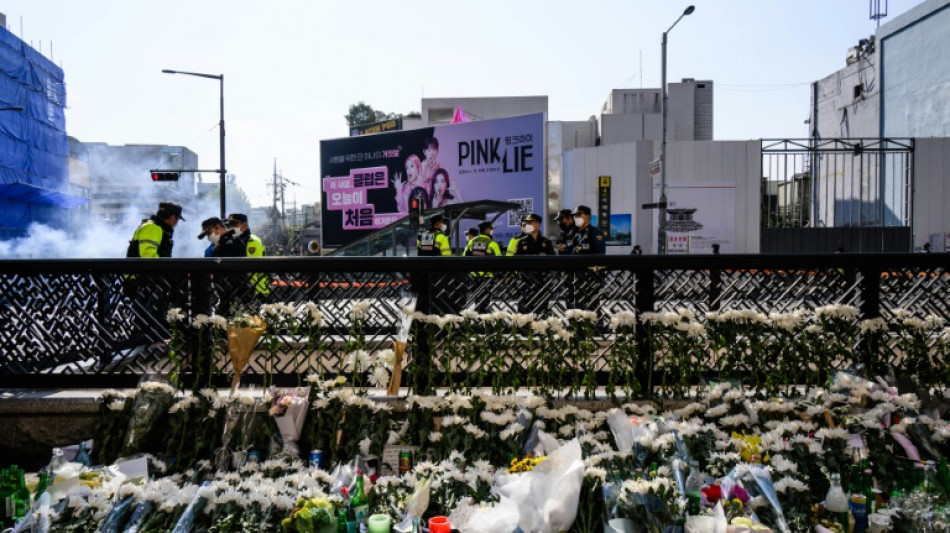
South Korea police admit crowd surge response was 'insufficient' / Photo: ANTHONY WALLACE - AFP

 'Be careful what you wish for': 'Obsession' director and star reflect on success
 Messi scores but Miami held by Nashville
 US Open champ Rybakina on top of world after injury scare

 Rybakina reigns serene as new world number one
 South Africa defeat New Zealand 43-28 to complete 3-1 series victory
 Rybakina triumphs in US Open, denies Sabalenka three-peat

 Japanese floating parking platform is designed to lift cars above floodwater

 Anthropic details Claude misuse as US targets major illicit online marketplace

 Fifth Circuit upholds dismissal of Jackson residents' constitutional water claims

 Winston County trash-debt prosecutions face challenge from civil-rights lawyers

 Marmot research gains over $140,000 from meme-coin fees alongside wildlife contest

 Queens residents seek renewed enforcement along Roosevelt Avenue

 United States beats Spain 76-66 to set up World Cup final against France

 Cristian Mungiu's Fjord examines a family's conflict with Norwegian child authorities

 Gilbert Arenas questions Jonathan Kuminga's decision to join Minnesota

 Arteta blasts 'unacceptable' Sunderland penalty despite Arsenal win

 Mbappe at the double as Real Madrid sink Rayo

 Arsenal extend perfect Premier League start as Chelsea, Liverpool held

 US survive Spain scare to book World Cup final clash with France

 Celine Dion makes long-awaited return to stage in Paris
 Werro crowned Ultimate queen, US sweep 100m races

 Venezuelans outside Caracas say capital not sharing blackout burden

 Danish WWII drama wins top prize at Venice festival

 Chelsea boss Alonso yearns for 'boring game' after Hull make their point
 Werro outguns Hodgkinson to win women's 800m at Ultimate

South Korea's police chief said Tuesday that officers had received multiple urgent reports of danger ahead of a deadly crowd crush at a Halloween event but their handling of them was "insufficient".
At least 156 mostly young people were killed, and scores more injured, in a deadly crowd surge late Saturday at the first post-pandemic Halloween party in Seoul's popular Itaewon nightlife district.
An estimated 100,000 people had flocked to the area, but because it was not an "official" event with a designated organiser, neither the police nor local authorities were actively managing the crowd.
"There were multiple reports to the police indicating the seriousness at the site just before the accident occurred," national police chief Yoon Hee-keun said.
Police knew "a large crowd had gathered even before the accident occurred, urgently indicating the danger," he said, acknowledging the way this information was handled had been "insufficient".
Seoul's interior minister on Tuesday became the first top official to make a clear apology to the public for the disaster, one of the worst ever in the country's history.
"I would like to take this opportunity to express my sincere apologies to the public as the minister in charge of the people's safety for this accident," Lee Sang-min said before bowing his head before lawmakers and cameras.
He promised to investigate what had caused the crowd crush and ensure a disaster on this scale could never happen again.
South Korea is typically strong on crowd control, with protest rallies often so heavily policed that officers can outnumber participants.
But police deployed only 137 officers to Itaewon for Halloween, while 6,500 officers were present at a protest across town attended by about 25,000 people, local reports said.
South Korean President Yoon Suk-yeol said Tuesday the country needed to urgently improve its system for managing large crowds in the wake of the disaster.
"The safety of the people is important, whether or not there is an event organiser," he told a cabinet meeting.
He called for the country to develop "cutting-edge digital capabilities" to improve crowd management -- but critics claim such tools already exist and were not deployed in Itaewon.
- Disaster was avoidable -
Seoul's City Hall has a real-time monitoring system that uses mobile phone data to predict crowd size, but it was not employed Saturday night, local media reported.
Itaewon's district authorities also did not deploy any safety patrols, with officials saying the Halloween event was considered "a phenomenon" rather than "a festival", which would have required an official plan for crowd control.
On the night, tens of thousands of people thronged a narrow alleyway, with eye-witnesses describing how, with no police or crowd control in sight, confused partygoers pushed and shoved, crushing those trapped in the lane.
Analysts say this was easily avoidable, even with only a small number of police officers.
"Good, safe crowd management is not about the ratio, but about the crowd strategy -- for safe crowd capacity, flow, density," said G. Keith Still, a crowd science professor at the University of Suffolk.
South Korean expert Lee Young-ju said that if local police knew they would be short-handed, they could have sought help from local authorities or even residents or shop owners.
"It's not just the numbers," Lee, a professor from the Department of Fire and Disaster at the University of Seoul, told AFP.
"The question is, how did they manage with the limited number (of police) and what kind of measures did they take to make up for it."
O.Gutierrez--AT