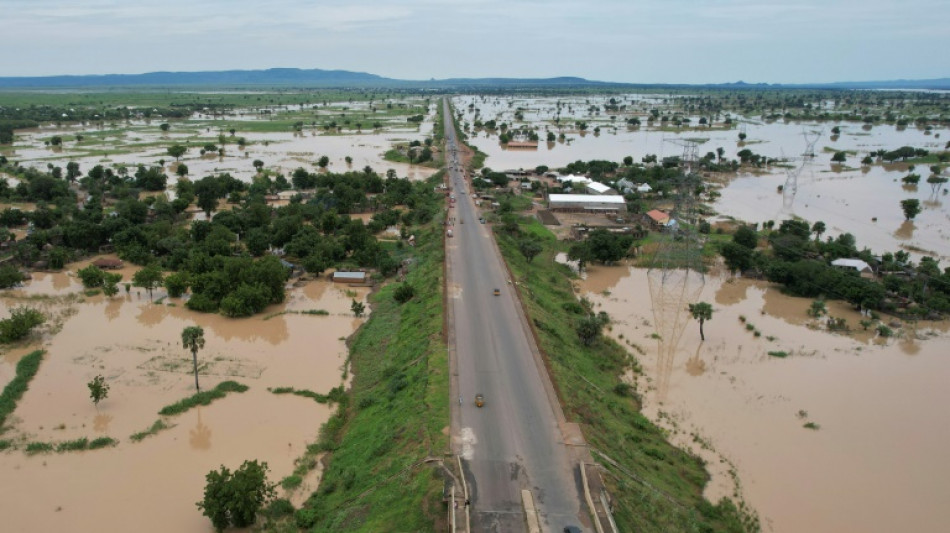
Food crisis looms in Nigeria as floods destroy crops / Photo: Radeno Haniel - AFP

 Generative AI's power sparks fears of dumbing humans down
 'Like my lover': Chinese users bid farewell to AI companions

 Empty skyscrapers: China's property slump still throttling growth

 Cuba slowly gets power back after latest blackout
 AI demand powers forecast hike, profit gains at tech giant ASML
 Aussie Rules removes Indigenous figure from Hall of Fame

 France set to adopt assisted dying law in final vote
 Australian swimmer O'Callaghan reveals she has spinal fractures

 Argentina and England collide with World Cup final spot at stake
 AI ignites 'ignored sector' for Japan chipmaker Kioxia

 Writers union sues to block US Paramount deal

 UK announces social media curfew for older teens

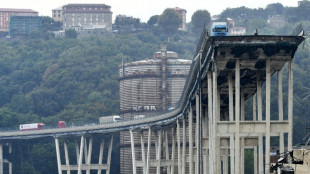 Italy court to rule in deadly bridge collapse case

 Tuchel unfazed by history ahead of England v Argentina World Cup semi

 Scaloni says fatigue not a concern for Argentina in World Cup semi-final

 MPS Law Welcomes Howard Teplinsky as a Partner

 Labconco Strengthens Scientific Product Validation and Discovery Through Continued Partnership With Bioz

 InterContinental Hotels Group PLC Announces Transaction in Own Shares - July 15
 Caledonia Mining Corporation Plc: Notification of Relevant Change to Significant Shareholder

 Mac Allister calls on Argentina to channel Maradona spirit in England World Cup clash

 Key battles as England face Argentina in World Cup semi-final

 Deschamps says France 'devastated' by defeat, questions referee

 IBM shares plunge 25% as AI spending boom disrupts business

 Majestic Spain stun France to reach World Cup final

 Nasdaq rebounds as cooling US inflation weighs on dollar

Usman Musa had spent more than $1,300 on his 10-hectare rice farm in Nigeria's Kogi state, now submerged by the country's worst floods in a decade.
In a wooden canoe, the 38-year-old father of four paddled his way through the murky waters, passing by his and relatives' houses, the local hospital and school.
Only the roofs were visible.
Across Africa's most populous country, communities and crops of sorghum, maize, rice and vegetables are under water, with farmers and aid workers warning of a possible food crisis.
The country, home to more than 200 million people, was already grappling with high inflation and worrying levels of food insecurity.
Now the situation will worsen, with nearly 110,000 hectares (272,000 acres) of farmland completely destroyed by flooding since August according to the latest government figures.
"Flooding is still ongoing but we can safely say that between 60 to 75 percent of the yield we expected is going to be lost," Kabir Ibrahim, president of All Farmers Association of Nigeria, told AFP this week.
"It's monumental. So many people are crying."
More than 600 people have died and 1.3 million others were forced to leave their homes according to the latest figures given by the Minister of Humanitarian Affairs Sadiya Umar Farouq.
- Risk of hunger -
Floods are not uncommon in Nigeria during the rainy season from May to November but they have been extreme this year.
Officials and residents blame climate change but also poor planning and the release of excessive water from dams, a process that is meant to ease pressure.
"If you don't open the water through the spillways, then dams will break," said Ibrahim, and then "it would be like Pakistan. All of Nigeria would be under water like Pakistan."
Farmers were warned ahead of time but it wasn't enough.
"We used the predictions and avoided planting along flood-prone areas," said Ibrahim, "but now you can see that the devastation is all over."
As a result, Ibrahim, whose organisation represents 20 million farmers, believes "there will be more hardship towards the end of the year and beginning of next year."
Food inflation year-on-year was already at 23.3 percent last month, in part because of ripple effects on the import-dependent country from the coronavirus pandemic and the Russia-Ukraine war.
Rampant insecurity with gunmen repeatedly attacking rural communities also forced many farmers to abandon their fields.
The World Food Programme and the UN's Food and Agriculture Organization (FAO) said last month that Nigeria was among six countries facing a high risk of catastrophic levels of hunger, even before the floods.
Now, "the impact of the floods on food production is a real threat to the country and could lead to a major food crisis," said Hussaini Abdu, Nigeria director of the CARE charity.
The FAO representative in Nigeria, Fred Kafeero, said he was "deeply concerned" as food supplies were expected to be low "due to anticipated reduction in household production".
The aid official said the floods were also affecting livestock and had increased the risk of vector-borne disease outbreaks such as cholera.
- Preventive measures -
The floods have not just destroyed farmlands, they have also prevented the transport of trucks and damaged roads and bridges, further pressuring the food supply.
"We were hoping inflation would get a break with the (upcoming) harvest but now with the floods, it puts a big question mark on our forecast on inflation," said Ari Aisen, the IMF's Resident Representative for Nigeria.
"It looks very serious but it's difficult to judge at this point," he told AFP, adding that while it was early to assess, "there is an upside risk for inflation, for food price increases."
The last massive floods in Nigeria in 2012 cost nearly $17 billion, according to the World Bank.
While immediate assistance is now needed, the International Monetary Fund said it would be less costly to invest in preventive measures and policies.
Countries should invest to "help populations adapt to these types (of) events rather than using resources after the fact," said Aisen.
But in the meantime, the government said it was ramping up support to affected communities.
President Muhammadu Buhari approved the release of 12,000 metric tons of assorted grains from a national strategic reserve stock.
But farmers are not sure it will be enough.
Buhari restricted the import of rice in 2015, to increase local production and self-sufficiency.
For Ibrahim, resuming those imports "should not be ruled out, if the situation becomes dire".
Weather forecast agencies have warned there could be more floods until the end of November.
A.Taylor--AT