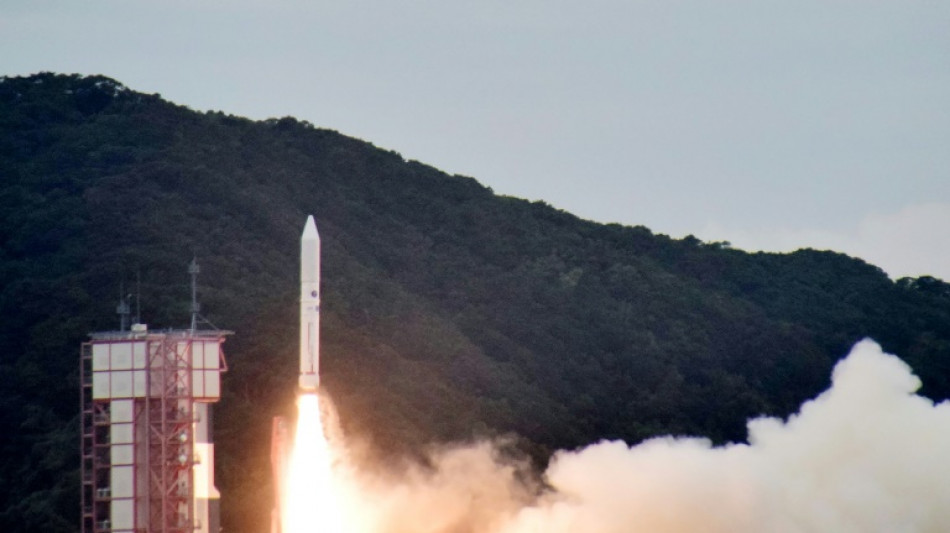
Japanese rocket launch fails in blow for space agency / Photo: STR - JIJI Press/AFP

 i-payout Expands U.S. Money Transmitter Licensing Footprint and Advances European EMI Strategy

 Artists exit Sheeran tour in solidarity with Macklemore pro-Palestinian comments

 Espi saves Real Madrid with late winner at Elche

 Liverpool pile on misery for Spurs in League Cup, Dowman dazzles for Arsenal

 Trump blasts Supreme Court justices over 'horrible' mail vote ruling

 Maduro ally pleads guilty to US money laundering charges

 Finnish president Stubb speaks to AFP about Trump, Russia and saunas

 Trump says Kennedy Center to close after judge bars name change

 South Africa intensifies hunt after eight women found dead

 'Battle of Chile' documentary-maker Patricio Guzman dies, aged 85

 Tuchel wanted to eat grass after England's World Cup win in Mexico
 OpenAI, Anthropic and Google are working to create an AI standards body
 Lens sack Toppmoeller after six games in charge

 Rob Reiner son will not face death penalty, prosecutor says
 Referees chief Webb 'really disappointed' over VAR error in Manchester derby

 Maiden Renshaw ODI century sets up Australia win in Zimbabwe

 EU calls Russia 'reckless' after flares fired at Danish helicopter

 US Treasury chief says to meet Chinese counterpart at weekend

 Trump slams 'horrible' Supreme Court mail-in ballot ruling
 Brazil's crisis-hit Supreme Court probes judge's ties to jailed banker
 Sterling admits dangerous driving after Lamborghini crash

 Ambassador to Thailand plays down anti-Israeli protests

 BingX Evolves into a Multi-Asset Trading Platform, Connecting Users to Global Opportunities

 Flick supporting 'self-confident' Yamal Ballon d'Or bid
 As Ballon d'Or vote nears, stars campaign for the award

The launch of a Japanese rocket taking satellites into orbit to demonstrate new technologies failed after blast-off on Wednesday because of a positioning problem, the country's space agency said.
It was Japan's first failed launch in nearly two decades, and the only one for an Epsilon rocket, a solid-fuel model that has flown five successful missions since its 2013 debut.
The unmanned craft took off from Uchinoura Space Center in the southern Kagoshima region, with its lift-off livestreamed by the Japan Aerospace Exploration Agency (JAXA).
But a self-destruct signal was sent to the rocket less than 10 minutes later because of "positioning abnormalities", said Yasuhiro Funo of JAXA, who led the project.
The livestream was halted and presenters wearing hard-hats told viewers there had been a problem with the launch.
Funo explained at a press conference that a technical issue was detected before the third -- and final -- stage of the launch, just as the last powerful booster was about to be ignited.
"We ordered the rocket's destruction because if we cannot send it into the orbit that we planned, we don't know where it will go," he said, leading to safety concerns about where the machinery could fall.
After the mission was aborted, the rocket's parts were assumed to have landed in the sea east of the Philippines, he added.
Japan's last failed space launch was of a pair of spy satellites to monitor North Korea in 2003, and the only other time JAXA has sent a destroy order to a rocket was in 1999.
- 'Pulsed-plasma thruster' -
The 26-metre (85-foot) Epsilon-6 rocket had been carrying a box-shaped satellite due to orbit Earth for at least a year to carry out experiments, as well as eight micro-satellites.
Researchers and private companies had engineered new technologies to be tried out in space as part of the agency's third Innovative Satellite Technology Demonstration programme.
Their gadgetry ranged from a "pulsed-plasma thruster" to an experiment in "harvesting energy with (a) lightweight integrated origami structure", according to a JAXA fact sheet.
JAXA describes Epsilon as "a solid-fuel rocket designed to lower the threshold to space... and usher in an age in which everyone can make active use of space".
It is smaller than the country's previous liquid-fuelled model, and a successor to the solid-fuel M-5 rocket that was retired in 2006 due to its high cost.
JAXA president Hiroshi Yamakawa apologised for Wednesday's failure, saying the agency was "terribly sorry that we couldn't meet the Japanese people's expectations".
"We will pour efforts into finding out the cause and will take counter-measures" to prevent a recurrence, Yamakawa said.
Japan's space programme is one of the world's largest, and last week JAXA astronaut Koichi Wakata flew to the International Space Station as part of the Crew-5 mission.
JAXA has also been in the spotlight after its mission to the asteroid Ryugu by a space probe named Hayabusa-2, which collected pristine material from the celestial body that is now being analysed for clues to the origins of life.
B.Torres--AT