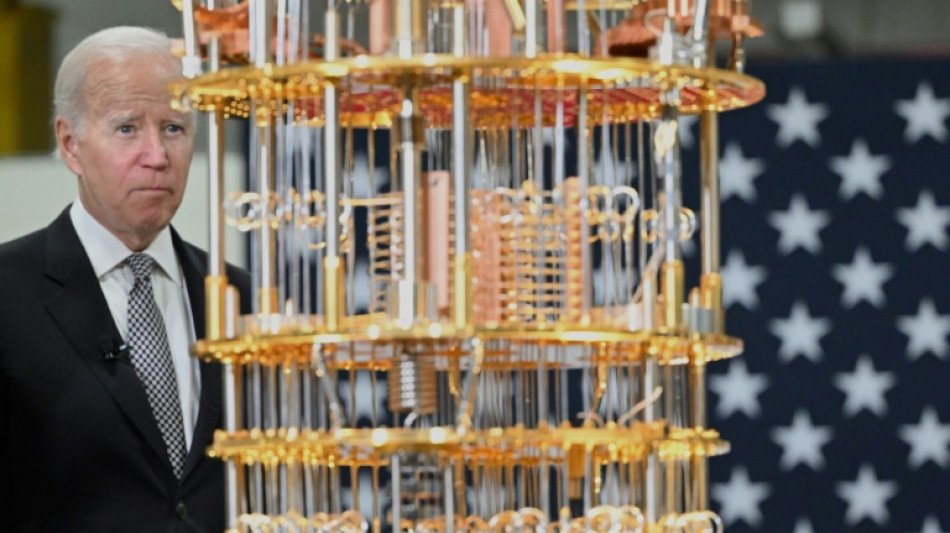
Biden moves to end legal limbo for US Big Tech in Europe / Photo: MANDEL NGAN - AFP

 'Desperate' Sabalenka books US Open title clash with Rybakina

 Rybakina rallies to beat Gauff, book US Open final with Sabalenka

 Manchester derby poses Maresca's first big test, Chelsea aim to end Hull Honeymoon

 It's all coming back: Celine Dion fans gear up for Paris return

 Fans celebrate Celine Dion's Paris return with giant karaoke

 'Insane' Sabalenka powers past Pegula into US Open final

 Hong Kong sentences Tiananmen activists to between 5 and 7 years in jail

 Yu Zidi: fearless swimming prodigy, 13, with Olympics in her sights

 Japan feminist theatre fights misogyny in 'cute' fashion

 Vance assails Democratic 'hate' in fiery US midterm pitch

 Party leaders trade barbs before Swedish election

 China, Iran among countries that have used AI to aid spying, Anthropic says

 Sabalenka storms past Pegula to reach US Open final in bid for three-peat

 Two-time defending champion Sabalenka powers past Pegula into US Open final

 Tremor recorded as Israel says Hezbollah tunnels destroyed in south Lebanon

 Putin arrives in India for BRICS summit coloured by wars

 Springboks, All Blacks clash in groundbreaking US decider

 Man United, Bayern cruise as Como make dream Champions League start

 Musiala returns to help Bayern sink Bodo in Champions League

 Surging oil prices, higher bond yields weigh on stocks

 Russell admits he needs luck as Antonelli focuses on the job

 Canada pledges support for Ukraine air defense as Zelensky visits

 Latin America fact-check group asks Meta not to replace verification practice

 Seahawks' Darnold gets good news on hip injury: coach

 Evasive Alonso teases reporters on his F1 future

US President Joe Biden signed an executive order on Friday designed to protect the privacy of personal data transfers between the EU and the United States and address European concerns about US spying activity.
The executive order provides a new legal framework for transatlantic data flows that are critical to the digital economy, the White House said.
The move by Biden is the latest attempt to end years of court battles in which activists in Europe have questioned the legality of the data transfers and thrown the EU operations of US Big Tech into jeopardy.
"This is a culmination of our joint efforts to restore trust and stability to transatlantic data flows," Commerce Secretary Gina Raimondo told reporters.
"It will enable a continued flow of data that underpins more than a trillion dollars in cross-border trade and investment every year."
The EU's Justice Commissioner Didier Reynders hailed the executive order as a "significant step", though officials in Brussels warned that it was only the start of a process that could take months to reach a new data deal.
US tech giants have faced a barrage of lawsuits from EU privacy activists concerned about the ability of US intelligence services to access the personal data of Europeans that use Facebook or Google for their internet needs.
Europe's top court has invalidated previous arrangements, known as equivalency deals, after hearing complaints that US laws violate the fundamental rights of EU citizens.
The White House said the executive order addresses concerns raised by the Court of Justice of the European Union when it ruled that the previous framework known as Privacy Shield did not provide adequate protection.
- Court battle 'likely' -
Austrian privacy activist Max Schrems, whose legal campaigns brought down the previous pacts, said he would likely challenge the new arrangement.
"We will likely attack (the deal) in court," he told AFP, putting the chances at "90 percent".
"We need to first analyse it in detail, which will take several days," he said, adding that at first glance it seems the central privacy issues "haven't been resolved".
Privacy Shield, struck down in July 2020, was the successor to another EU-US deal, Safe Harbor, which was itself torpedoed by a court ruling in 2015.
Businesses have since resorted to legally uncertain workarounds to keep the data flow moving, with hope that the two sides could come up with something stronger in the long term.
Striking a new agreement "is of great importance," said Christian Borggreen, senior vice predident in Europe for the Big Tech lobby, the Computer & Communications Industry Association.
"It will support continued transatlantic commerce, strengthen data protection, and provide legal clarity for data transfers between the EU and US," he said.
- 'Robust commitments' -
Raimondo expressed confidence that the new arrangement, which builds upon an agreement in principle announced in March, will survive the intense legal scrutiny that began after revelations by former National Security Agency contractor Edward Snowden of mass digital spying by US agencies.
"The EU-US data privacy framework includes robust commitments to strengthen the privacy and civil liberties safeguards for signals intelligence which will ensure the privacy of EU personal data," she said.
The executive order requires that US signals intelligence activities be conducted "only in pursuit of defined national security objectives".
US agencies must also "take into consideration the privacy and civil liberties of all persons" regardless of nationality or country of residence."
It also creates an independent court for EU individuals "to seek redress if they believe they are unlawfully targeted by US intelligence activities."
Judges on the newly created court will be appointed from outside the US Government and "review cases independently," the White House said.
Their decisions will be binding.
B.Torres--AT