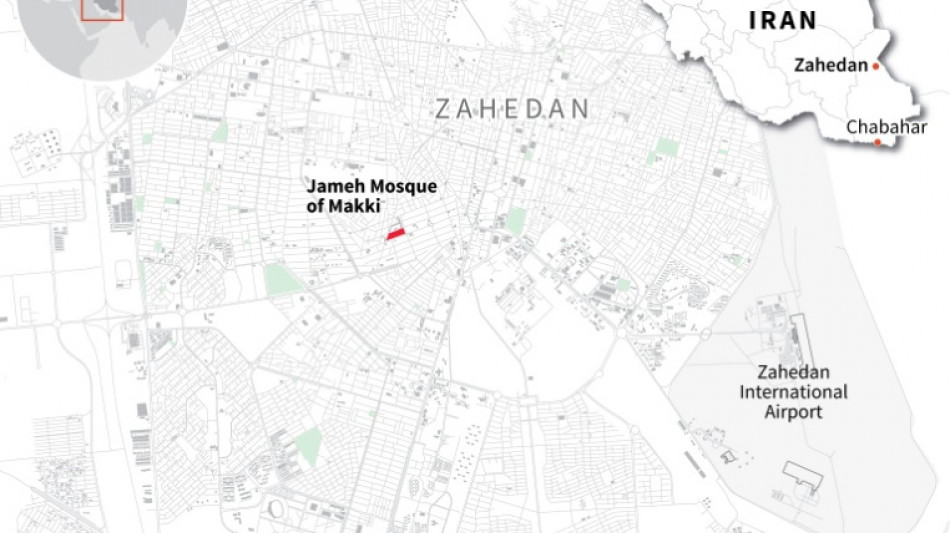
Iran protests: What happened on Zahedan's 'Bloody Friday'? / Photo: Julia Han JANICKI - AFP

 Brazil's Supreme Court clashes over handling of probe involving judge

 Trump threatens to keep Kennedy Center shut if his name not added

 i-payout Expands U.S. Money Transmitter Licensing Footprint and Advances European EMI Strategy

 Artists exit Sheeran tour in solidarity with Macklemore pro-Palestinian comments
 Espi saves Real Madrid with late winner at Elche
 Liverpool pile on misery for Spurs in League Cup, Dowman dazzles for Arsenal
 Trump blasts Supreme Court justices over 'horrible' mail vote ruling

 Maduro ally pleads guilty to US money laundering charges
 Finnish president Stubb speaks to AFP about Trump, Russia and saunas

 Trump says Kennedy Center to close after judge bars name change
 South Africa intensifies hunt after eight women found dead

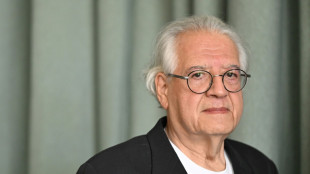 'Battle of Chile' documentary-maker Patricio Guzman dies, aged 85

 Tuchel wanted to eat grass after England's World Cup win in Mexico
 OpenAI, Anthropic and Google are working to create an AI standards body
 Lens sack Toppmoeller after six games in charge
 Rob Reiner son will not face death penalty, prosecutor says
 Referees chief Webb 'really disappointed' over VAR error in Manchester derby
 Maiden Renshaw ODI century sets up Australia win in Zimbabwe
 EU calls Russia 'reckless' after flares fired at Danish helicopter
 US Treasury chief says to meet Chinese counterpart at weekend
 Trump slams 'horrible' Supreme Court mail-in ballot ruling

 Brazil's crisis-hit Supreme Court probes judge's ties to jailed banker
 Sterling admits dangerous driving after Lamborghini crash
 Ambassador to Thailand plays down anti-Israeli protests
 BingX Evolves into a Multi-Asset Trading Platform, Connecting Users to Global Opportunities

Iranian security forces have massacred over 80 people in the southeastern city of Zahedan in Sistan-Baluchestan province, in a crackdown on protests that erupted as Iran is convulsed by nationwide demonstrations, rights activists charge.
President Ebrahim Raisi has ordered an investigation into the unrest that started on September 30 after Friday prayers, which officials have characterised as attacks by "extremists" on police stations.
Activists however say the horrifying images of bloodied corpses with bullet wounds are emblematic of Tehran's repressive polices towards a poor ethnic minority region.
- Where did the killings take place?
Zahedan is the main city of Sistan-Baluchestan, Iran's poorest region, on the border with Pakistan. Zahedan is one of Iran's few Sunni-majority cities and the region is populated by the Baluch ethnic minority who adhere to Sunni Islam rather than the Shiism predominant in Iran.
Activists have long complained the region has been the victim of discrimination by Iran's Shiite clerical leadership, with disproportionate numbers of Baluch killed in clashes every year and also hanged in executions.
The region has been the scene of attacks on the Iranian security forces that Tehran has blamed on Sunni extremist groups, while the border area is also seen as a hub for drug smuggling by armed gangs.
Amnesty International said that in 2021 at least 19 percent of all executions were of members of the Baluchi minority, who it said make up five percent of Iran's population.
"Killing Baluch does not cost much for the Iranian government," said Abdollah Aref, director of the UK-based Baluch Activists Campaign (BAC).
-What sparked the protests?
The unrest erupted two weeks into nationwide protests in Iran over the death of Mahsa Amini, who had been arrested by the notorious morality police.
However the trigger for the protests were accusations that a regional police chief had raped a 15-year-old-girl in custody in the port city of Chabahar, also in Sistan-Baluchestan. It is not clear why she was detained.
The accusation had been made public last month by the Friday prayer leader in the town of Rask south of Zahedan, prompting protests that then spread to the main city of the region.
-What was the chain of events?
According to Aref, a protest was planned after Friday prayers in Zahedan on September 30. Demonstrators then headed to the police station to protest the rape and also shouted slogans against supreme leader Ayatollah Ali Khamenei.
Amnesty said "a minority" of protesters threw stones at the police station. Security forces responded by firing "live ammunition, metal pellets and teargas", including from the roof of the police station.
The protests then spread across the city, targeting other police stations, said Aref. "The police sought to send a message," he added.
Internet monitor Netblocks reported access disruptions in Zahedan.
-How many people were killed?
According to Amnesty, 82 people have been killed, with 66 losing their lives on September 30 alone, including three children.
The protest "was bloodily suppressed by security forces. It has since been named Zahedan's 'Bloody Friday'," said Norway-based group Iran Human Rights (IHR).
Influential Sunni cleric Molavi Abdol Hamid charged that "a group of officers... opened fire Friday evening on a crowd that gathered around a mosque, killing and wounding multiple young people".
But state media has put the death toll from the events at 20, including six members of the security forces.
Aref said the death toll was accentuated by a shortage of blood and bandages, meaning many of the wounded died from their injuries.
He added: "Many did not go to hospital for fear of being arrested. They preferred home treatment but then lost a lot of blood."
Amnesty said that, according to its evidence, "the majority of victims were shot in the head, heart, neck and torso, revealing a clear intent to kill or seriously harm."
Iranian Foreign Minister Hossein Amir-Abdollahian on Wednesday blamed the violence in Zahedan and elsewhere in Iran on "foreign interventionists, organised agents and terrorists".
-What is the situation now?
Aref said the situation in Zahedan has calmed, although new protests were possible after weekly prayers this Friday.
But he added many people had been arrested in a clampdown on participants in the protests, although the precise figures were not clear.
Security forces used aerial drones and facial recognition technology to identify protesters and arrest them, he said.
Reports said that Taftan, the main border crossing east of Zahedan between Iran and Pakistan's Balochistan province, had been closed in the wake of the unrest.
Meanwhile executions of Baluch have continued. Four of five people who were hanged at the weekend in the prison in the city of Mashhad for drug related crimes were Baluch, IHR said.
Out of 251 people executed in Iran this year, 67 were Baluch, it said.
S.Jackson--AT