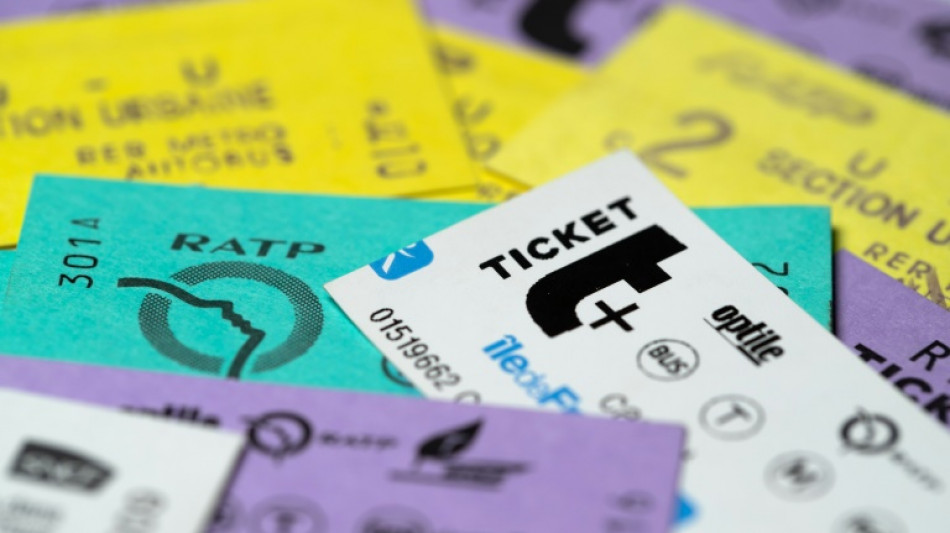
Last stop: Paris waves goodbye to cardboard Metro tickets / Photo: JOEL SAGET - AFP

 Brazil's Supreme Court clashes over handling of probe involving judge

 Trump threatens to keep Kennedy Center shut if his name not added

 i-payout Expands U.S. Money Transmitter Licensing Footprint and Advances European EMI Strategy

 Artists exit Sheeran tour in solidarity with Macklemore pro-Palestinian comments

 Espi saves Real Madrid with late winner at Elche
 Liverpool pile on misery for Spurs in League Cup, Dowman dazzles for Arsenal

 Trump blasts Supreme Court justices over 'horrible' mail vote ruling
 Maduro ally pleads guilty to US money laundering charges
 Finnish president Stubb speaks to AFP about Trump, Russia and saunas

 Trump says Kennedy Center to close after judge bars name change
 South Africa intensifies hunt after eight women found dead
 'Battle of Chile' documentary-maker Patricio Guzman dies, aged 85
 Tuchel wanted to eat grass after England's World Cup win in Mexico
 OpenAI, Anthropic and Google are working to create an AI standards body
 Lens sack Toppmoeller after six games in charge

 Rob Reiner son will not face death penalty, prosecutor says
 Referees chief Webb 'really disappointed' over VAR error in Manchester derby
 Maiden Renshaw ODI century sets up Australia win in Zimbabwe
 EU calls Russia 'reckless' after flares fired at Danish helicopter

 US Treasury chief says to meet Chinese counterpart at weekend

 Trump slams 'horrible' Supreme Court mail-in ballot ruling
 Brazil's crisis-hit Supreme Court probes judge's ties to jailed banker
 Sterling admits dangerous driving after Lamborghini crash

 Ambassador to Thailand plays down anti-Israeli protests

 BingX Evolves into a Multi-Asset Trading Platform, Connecting Users to Global Opportunities

The Paris Metro is phasing out cardboard tickets after 120 years, taking the capital's urban transit into a contactless future but leaving behind nostalgic fans who will miss the humble rectangular cards.
Beyond their intended use as a transport token, the tickets with their trademark magnetic strip have inspired artists, filmmakers and singers, served as emergency notepads and, most of all, bookmarks.
"As the metro ticket disappears, so does a part of our lives," said Gregoire Thonnat, a collector and author of a book on the history of the metro ticket. "The metro ticket is part of how we picture Paris."
Ile-de-France Mobilites, which operates the metro's ticketing system, had wanted the pack of 10 tickets known as "carnets" to be gone by the first quarter of this year.
But then the Covid-19 pandemic erupted, and Russia's war in Ukraine, and with it a global shortage of microchips needed to make the smartcards to replace the tickets -- whose sales still total 550 million per year, more than 50 tonnes of paper.
"We were in a hurry, but the chip crisis slowed us down," Laurent Probst, director-general at Ile-de-France Mobilites told AFP.
The operator has started cutting the number of metro stations that still sell carnets to nudge clients towards plastic cards, and many turnstiles can no longer read cardboard tickets.
- 'Change their habits' -
As a result, the share of card tickets used on urban trips has dropped from more than two-thirds a year ago to well under half now. "Our customers are beginning to change their habits," Probst said.
He said carnets would be gone completely sometime next year.
But, probably until 2024, travellers will still be able to buy single tickets at 1.90 euros ($1.82), a markup from the 1.49 euros a single journey costs when using a smartcard.
Ile-de-France Mobilites is pushing ahead with more modernisation, including the use of smartphones at turnstiles, with Android phones to be enabled within weeks and Apple phones in 2023.
"I'm enthusiastic about this development," Probst said. "This is a sea change in the quality of our customer service."
Paris's leap into the future comes 20 years after the New York subway abolished metal tokens, and more than a decade after London's Underground went mostly paperless, but some are pleased that Paris has taken things slowly.
"I enjoy the texture of it, I enjoy the cleanness of the ticket itself when it's new, and how much you can destroy it and still have it," said Sarah Sturman, an Italian-American artist in Paris who uses metro tickets in her collage work.
"I'm going to keep collecting metro tickets until they're gone, and when they're gone they'll be even more precious," she told AFP.
"If I see a metro ticket in a scrapbook 10 years from now, it will all come rushing back: Memories of being on the metro late at night, or in the rush hour, my favourite metro line, or why I hate another one, losing the tickets, trying to sort through my bag at the turnstile, doing laundry and finding your crumpled metro ticket in a pocket afterwards," she said.
- 'Ideal thickness' -
Cannabis smokers will also miss the 30-by-66-millimetre ticket, which can be used to make filter tips, or "crutches", for joints.
"Ideal thickness, perfect width, readily available -- the three gold standards of a good crutch," said Jake, a Japanese-American student in Paris.
The metro ticket also has its place in popular culture, famously in singer-songwriter Serge Gainsbourg's 1959 hit "Le Poinconneur des Lilas" (The ticket puncher at the Lilas station); as a keepsake for Yves Montand in the 1953 film "Wages of Fear"; and on the cover of Raymond Queneau's novel "Zazie in the Metro" that director Louis Malle made into a film in 1960.
"The useful life of a metro ticket is one hour, or one and a half hours, and yet we get attached to it," Thonnat said. "It's quite irrational."
"Metro ticket" is also the name of a pubic hair trimming style that leaves just a ticket-size strip after waxing. The cut, known in the United States as a "landing strip," is the most popular among Parisian women, according to a 2020 study published by the Version Femina magazine.
- 'Something to show our kids' -
Some tourists visiting Paris can't wait for the day when they won't have to decipher complicated metro ticket machines.
"I don't like paper tickets, I want everything on my phone," said Javier Romani, a visitor from the Catalonia region in Spain.
"I'm against the paper tickets," said Jeff Noel, from Indianapolis in the US state of Indiana. "If you could do this electronically in your hotel room it would be a lot easier than trying to find a machine."
Stefania Grigoriadou, from Thessaloniki, Greece, said she preferred online booking but would hold on to the ticket she bought to get to the Disneyland Paris theme park.
"It's nice to have it as a souvenir. Maybe we won't come to Paris again, and so we have something to show to our kids in the future," she told AFP.
R.Chavez--AT