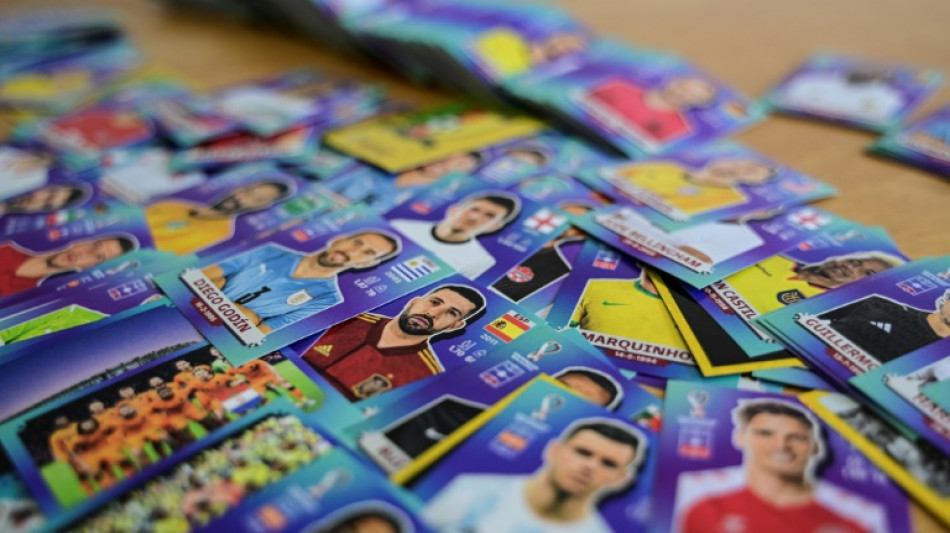
In Latin America, World Cup stickers are a quadrennial craze / Photo: MARTIN BERNETTI - AFP

 Brazil's Supreme Court clashes over handling of probe involving judge
 Trump threatens to keep Kennedy Center shut if his name not added
 i-payout Expands U.S. Money Transmitter Licensing Footprint and Advances European EMI Strategy

 Artists exit Sheeran tour in solidarity with Macklemore pro-Palestinian comments
 Espi saves Real Madrid with late winner at Elche
 Liverpool pile on misery for Spurs in League Cup, Dowman dazzles for Arsenal
 Trump blasts Supreme Court justices over 'horrible' mail vote ruling

 Maduro ally pleads guilty to US money laundering charges
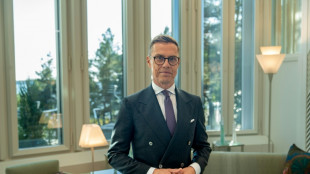 Finnish president Stubb speaks to AFP about Trump, Russia and saunas
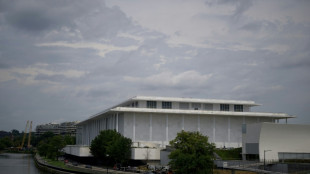 Trump says Kennedy Center to close after judge bars name change
 South Africa intensifies hunt after eight women found dead
 'Battle of Chile' documentary-maker Patricio Guzman dies, aged 85
 Tuchel wanted to eat grass after England's World Cup win in Mexico
 OpenAI, Anthropic and Google are working to create an AI standards body
 Lens sack Toppmoeller after six games in charge
 Rob Reiner son will not face death penalty, prosecutor says
 Referees chief Webb 'really disappointed' over VAR error in Manchester derby
 Maiden Renshaw ODI century sets up Australia win in Zimbabwe
 EU calls Russia 'reckless' after flares fired at Danish helicopter

 US Treasury chief says to meet Chinese counterpart at weekend
 Trump slams 'horrible' Supreme Court mail-in ballot ruling

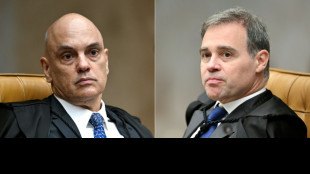 Brazil's crisis-hit Supreme Court probes judge's ties to jailed banker
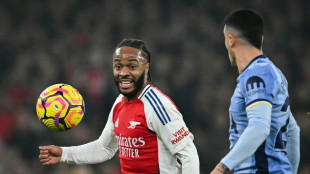 Sterling admits dangerous driving after Lamborghini crash
 Ambassador to Thailand plays down anti-Israeli protests
 BingX Evolves into a Multi-Asset Trading Platform, Connecting Users to Global Opportunities
Some spend crazy amounts, others line up at dawn or gather at informal swap meets -- anything to satisfy a passion that combines love of soccer, this year's World Cup in Qatar and the ever-popular pursuit of Panini soccer stickers.
Sold in 150 countries, the stickers seem to arouse a particular frenzy in Latin America because of the possibility that this might be the last World Cup for Argentinian football icon Lionel Messi, who is 35, or that a Latin American side might finally break Europe's hold on the Cup.
"Almost everything I earn, that anyone lends me, or that they owe me, I invest in the stickers," Hilda Losada, who is Argentinian, told AFP.
The 68-year-old grandmother, who is working to complete her album of nearly 700 stickers -- and her grandson's as well -- has been waiting in line since 5:00 am for the opening of a store in Buenos Aires.
The stickers have been in short supply for days in Argentina, with the government itself intervening to mediate between the Italian publisher and frustrated shopkeepers who want a bigger piece of the juicy trade.
"This is one of the few places where you can find them now," Losada said, standing in a long line of collectors.
Not everyone will leave happy, and some are vowing to turn to the black market, if need be, even if it costs twice the official price of about $1 for five stickers.
Her family tells her she's crazy, but Losada pays them no mind as she happily pursues her fascination. She has been collecting the cards every four years since she was "a little girl," she insists, even if galloping inflation in Argentina -- currently at 56 percent -- does not make that easy.
"Argentina is nearly always in an economic crisis," shrugged the shop owner, Leila Edul. "But now, with these stickers... money somehow appears out of nowhere."
That is true despite the soaring price of a packet since the 2018 World Cup in Russia. In Brazil, the cost has doubled, from 37 US cents to 74 cents.
- 'We like to trade' -
"My father bought me three packets," said an exuberant Tiziano Orselli, 14, as the two inspected the offerings at a swap meet at Buenos Aires's Rivadavia Park.
"When I saw 'Argentina 19' and realized it was Messi, I was too happy," he said. I showed it to everybody and then I stuck it, there, in the album," he said, his eyes still wide at the thought.
Mauricio Valencia had set up a table on sawhorses and piled it high with stacks of stickers to trade or sell. He said he had done this previously in Colombia, because "in Latin America we like to trade (Panini) stickers."
"But it's not the same here," he added. "There is such fervor -- it's packed every weekend."
Raul Vallecillo, a Panini official in Chile, said Latin American sales have exceeded the expectations of the Italian manufacturer, which published its first album for the 1970 World Cup in Mexico.
Chile's national team did not qualify for this year's World Cup, which opens in Qatar in November, yet Panini sold in a single month the stock it had expected to last four months, he said. The same trend holds in Venezuela, Colombia and Peru, all of which also failed to qualify, he said.
Vallecillo said the infatuation with the cards is heightened by the likelihood that this will be the last appearance of aging superstars like Messi and Cristiano Ronaldo, as well as the hope the Argentine or Brazilian side will be able to break the European teams' 20-year stranglehold on the championship.
- Street vendors -
In Sao Paulo, collectors have been gathering outside the Football Museum.
Forty-year-old Leandro Fonseca is on the hunt for some special-edition stickers, including some with Neymar's image, which have been selling on the internet for hundreds of dollars.
"I'm off to a late start on the 'extras,' but I hope to fill 20 albums, he said. "I fill several during every World Cup."
He said he had spent around $1,800 so far to complete seven albums.
Across Latin America, the resale business is brisk.
On a busy road in Montevideo, children come, carrying lists of sticker numbers, to try to buy those they're missing.
The stickers of stars like Messi, Neymar and local favorite Luis Suarez sell for around 100 pesos ($2.40). Other lesser stars from the Uruguayan, Argentine or Brazilian sides go for 20 to 50 pesos, while still others go for just 10 pesos (though a star like France's Kylian Mbappe brings in 50 pesos).
Guillermo Orcile has been helping his seven-year-old son Salvador complete his album entirely through trades.
"It's important that he understand how trading works, which makes these albums important," he said.
"Because if it's just about buying, then the spirit is lost."
S.Jackson--AT