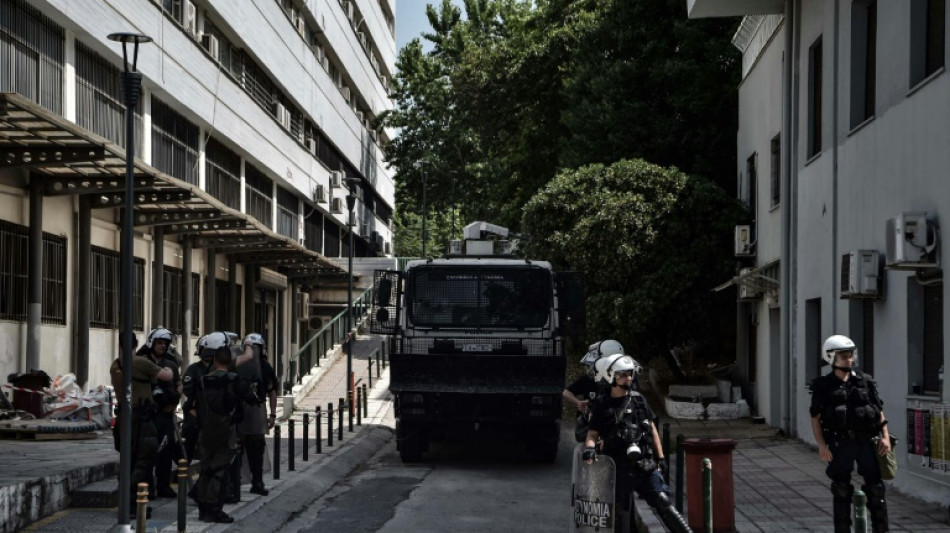
'Surreal': Greek university police makes dud debut / Photo: Sakis MITROLIDIS - AFP

 Brazil's Supreme Court clashes over handling of probe involving judge

 Trump threatens to keep Kennedy Center shut if his name not added

 i-payout Expands U.S. Money Transmitter Licensing Footprint and Advances European EMI Strategy

 Artists exit Sheeran tour in solidarity with Macklemore pro-Palestinian comments

 Espi saves Real Madrid with late winner at Elche

 Liverpool pile on misery for Spurs in League Cup, Dowman dazzles for Arsenal

 Trump blasts Supreme Court justices over 'horrible' mail vote ruling

 Maduro ally pleads guilty to US money laundering charges

 Finnish president Stubb speaks to AFP about Trump, Russia and saunas

 Trump says Kennedy Center to close after judge bars name change

 South Africa intensifies hunt after eight women found dead

 'Battle of Chile' documentary-maker Patricio Guzman dies, aged 85

 Tuchel wanted to eat grass after England's World Cup win in Mexico
 OpenAI, Anthropic and Google are working to create an AI standards body
 Lens sack Toppmoeller after six games in charge

 Rob Reiner son will not face death penalty, prosecutor says
 Referees chief Webb 'really disappointed' over VAR error in Manchester derby
 Maiden Renshaw ODI century sets up Australia win in Zimbabwe
 EU calls Russia 'reckless' after flares fired at Danish helicopter

 US Treasury chief says to meet Chinese counterpart at weekend

 Trump slams 'horrible' Supreme Court mail-in ballot ruling

 Brazil's crisis-hit Supreme Court probes judge's ties to jailed banker
 Sterling admits dangerous driving after Lamborghini crash

 Ambassador to Thailand plays down anti-Israeli protests

 BingX Evolves into a Multi-Asset Trading Platform, Connecting Users to Global Opportunities

Over a year after it was conceived as a ground-breaking response to Greece's notoriously unruly universities, a special campus police force has officially deployed -- to underwhelming results.
The squad of 1,000 officers deployed in September to four out of Greece's more than 20 university campuses. In Athens and second city Thessaloniki, all were chosen for having the highest instances of drug trading and petty crime.
"We haven't seen them," deadpanned one professor at Athens Polytechnic.
Armed only with batons, the freshly trained university protection squads (OPPI) have been deployed sparingly -- and under the protection of seasoned riot police -- following protests from outraged student groups.
"The campus police turned up once, there was uproar and they pulled back," said Sabina Kurrizi, a history student at Thessaloniki's Aristotelio University, also part of the initiative.
"Riot police are protecting the OPPI, who are supposed to be protecting us. It's absurd," she added.
Greek universities are chronically underfunded and notoriously disrupted by strikes, sit-ins and violence against students and staff.
Based on the most recent figures, Greece spent just under $4,100 per student in tertiary education in 2015, according to the Organisation for the Economic Co-operation and Development, compared to an OECD average of more than $15,600.
"Having a police squad guarding another police squad is surreal," says Theodoros Tsairidis, the head of the Thessaloniki police officers union.
- 'Safety' -
"Must be a world first," he quipped to AFP.
Inadequate state spending on education is a long-running concern in Greece.
In 2009, the year before the Greek economic crisis, the education ministry's annual budget was more than 7.2 billion euros ($6.9 billion). This year, it's less than five billion.
In 2020, the rector of Athens University of Economics and Business was assaulted in his office by a group of hooded youths, who put a sign around his neck that read "Solidarity to sit-ins".
Upon coming to power in 2019, the conservative government of Prime Minister Kyriakos Mitsotakis made law and order a top priority.
"Our government is determined to make the sense of safety in (universities) a reality," Citizen's Protection Minister Takis Theodorikakos said this week after the police raided Athens Polytechnic in an anti-gang crackdown.
More than 30 people were arrested in the swoop in connection with three gangs who turned part of a dilapidated student dormitory into a hideout, police said.
The Polytechnic is another campus chosen for the OPPI deployment.
"Prevention is always preferable to suppression," Deputy Education Minister Angelos Syrigos told daily newspaper Kathimerini on September 20.
"Having a police force nearby creates a sense of safety, and could avert violent incidents or damage," he said.
- 'Climate of fear' -
But a police presence in universities is highly controversial in Greece. During the Greek dictatorship, the police helped the army brutally crush a 1973 student uprising at the Athens Polytechnic.
Further outrage was caused this month when riot police fired tear gas during a student concert at Aristotelio.
Aristotelio staff told a news conference this week that the presence of riot police was disrupting daily life on campus.
"This is an anarchic force that creates a climate of fear. Classes cannot be held under a climate of fear," electrochemistry professor Sotiris Sotiropoulos told reporters.
"It's a risk to our physical and mental safety," he said.
Student reactions are mixed.
"Yes, there were incidents of lawlessness, but now we have tank-like police vehicles on campus... many of my fellow students are afraid to walk around," says Irini, 21, a biology student at Aristotelio.
But Artemis, a 22-year-old psychology undergraduate, says the university's sprawling park-like campus is dangerous at night.
"There is drug trading on a daily basis, and frequent fights and stabbings. There are also regular sit-ins and vandalism by people who are not part of the university," she said.
"We can't have just anybody coming in and doing whatever they feel like. Students have nothing to fear from increased security," she argued.
Y.Baker--AT