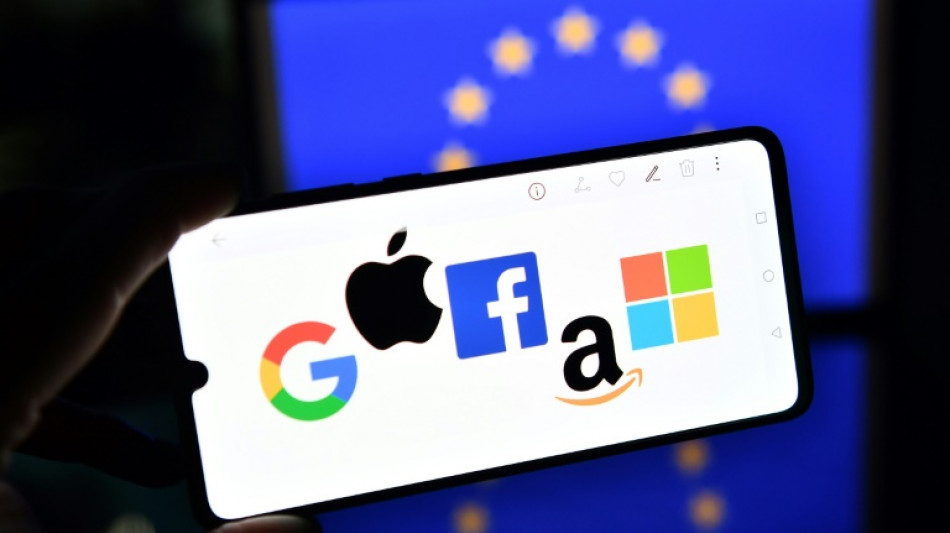
Europe's battle with Big Tech: billions in fines and tough laws / Photo: JUSTIN TALLIS - AFP/File

 Pietersen joins England coaching team ahead of World Cup

 Germany's triumphant far-right AfD aims fire at Merz

 Fury claims Joshua bout is off, calls for Usyk trilogy

 British family bids to row back against suicide taboo

 China's teenage 223cm basketball player 'just a little girl'

 Tokyo's Shinjuku to ban more than half of vacation rentals

 Australian Rules limits contact training to reduce concussion

 Germany's Merz under pressure from far-right election triumph

 Nepal tunnel rescues face 'unprecedented' challenge

 Mourinho's Real Madrid European revival bid starts with Inter reunion

 Solomons PM survives attempt to oust government

 Ohtani 'unlikely' to pitch again this season, says Dodgers manager

 Driver thanks 'superhero' rival for saving him from flaming race car

 Can dogs sniff cancer? AI joins the hunt in India

 Shelton steams into US Open quarter-final clash with Alcaraz
 25 years on, America seeks to keep 9/11 memories alive

 'Trumpapalooza' tests Republican bet on unpopular US president

 Pegula tops Cirstea to reach US Open quarter-finals

 Australians could opt out of social media algorithms under new law

 Genflow Biosciences PLC Announces Appointment of Investor Relations Adviser

 Enjoying the moment: Alcaraz steps it up to reach US Open quarter-finals

 Five dead, five injured after Amazon cargo plane overshoots Miami runway

 La Rochelle half-backs lead fightback against Toulouse

 US envoys have 'more effective proposals': Ukraine official

 Defending champion Alcaraz powers into US Open quarter-finals

The European Union is on a mission to rein in US tech giants, which have been accused of tax avoidance, stifling competition, raking in billions from news without paying for it and spreading misinformation.
In the past few years, the EU has slapped eye-watering fines on Apple and Google in tax and competition cases, and drawn up a landmark law to curb the market dominance of Big Tech. Brussels has also toughened its code of conduct on disinformation and hate speech.
As a European court on Wednesday rejected Google's appeal against a 4.3-billion-euro antitrust fine ($5 billion at the time it was levied), we look at the battle between Brussels and Silicon Valley:
- Stifling competition -
The digital giants are regularly criticised for dominating markets by elbowing out rivals.
In July, the European Parliament adopted the Digital Markets Act to curb the market dominance of Big Tech, with violations punishable with fines of up to 10 percent of a company's annual global sales.
Brussels has slapped over eight billion euros in fines on Google alone for abusing its dominant market position.
In 2018, the company was fined 4.3 billion euros -- the biggest ever antitrust penalty imposed by the EU -- for abusing the dominant position of its Android mobile operating system to promote Google's search engine.
Google lost its appeal against that decision on Wednesday, though the fine was reduced to 4.1 billion euros.
The firm is also challenging a 2.4-billion-euro fine from 2017 for abusing its power in online shopping and a separate 1.5-billion-euro fine from 2019 for "abusive practices" in online advertising.
The EU has also gone after Apple, accusing it of blocking rivals from its contactless iPhone payment system, and fined Microsoft 561 million euros in 2013 for imposing its search engine Internet Explorer on users of Windows 7.
Italy joined in the action last year, hitting Amazon with a 1.1-billion-euro antitrust fine for abusing its dominance to push its logistics business.
- Taxation -
The EU has had less success in getting US tech companies to pay more taxes in Europe, where they are accused of funnelling profits into low-tax economies like Ireland and Luxembourg.
In one of the most notorious cases, the European Commission in 2016 found that Ireland granted illegal tax benefits to Apple and ordered the company pay 13 billion euros in back taxes.
But the EU's General Court later overturned the ruling, saying there was no evidence the company broke the rules.
The Commission also lost a similar case involving Amazon, which it had ordered to repay 250 million euros in back taxes to Luxembourg.
Frustrated by the lack of progress, France, Italy and several other European nations forged ahead with their own taxes on tech companies while waiting for a global agreement on the issue.
That came in October 2021 when the G20 group of nations agreed on a minimum 15 percent corporate tax rate. Nearly 140 countries signed up to the deal.
- Personal data -
Tech giants are regularly criticised over how they gather and use personal data.
The EU has led the charge to rein them in with its 2018 General Data Protection Regulation, which has since become an international reference.
Companies must now ask for consent when they collect personal information and may no longer use data collected from several sources to profile users against their will.
Amazon was fined 746 million euros by Luxembourg in 2021 for flouting the rules.
Earlier this month, Irish authorities fining Instagram, a Meta subsidiary, 405 million euros for breaching EU regulations on the handling of children's data.
- Fake news and hate speech -
Social networks, particularly Facebook and Twitter, are often accused of failing to tackle disinformation and hate speech.
In July, the European Parliament approved a Digital Services Act that forces big online companies to reduce risks linked to disinformation or face fines of up to six percent of their global turnover.
- Paying for news –
Google and other online platforms are also accused of making billions from news without sharing the revenue with those who gather it.
To tackle this, an EU law in 2019 created a form of copyright called "neighbouring rights" allowing for print media to demand compensation for use of their content.
France was the first country to implement the directive.
After initial resistance, Google and Facebook agreed to pay French media, including AFP, for articles shown in web searches.
That did not stop the company being fined half-a-billion euros by France's competition authority in July 2021 for failing to negotiate "in good faith", a ruling Google has appealed.
Facebook has also agreed to pay for some French content.
Ch.Campbell--AT