
Marijuana Schedule III Escapes an Immediate Freeze-Now the Billion-Dollar Order Must Survive the Law

 Argentina begin life after Messi with Bolivia friendly

 Helen Mirren delves into Patricia Highsmith's mind in 'A Talent for Murder'
 Sanders, Bannon warn of AI dangers in rare US left-right alignment

 US Senate crypto bill collapses amid partisan deadlock

 Raptors confirm Leonard return after Clippers salary cap scandal

 Empty benches as schools reopen in Venezuela's quake-hit Guaira

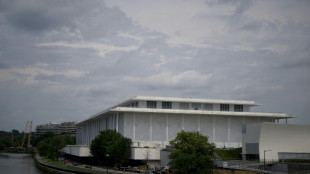 US judge rules Trump's name must remain off Kennedy Center

 Samson fires India to T20 series win over Afghanistan

 Carney sells Canada to global investors but says US ties still key

 Tiny English village holds 'independence' vote over asylum seeker housing

 Trump slams Supreme Court over 'horrible' mail-in ballot ruling

 Protesting shepherds, farmers clash with Romanian police

 Saudi, Egypt demand open Red Sea, as Riyadh vows to hit back against Houthis

 Foundation Lets Ledger Users Switch to Open Source Without Starting Over

 Canada remains 'most important partner' for US in 'key areas': Carney

 Carrick urges Man Utd to use derby pain as fuel against Brighton

 Turkey police detain dozens over pro-LGBTQ Istanbul rally

 'Kenya's moment' as Nairobi to host 2029 world athletics champs in African first

 China warns against space 'battlefield' after US says weapons deployed

 Denmark says Russian frigate fired flares at helicopter

 EU to propose curbing social media, online games for under 15s

 FX Junction Reaches 40,600 Members and 26 Million Trades

 Prominent Greek neo-Nazi exits prison, vows return to politics

 'Obsessed': explosive state crime inquiry grips South Africa

 Sri Lanka's javelin champ returns to 'broken' welcome

"The federal appeals court left the limited Schedule III order in effect while MMJ's challenge proceeds, but the stay denial did not uphold the order's legality or decide the separate DEA proceeding considering broader marijuana rescheduling." - Duane Boise, President, MMJ International Holdings
WASHINGTON, D.C. / ACCESS Newswire / September 9, 2026 / The United States Court of Appeals for the District of Columbia Circuit has denied a request to suspend the federal government's limited marijuana Rescheduling Order while consolidated legal challenges brought by MMJ International Holdings and other petitioners proceed.
The September 9 ruling means the existing order remains effective during judicial review. It does not uphold the order's legality, decide the merits of the petitioners' claims or authorize the separate DEA administrative proceeding considering whether marijuana should be transferred more broadly to Schedule III.

The consolidated litigation is SAM, Inc. v. United States Department of Justice, Nos. 26-1106, 26-1130 and 26-1136. MMJ International Holdings, Inc., MMJ BioPharma Cultivation, Inc. and MMJ BioPharma Labs, Inc. are among the petitioners challenging the federal action.
"The court decided whether the extraordinary remedy of an interim stay was warranted before full merits briefing," said Duane Boise, president of MMJ International Holdings. "It did not decide whether the Attorney General had authority to create this unprecedented Schedule III system without completing the procedures Congress enacted."
What Remains in Effect
The April 2026 final order placed two defined categories into Schedule III:
The order also established an expedited federal registration process for certain state licensed medical-marijuana entities.
Marijuana outside those categories, including marijuana associated solely with state adult use programs, was not transferred to Schedule III by that limited order.
The D.C. Circuit's stay decision leaves this existing framework in effect while the court reviews its legality. It does not constitute judicial approval of the framework.
What the Court Did Not Decide
The court's two-page order (see attached) stated that the petitioners had not satisfied the "stringent requirements" for a stay pending review. It did not identify whether that conclusion was based on likelihood of success, irreparable injury, competing harms, the public interest or a combination of those factors.
The court did not decide:
"This was not the finish line," Boise said. "The central statutory questions remain unanswered."
Court Directs the Parties to Prepare for Briefing
The D.C. Circuit ordered the parties to submit proposed briefing formats within 30 days. The court strongly encouraged a joint proposal and warned that it disfavors repetitive submissions by aligned parties.
The court stated that parties seeking separate briefs or additional words must provide detailed justifications identifying the issues requiring separate treatment.
That instruction is significant for MMJ because its challenge includes issues distinct from those advanced by drug-testing organizations, public-interest groups and state petitioners.
MMJ's position arises from its investment of more than eight years and over $10 million developing cannabinoid pharmaceuticals through the federal FDA and DEA pathways while state marijuana operators received immediate Schedule III treatment based on state medical-marijuana licenses.
MMJ intends to preserve its distinct arguments concerning competitive injury, federal pharmaceutical development, DEA registration delays and the government's unequal treatment of FDA pathway cannabinoid medicines.
State Marijuana Companies Denied Full Intervention
The court also denied a request by MedPharm Iowa, LLC, and Tri-Mountain Pure, LLC to intervene as full parties supporting the government and defending the Schedule III order.
The court concluded that the companies had not demonstrated that their interests were inadequately represented by existing parties. It permitted them to participate as amici curiae, allowing them to submit arguments without receiving the procedural status of intervening parties.
Cannabis Industry Attorneys was also permitted to participate as an amicus.
A Separate DEA Proceeding Continues
The appellate cases challenge the already effective limited order covering FDA-approved products and qualifying state-licensed medical marijuana.
A separate DEA administrative proceeding is considering a broader question: whether marijuana generally should be transferred from Schedule I to Schedule III.
The two proceedings must not be confused.
The D.C. Circuit did not approve, direct or authorize the broader DEA proceeding in its September 9 order. That administrative matter is moving forward independently under a separate order and administrative record.
In its closing submission to the DEA administrative law judge, DEA argued that marijuana no longer satisfies the statutory requirements for Schedule I. The agency cited more than 30,000 practitioners treating over six million patients in 43 jurisdictions as evidence of accepted medical use and accepted safety under medical supervision.
MMJ disputes whether patient counts and state physician certifications establish that marijuana possesses standardized chemistry, reproducible dosing, adequate safety evidence and well-controlled proof of efficacy.
"A state authorization to purchase dispensary marijuana is not an FDA approval, and a physician's certification is not the same as a prescription for an approved pharmaceutical," Boise said. "Widespread use may be evidence for the government to evaluate, but volume alone does not transform variable products into scientifically validated medicines."
The DEA administrative law judge will issue a recommendation. Final administrative authority rests with the DEA Administrator, subject to applicable judicial review.
The Treaty Question Remains Central
The Attorney General relied on the treaty-implementation provision of the Controlled Substances Act to issue the limited Schedule III order without completing the ordinary scheduling process.
MMJ maintains that the Single Convention may require the United States to control marijuana but does not compel the particular system the Attorney General selected.
The treaty does not expressly require the United States to:
In NORML v. DEA, 559 F.2d 735 (D.C. Cir. 1977), the D.C. Circuit rejected DEA's attempt to treat international treaty obligations as a broad substitute for the scientific, medical and procedural framework Congress established.
MMJ argues that when a treaty permits multiple domestic approaches, the Attorney General cannot use treaty authority to avoid the ordinary requirements of federal law.
Financial Benefits Remain Exposed to Judicial Review
Because the limited order remains effective, covered state medical-marijuana operators may continue relying on Schedule III while the appeal proceeds, including any applicable consequences under Internal Revenue Code Section 280E.
Those benefits remain exposed to the final outcome of the litigation.
If the D.C. Circuit later vacates the state-license portion of the order, remands it to DOJ or determines that the Attorney General used an unlawful procedure, the resulting legal and financial consequences could be substantial.
"The industry may continue operating under the order while the case is pending," Boise said. "But the court has not ruled that the foundation beneath those benefits is lawful."
About MMJ International Holdings
MMJ International Holdings is developing proprietary cannabinoid-based medicines through the FDA clinical-development process. Its affiliated companies include MMJ BioPharma Cultivation, Inc. and MMJ BioPharma Labs, Inc.
MMJ's programs include investigational new drug applications involving Huntington's disease and multiple sclerosis, an Orphan Drug Designation, a DEA Schedule I analytical registration and approximately 50,000 defined-dose softgel capsules manufactured through Catalent Pharma Solutions.
Media Contact:
Madison Hisey
[email protected]
203-231-8583
This release concerns pending judicial and administrative proceedings. The D.C. Circuit has not decided the merits of the consolidated appeals, and the DEA administrative law judge has not issued a final recommendation in the separate broader rescheduling proceeding.
SOURCE: MMJ International Holdings
View the original press release on ACCESS Newswire
M.Robinson--AT