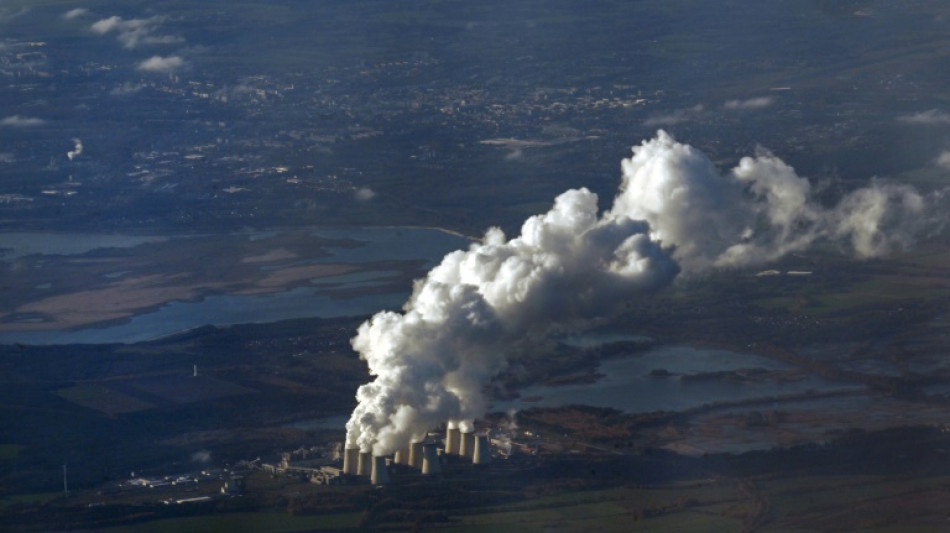
Explosives used in sabotage attack on German power lines / Photo: INA FASSBENDER - AFP/File

 Zach Hickerson Recounts Hayden Panettiere's Final Moments in New Interview

 Luxembourg Housing Petition Passes Threshold for Parliamentary Consideration

 Raheem Sterling Receives Suspended Sentence After Lamborghini Crash

 Audience to Choose the Set List at Luxembourg's First FAMIL Jukebox Night

 Luxembourg Pay Rise Delayed as Regional and World Headlines Develop

 Chennai Urbanist Sashna Develops 'Anniki' Card Game to Gamify Tamil Nadu History

 Transport Minister Defends Land Seizure Powers for Toronto-Quebec City High-Speed Rail

 UAE Weather Forecast: Scattered Showers and Fog Expected as Temperatures Drop
Improvised explosive devices were used Tuesday in a sabotage attack near a coal-fired power plant in Germany, with several electricity lines damaged and supply briefly interrupted, officials said.
Several of the devices were found around 8:00 am (0600 GMT) at the Preilack substation, which distributes power from the nearby Jaenschwalde plant, a police spokeswoman told AFP.
At least one detonated but others failed to go off, she said, adding that no one was hurt and there was no major blackout in the area about 100 kilometres (60 miles) southeast of Berlin.
It was the latest in a string of arson attacks around the German capital, with far-left militants often claiming responsibility.
Berlin, a key backer of Ukraine, is also on high alert for sabotage plots linked to Russia.
Dietmar Woidke -- premier of Brandenburg state, where the incident took place -- condemned the targeting of the power lines.
"We take attacks on our critical infrastructure very seriously," he said in a statement, adding there was a "worryingly high frequency" of such episodes.
"Anyone who tries to sabotage our critical infrastructure and paralyse society is attacking all of us. But we will not allow ourselves to be blackmailed or intimidated by criminal activity."
Power plant operator LEAG described the incident as an "attack". Following the incident, there was a "technical failure" in a unit at the power plant, and a possible connection was being investigated, it said.
- String of arson attacks -
Grid operator 50Hertz claimed that unidentified perpetrators damaged several lines in its grid.
"There was a brief interruption of service. All lines are now back in operation. The general power supply is currently not affected," it said in a statement.
In further comments to the Focus news outlet, a spokesman for the operator said homemade projectiles, resembling fireworks typically used on New Year's Eve in Germany, were used in the attack.
Local newspaper the Maerkische Allgemeine Zeitung reported they resembled large, homemade model rockets.
The police spokeswoman said an investigation had been launched to determine who was behind the incident.
Among the recent arson attacks, the most serious took place in Berlin in January.
It caused an electricity outage that left tens of thousands of homes and thousands of businesses without power for nearly a week in the middle of winter in the southwest of capital.
The far-left "Vulkangruppe" (Volcano Group) claimed responsibility for the arson attack on high-voltage cables that caused that blackout.
It also claimed to be behind two sabotage attacks targeting a Tesla electric car factory just outside Berlin.
D.Lopez--AT


