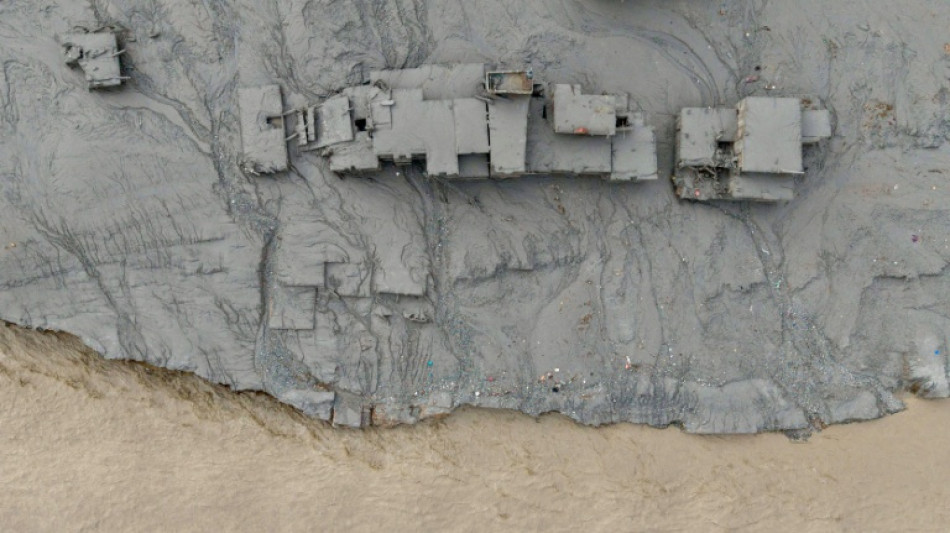
UN, Nepal warn of climate threat after deadly floods / Photo: Prabin RANABHAT - AFP

 Zach Hickerson Recounts Hayden Panettiere's Final Moments in New Interview

 Luxembourg Housing Petition Passes Threshold for Parliamentary Consideration

 Raheem Sterling Receives Suspended Sentence After Lamborghini Crash

 Audience to Choose the Set List at Luxembourg's First FAMIL Jukebox Night

 Luxembourg Pay Rise Delayed as Regional and World Headlines Develop

 Chennai Urbanist Sashna Develops 'Anniki' Card Game to Gamify Tamil Nadu History

 Transport Minister Defends Land Seizure Powers for Toronto-Quebec City High-Speed Rail

 UAE Weather Forecast: Scattered Showers and Fog Expected as Temperatures Drop
Nepal's foreign minister and the UN climate chief on Saturday warned of the growing threat from global warming to the Himalayas, as rescuers race to find thousands missing after torrential flooding along the border with China.
The US Geological Survey said the disaster on Wednesday near the high-altitude border was caused by a glacial collapse that sent a torrent of debris downstream, with nearly 3,000 people missing and 682 confirmed dead.
While the exact cause of the collapse is unclear, climate change is causing glaciers to melt worldwide, increasing the risk of such disasters.
Nepalese Foreign Minister Shisir Khanal said he had spoken by phone with his Chinese counterpart Wang Yi, agreeing to increase the sharing of "real-time hydrological data", according to a statement.
Wang, in a Chinese foreign ministry statement, said Beijing had "shared crucial information with Nepal, including disaster area imagery, satellite and hydrological data, as well as early warnings about upstream barrier lakes".
Wang added that "China and Nepal are bound by mountains and rivers, sharing a common destiny".
Khanal earlier told reporters that Nepal needed greater research to "understand the changing dynamics of the Himalayan ecosystem" and the risks they pose to the landlocked country, encircled by India and China.
That includes not only risks "to Nepal and the downstream community, but also to our northern neighbour, to China, as well," Khanal said.
Himalayan glaciers, which provide critical water to nearly two billion people, are melting faster as the planet heats, exposing communities to unpredictable, costly disasters.
Khanal said climate change required international action.
"We always highlight that Nepal contributes less than or just about 0.01 percent of greenhouse gases but we, the people of Nepal, are one of the major victims of the changing climate and its impact," he added.
"So we request the global community also to come together to preserve the Himalayan ecosystem."
UN climate chief Simon Steill meanwhile said in a statement that the "sudden glacial collapse and flash flood is a devastating reminder of how fragile these mountain environments can be".
"We also know a warming climate, driven by humanity burning colossal amounts of coal, oil and gas, is making tragedies like this one, and so many others around the world, much more likely, frequent and severe, with vulnerable communities often hardest hit," he added.
Melting glaciers and thawing permafrost can also destabilise mountain slopes, increasing the risk of landslides and other hazards.
burs-pjm/des/sst
Th.Gonzalez--AT


