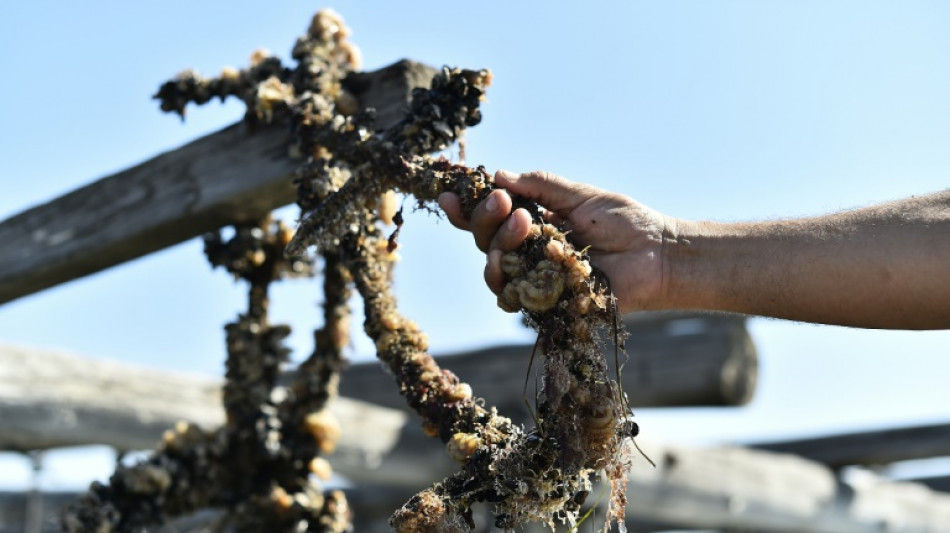
Heatwave batters Spain's Mediterranean mussel crop / Photo: Pau BARRENA - AFP

 Philippine sensation Eala looks forward to Asian Games 'fun'
 Jakarta airport extends closure after volcano eruption

 Lonely woman director in Venice sees industry backsliding on gender

 Tech firms rally on mixed day for Asian markets, with eyes on US inflation

 World number one An sends Asian Games warning with China hat-trick
 PSG go for three in a row as Champions League returns
 "Super-human' Alcaraz books US Open quarter-final clash with Shelton

 ECB set to hike interest rates as Iran war flares anew

 AI data centers are less thirsty now, tech giants say

 North Korea vows nuclear-armed navy as US ally drills open

 Under-fire Labuschagne named in Australia Test squad for South Africa

 Enjoying the moment: Alcaraz steps it up to reach US Open quarter-finals

 Five dead, five injured after Amazon cargo plane overshoots Miami runway

 La Rochelle half-backs lead fightback against Toulouse

 US envoys have 'more effective proposals': Ukraine official

 Defending champion Alcaraz powers into US Open quarter-finals

 Amazon cargo plane overshoots Miami runway, hits vehicles, catches fire

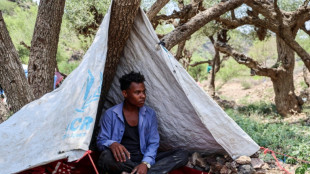 Toll from Yemen clashes passes 300 as civilians flee homes

 Sabalenka books US Open quarter-final clash with Noskova

 German AfD supporters jubilant at far right's thumping win

 Zelensky warns war likely to continue into winter after US talks

 Arsenal deliver statement fightback to end Chelsea's flying start

 Leclerc accepts blame as Hamilton laments Ferrari approach

 Sabalenka surges past Townsend to reach US Open quarter-finals

 Smiling face of Germany's far-right AfD: Ulrich Siegmund

"There's nothing left here," sighs Javier Franch as he shakes the heavy rope of mussels he's just pulled to the surface in northeastern Spain. They are all dead.
With the country hit by a long and brutal heatwave this summer, the water temperature in the Ebro Delta, the main mussels production area of the Spanish Mediterranean, is touching 30 degrees Celsius (86 degrees Fahrenheit).
And any grower who hasn't removed their molluscs in time will have lost everything.
But that's not the worst of it: most of next year's crop has also died in one of the most intense marine heatwaves in the Spanish Mediterranean.
By the end of July, experts said the western Mediterranean was experiencing an "exceptional" marine heatwave, with persistently hotter-than-normal temperatures posing a threat to the entire marine ecosystem.
"The high temperatures have cut short the season," says Franch, 46, who has spent almost three decades working for the firm founded by his father, which has seen production fall by a quarter this year.
The relentless sun has heated up the mix of fresh and saltwater along Catalonia's delicate coastal wetlands where the River Ebro flows into the Mediterranean.
On a scorching summer morning in Deltebre, one of the municipalities of the Delta, the mussel rafts -- long wooden structures with ropes attached which can each grow up to 20 kilograms (44 pounds) of mussels -- should be teeming with workers hurrying around during the busy season.
But there is hardly any movement.
"We lost the yield that was left, which wasn't much, because we were working to get ahead so we wouldn't go through this," explains Carles Fernandez, who advises the Ebro Delta's Federation of Mollusc Producers (Fepromodel).
"But the problem is that we've lost the young stock for next year and we'll have quite a high cost overrun."
- Millions in losses -
The heat has wiped out 150 tonnes of commercial mussels and 1,000 tonnes of young stock in the Delta, initial estimates suggest.
And producers are calculating their losses at over one million euros ($1,000,000) given they will now have to buy young molluscs from Italy or Greece for next year.
"When you have a week when temperatures are higher than 28C, there can be some mortality, but this summer it has lasted almost a month and a half," with peak temperatures of almost 31C, says Fepromodel head Gerardo Bonet.
Normally, the Ebro Delta's two bays produce around 3,500 tonnes of mussels, and 800 tonnes of oysters, making Catalonia Spain's second-largest producer, although it remains far behind the output of Galicia, the northwestern region on the colder Atlantic coast.
For years now, the harvest in the Delta has been brought forward, cutting short a season that once ran from April to August.
- 'Tropical' Mediterranean -
Hit by coastal erosion and a lack of sediment supply, the rich ecosystem of the Ebro Delta -- a biosphere reserve and one of the most important wetlands of the western Mediterranean -- is particularly vulnerable to climate change.
And this extreme summer, when Spain endured 42 days of heatwave -- a record three times the average over the past decade, the AEMET national forecaster says -- has also left its mark below the surface of the water.
"Some marine populations which are unable to cope with temperatures as high as these over a long period of time are going to suffer what we call mass mortality," says marine biologist Emma Cebrian of the Spanish National Research Council (CISC).
"Imagine a forest, it's like 60 or 80 percent of the trees dying, with the resulting impact on its associated biodiversity," she says.
The succession of heatwaves on land has generated another at sea which -- pending analysis of all the data in November -- may turn out to be "the worst" in this area of the Mediterranean since records began in the 1980s.
Although marine heatwaves are not a new phenomenon, they are becoming more extreme with increasingly dire consequences.
"If we compare it with a wildfire, one can have an impact, but if you keep having them, it will probably mean the affected populations are not able to recuperate," Cebrian said.
Experts say the Mediterranean is becoming "tropicalised", and mollusc grower Franch is struck by the mounting evidence as his boat glides between empty mussel rafts in a bay without a breath of wind.
He is mulling an increase in his production of oysters, which are more resistant to high temperatures, but which currently represent just 10 percent of his output.
But he hopes it will help ensure his future in a sector that employs 800 people directly or indirectly in the Ebro Delta.
"(The sector) is under threat because climate change is a reality and what we are seeing now will happen again," he says worriedly.
W.Nelson--AT