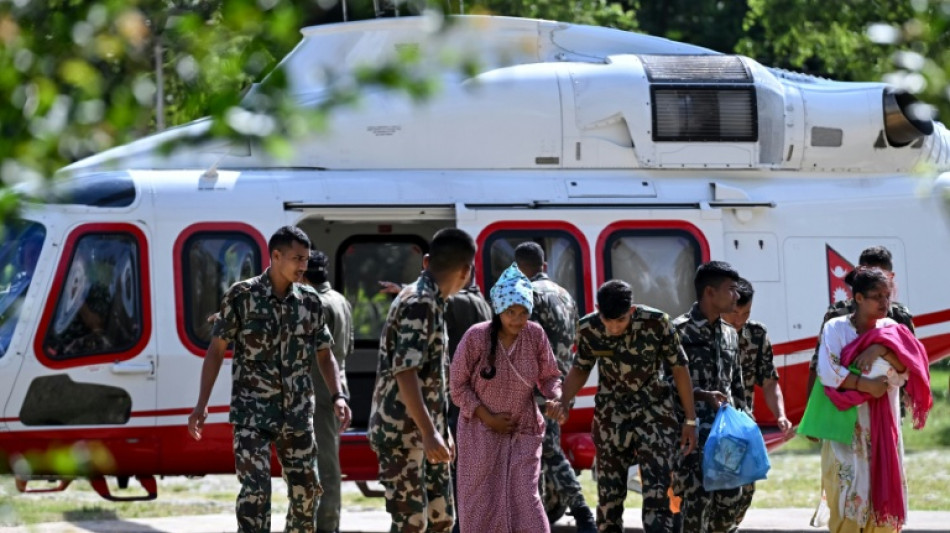
'Ran for our lives': Tales of survival from Nepal-China disaster / Photo: Arun SANKAR - AFP

 Zach Hickerson Recounts Hayden Panettiere's Final Moments in New Interview

 Luxembourg Housing Petition Passes Threshold for Parliamentary Consideration

 Raheem Sterling Receives Suspended Sentence After Lamborghini Crash

 Audience to Choose the Set List at Luxembourg's First FAMIL Jukebox Night

 Luxembourg Pay Rise Delayed as Regional and World Headlines Develop

 Chennai Urbanist Sashna Develops 'Anniki' Card Game to Gamify Tamil Nadu History

 Transport Minister Defends Land Seizure Powers for Toronto-Quebec City High-Speed Rail

 UAE Weather Forecast: Scattered Showers and Fog Expected as Temperatures Drop
Some survivors of the deadly floods on the Nepal-China border ran for their lives, others narrowly missed disaster, but all were eyewitnesses to a major calamity and its aftermath.
Rescue crews in helicopters have been plucking survivors from along the valleys ravaged in the tsunami-like flow of water and debris apparently unleashed by a glacier's collapse.
More than 1,400 people were still missing on Friday -- many of them foreign tourists -- and over 550 people were dead.
Here is what survivors told AFP:
- 'Suddenly engulfed us': the pilgrims -
Sivaranjani Muthunathan was travelling in Nepal by bus with 56 others from India's southern state of Tamil Nadu. They were heading towards the Chinese border when they became stuck in what they thought was a traffic jam.
"Then there was fog, smoke, something that seemed to suddenly engulf us," Muthunathan, 46, told AFP, showing a video she recorded on her phone of a torrent surging towards her.
Vehicles were swept away or buried under mud around them.
"One by one, we also climbed out through the driver's side," she said, recounting how she had then scrambled up a hill.
Another pilgrim who was on the bus, 53-year-old Vijayabhuvaneshwari, said: "We had no choice."
"Every vehicle in front of us, behind us, was gone," she told AFP.
"As we were climbing up, we could hear what felt like explosions," she said, giving only one name. "They were rocks and boulders crashing."
With older members of the group struggling to climb the bank, Poonguzhali Ponmambadan, 61, unwrapped her sari dress and gave it to her husband to use as a rope.
"He used it as a harness to lift several old people," she said.
- 'More died than were rescued': dam worker -
Workers rescued from dam projects along the Trishuli valley described a disaster that unfolded with terrifying speed.
"There were at least 400 workers at the site," Dev Shrestha, who was airlifted from the site where he was working, told AFP after his rescue. "More people died than were rescued."
Worker Buddha Tamang said he survived only because he was inside a tunnel at the dam where he worked when the flood struck -- but he had managed to get out and reach help.
"I survived as I was in the tunnel," said Tamang, who was airlifted on Thursday after being marooned for more than 24 hours.
"The senior officers working on the other side, they were all swept away."
Another worker, Arjun Kumar Tamang, spoke of "massive damage" at the hydropower site where he had been.
"I don't know how many people died but the force of the water swept everything away," he said.
- 'Only the river remained': engineer -
"I was at the powerhouse. I heard a loud noise. There was some seepage and we were told to come out," said Ananay Sharma a 29-year-old engineer from India working on a project in the area.
"When I came out, everything was gone, only the river remained," he added. "One residential camp completely washed away, another remains where we took shelter."
- '20 seconds': worker -
Gorakh Khatka, an engineer who had been in the Shanti Bazar area near the epicentre of the disaster, ran for his life.
"All we got to react was 20 seconds before mud and water was as high as 20 feet (six metres) in the inundated area," he said.
"We ran for our lives and spent more than 48 hours on a hill before help finally arrived."
T.Sanchez--AT


