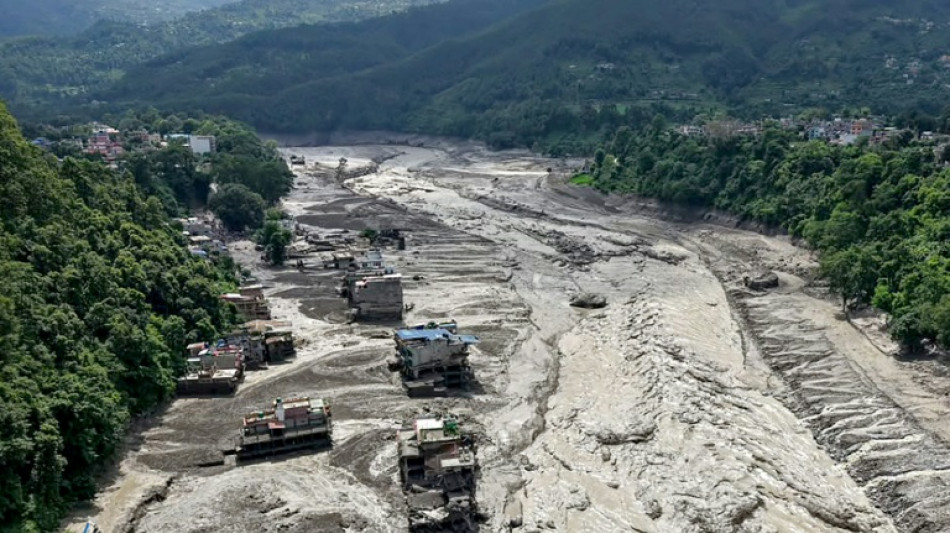
What experts know so far about Nepal's deadly floods / Photo: Prabin RANABHAT - AFP

 Zach Hickerson Recounts Hayden Panettiere's Final Moments in New Interview

 Luxembourg Housing Petition Passes Threshold for Parliamentary Consideration

 Raheem Sterling Receives Suspended Sentence After Lamborghini Crash

 Audience to Choose the Set List at Luxembourg's First FAMIL Jukebox Night

 Luxembourg Pay Rise Delayed as Regional and World Headlines Develop

 Chennai Urbanist Sashna Develops 'Anniki' Card Game to Gamify Tamil Nadu History

 Transport Minister Defends Land Seizure Powers for Toronto-Quebec City High-Speed Rail

 UAE Weather Forecast: Scattered Showers and Fog Expected as Temperatures Drop
The cause of the deadly landslide and flood along the Nepal-Tibet border isn't yet certain, but experts say the dangers associated with such events are compounded by the region's extreme topography, with risks rising due to climate change.
These hazards include glacial lake outburst floods (GLOF) -- the sudden and catastrophic release of vast volumes of water from melting glacier-fed lakes.
The flash floods and landslides killed at least 165 people and swept away entire villages. Videos from the region showed a terrifying wall of mud overwhelm buildings and toss vehicles like toys.
- Glacial collapse -
Nepal's Foreign Minister Shishir Khanal initially said an earthquake likely triggered a landslide that in turn blocked a river, sending water gushing downstream after it eventually breached the obstruction.
But in an updated note, the US Geological Survey said that while the event was initially reported as a magnitude 4.4 earthquake, "additional analysis of long period seismic waves indicate that the seismic energy was instead generated by a glacial collapse and debris flow."
Dorothy Heinrich, a researcher at the UK's University of Reading, told AFP that GLOFs were among the hazards posed by a warming planet in the region.
"We do know what climate change trends look like in the Himalayas. There is high confidence of more heat waves, glacial retreat, permafrost reduction, these sorts of things that can drive things like landslides and glacial outburst floods," she said.
But to determine whether a particular event is linked to climate change, scientists carry out what are known as attribution studies, which use simulations to compare how likely an event was in the fossil-fuel-warmed climate of today, versus the pre-industrial era.
A previous glacial outburst flood occurred in July 2025, originating in China's Gyirong County, then surging into Nepal's Rasuwa District.
- Running won't help -
A preliminary assessment by the Kathmandu-based International Centre for Integrated Mountain Development (ICIMOD) found "no anomalies" from the Chinese side of the border.
"We believe a rock-ice avalanche occurred in Nepal, blocking the Lhende river and causing the cascading flood event," Sarthak Shrestha, a remote sensing and geo information analyst with the intergovernmental institute, told AFP.
Hatim Sharif, a hydrologist at the University of Texas San Antonio, told AFP one thing that struck him was the lack of rainfall beforehand.
"That defeats essentially every operational flood warning system in the world," he said.
By the time you see the mud flow coming, it's too late.
"Running will not help," nor will trying to flee by vehicle, Sharif said, because the mud and water moving at high speed form a lethal combination "like liquid concrete."
The only solution is to climb up a hill, at least 20 feet (six meters), he estimates.
One possible long-term remedy might be river level gauges that relay changes to authorities in real-time, giving residents 20-30 minutes of warning, he said.
Qianggong Zhang, head of climate and environmental risks at ICIMOD, warned of the potential for a second flood because of an ongoing blockage upstream.
A.Ruiz--AT


