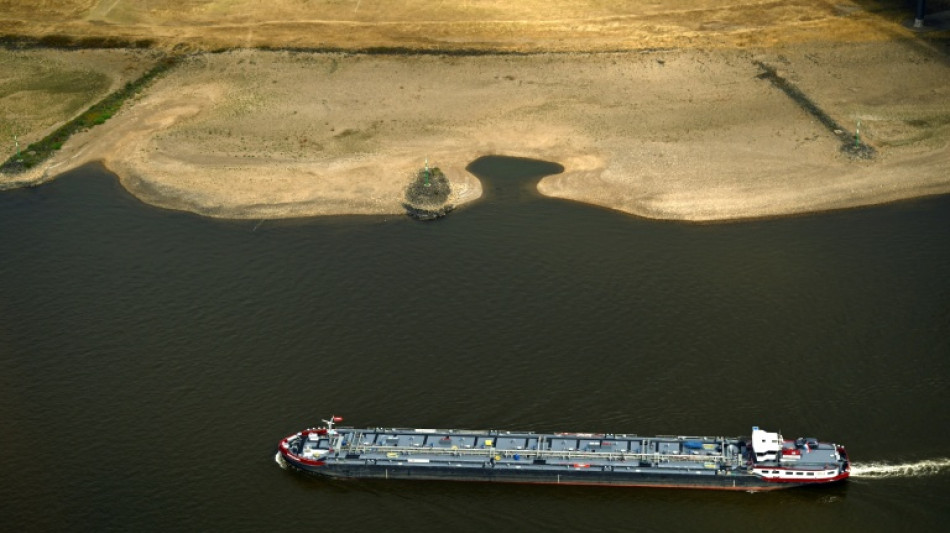
As Europe's rivers recede, shippers scramble to limit damage / Photo: Ina FASSBENDER - AFP

 Emmys gala will now stream its premier television awards

 Paramount completes Warner Bros takeover, creating Skydance
 Trump blames France unrest on Islam, migration

 Apple's Cook praises EU over efforts to protect children online
 Nobel winner Halzen says years of October 'misery' finally over
 Quebec separatist win rattles Carney's unity push

 'Itching' for change: Shiffrin cuts back slaloms this season

 'Gen Z has risen up': Tens of thousands mass for tense France school protests

 Caribbean tourism hotspot loses men to Russian war machine

 Danish reservists practice war games to respond to 'aggression'

 Bhuvneshwar returns to India's T20 squad for New Zealand tour

 Asos says probing 'unauthorised activity' after phone alerts

 Stocks climb as oil prices retreat under $100 per barrel

 Neutrinos: space particles that change our view of universe

 'Destined' Djokovic wins China Open, extending unbeaten record

 Iceland is 'critical outpost' for security, says Rubio during visit

 Israeli settlers beat AFP photographer covering West Bank

 'Gen Z has risen up': Tens of thousands demand better education in France

 $10 Million and Counting: Hola Prime Hits Major Trader Payout Milestone

 UEFA investigate Ireland-Israel tunnel bustup after spitting claim

 Djokovic wins China Open and keeps unbeaten record after de Minaur retires
 Amsterdam's Rijksmuseum hosts 'homecoming' show for Willem de Kooning

 World Bank forecasts modest growth for Latin America, highlights climate risks
 'Afraid for my future': Tens of thousands demand better education in France

 Pakistan PM urges Imran Khan supporters to end protest march

Exceptionally low river levels in a Europe hit hard by drought and record heat have plunged transporters into turmoil this summer, driving up costs that everyday consumers could end up bearing.
Major rivers on the planet's fastest-warming continent, including the Rhine and Danube, have sustained water shortages that scientists directly link to climate change.
The situation is especially critical in Germany on the Rhine, the core of the European inland waterway transport network.
"The situation is unprecedented," a spokesperson for Maersk, the Danish shipping giant, told AFP. "Today, most of the inland ports along the Rhine cannot be reached by barge anymore."
Clecat, a European association that represents freight forwarders, agreed that the "most acute disruption has been on the Rhine".
It said that at Kaub, a critical bottleneck for traffic on the river, the water gauge fell to around six centimetres (2.4 inches) on August 14, below the previous record low of 25 centimetres in 2018.
"The effects are being felt along the major industrial corridor from Rotterdam", Clecat said, adding that "Conditions are also severe on parts of the Danube, particularly in Serbia, Hungary and Romania".
One workaround for logistics operators is to move as much cargo off rivers as they can to trains or trucks.
"The aim is to... keep the distances travelled on the Rhine as short as possible," transport company Contargo told AFP.
- No easy alternatives -
But the opportunities for rail and road transport are limited.
Jean-Laurent Kistler, development director at the French waterways authority (VNF) in Strasbourg, where the Rhine forms the border with Germany, estimated that transporting the load of a single barge required "100 to 200 trucks".
But many products transported in bulk -- such as chemicals, hydrocarbons, construction materials or grain -- are not easily transferred to containers.
VNF Strasbourg says the load carried by ships on the Rhine fell from an average of 1,500 tonnes to just 400 tonnes in August.
The Clecat association noted the low river levels had already resulted in "higher transport costs, delays, postponed shipments and reduced production flexibility".
"The ships have to sail with lighter loads than usual to have less draught," said Alexandre Charpentier, transport specialist at the consulting firm Roland Berger, referring to how deep a vessel sits in the water.
"With fixed costs remaining the same, this leads to very significant unit cost increases," he said.
Operators pass on the resulting costs by applying low-water surcharges, which they introduce progressively if river levels keep falling.
These costs have reached more than 1,000 euros ($1,170) in surcharges per container at the most strained points, such as Kaub or Cologne, according to Contargo's rates.
"It can quickly double for container freight" and "be even more drastic for bulk cargo", said Pierre Cossart, director of Sogestran Logistics.
- Costs passed on? -
According to Clecat, "whether higher logistics costs translate materially into consumer prices depends on the duration of the disruption, the commodity and companies' ability to absorb or pass on costs".
But it noted that "For many bulk commodities, transport is an important component of the delivered price, so sustained increases will ultimately be felt further down the supply chain."
Charpentier said it was too early to forecast eventual price increases for consumers, but warned that the extra costs were difficult to absorb in full.
With drought episodes only expected to increase, operators are banking on better-suited vessels and greater intermodality, or the added use of trains and trucks.
But resilience also comes from water management, according to the VNF's Kistler.
While France has built a series of reservoirs and diversion channels along its portion of the Rhine to manage the flows, on the German side the river runs freely and is highly dependent on rainfall.
"We went from 10 ships a day to 25 (on Wednesday), 14 of them loaded," said Kistler, adding that it was "still far from the optimal load".
"This doesn't save the day."
enl/tq/yk/amj/js
A.Ruiz--AT