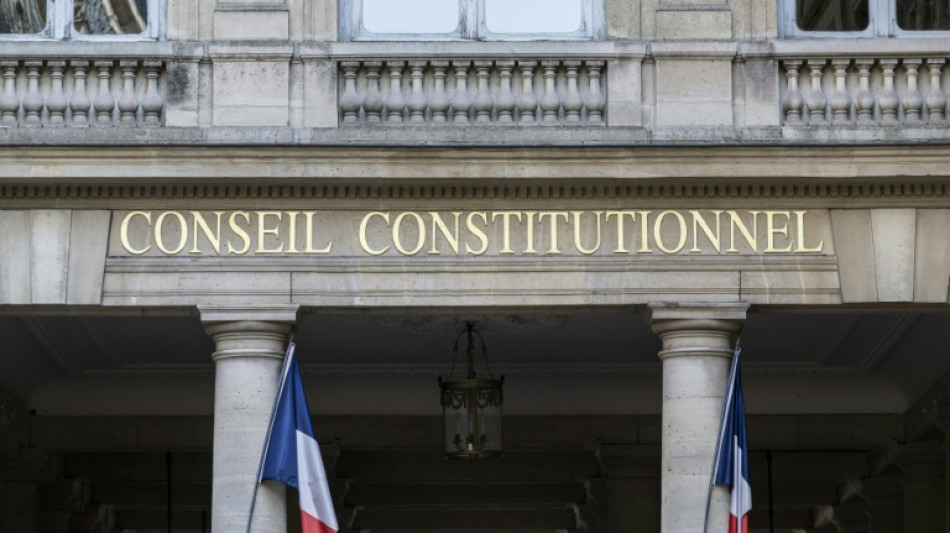
France upholds assisted dying law, strikes down social media ban for children / Photo: Martin LELIEVRE - AFP/File

 Australia probes app used in cheap smart glasses over privacy fears
 England needed to 'move on' from World Cup pain, says Tuchel

 O'Neill to stay at Celtic after period of "reflection"

 Kane marks 125th England cap with Wembley Nations League double

 Quebec's incoming separatist leader wants to block Crown from swearing-in

 Emmys gala will now stream its premier television awards

 Paramount completes Warner Bros takeover, creating Skydance

 Trump blames France unrest on Islam, migration

 Apple's Cook praises EU over efforts to protect children online

 Nobel winner Halzen says years of October 'misery' finally over

 Quebec separatist win rattles Carney's unity push

 'Itching' for change: Shiffrin cuts back slaloms this season

 'Gen Z has risen up': Tens of thousands mass for tense France school protests

 Caribbean tourism hotspot loses men to Russian war machine

 Danish reservists practice war games to respond to 'aggression'

 Bhuvneshwar returns to India's T20 squad for New Zealand tour

 Asos says probing 'unauthorised activity' after phone alerts

 Stocks climb as oil prices retreat under $100 per barrel

 Neutrinos: space particles that change our view of universe

 'Destined' Djokovic wins China Open, extending unbeaten record

 Iceland is 'critical outpost' for security, says Rubio during visit

 Israeli settlers beat AFP photographer covering West Bank

 'Gen Z has risen up': Tens of thousands demand better education in France

 $10 Million and Counting: Hola Prime Hits Major Trader Payout Milestone

 UEFA investigate Ireland-Israel tunnel bustup after spitting claim

France's top constitutional authority on Friday approved legislation on the right to assisted dying, but struck down a ban on social media access for children under 15 in a blow to one of President Emmanuel Macron's cherished reforms.
Macron's office hailed the Constitutional Council's decision on the assisted dying law, seen as one of the major social reforms of his second term.
The ruling "completes an exemplary democratic debate", the Elysee Palace said, adding that the legislation "provides an essential safeguard for our fellow citizens".
At the same time his office said the president had no plans to give up on his push to bar children from apps such as TikTok and the government would work on a new draft law.
The legislation establishing a right to assisted dying for some adults suffering from an incurable condition was passed by parliament in July after years of debate.
The Constitutional Council's ruling will see France join the Netherlands, Belgium, Switzerland and Canada, which have already legalised the practice.
The decision is a victory for Macron, who promised the law after his re-election in 2022, marking one of France's biggest social reforms since same-sex marriage was legalised in 2012.
At the same time the constitutional authority found that certain provisions of the legislation required clarification, including the so-called conscience clause, which allows healthcare professionals to refuse to take part in the procedure.
The clause must also apply to private healthcare facilities where assisted dying is "manifestly contrary" to their mission, provided they are not the only establishments able to meet "local needs", the constitutional authority said, meeting a key demand from Catholic healthcare institutions.
To be eligible for assisted dying, a patient must be of legal age and a French national or a long-term resident.
They must suffer from pain that is either unresponsive to treatment or, in the patient's view, unbearable if they have chosen not to receive or to stop receiving treatment.
The patient will administer a lethal substance themselves, with exceptions for those who are physically unable to do so and can be helped by a healthcare worker.
-'Deadly poison for children'-
But in a major setback to Macron, the constitutional authority struck down a ban on social media access for children under 15.
The Constitutional Council found that Article 1 of the legislation "constitutes an infringement that is neither appropriate, necessary, nor proportionate" to the freedom of expression and communication of those under 15.
In its ruling, the Constitutional Council also expressed concern about the potential impact on privacy of introducing an age-verification system for all users.
The law, which was due to take effect on September 1, would have barred younger users from social networks such as TikTok, Snapchat, and Instagram, among other restrictions.
The French government had promoted the ban as a way to better protect young people from the harmful effects associated with social media platforms, including anxiety, depression, sleep disorders and online harassment.
Macron had in July thanked members of parliament for backing the legislation and pledged to enforce it by September.
After the ruling, the Elysee said Macron had tasked Prime Minister Sebastien Lecornu with working on a new "legally robust draft" of the legislation.
Lecornu will have to work "as quickly as possible" on a draft that takes into account both the Constitutional Council's ruling and the European regulatory framework, the Elysee Palace said.
The presidency said Macron's determination to see the reform implemented remained undiminished.
Macron's former prime minister Gabriel Attal, who backed the proposal, expressed his disappointment.
"We take note of it and respect this decision, which applies to everyone," he said on X, vowing to continue fighting against what he described as "a deadly poison for our children".
The Constitutional Council did not rule on a separate provision banning mobile phone use in high schools from September 1.
A growing number of countries are taking steps to restrict social media access amid multiplying warnings over its harmful effects on children.
M.O.Allen--AT