Nigeria kidnap victims escape 'hellfire' captivity beaten, malnourished / Photo: Tonye BAKARE - AFP

 Australia's High Court rules against coal mine in landmark climate case

 Australia touts new funds for Pacific infrastructure at Fiji 'pre-COP'

 Eva Marie Saint, Oscar winner of Hollywood classics, dies at 102

 Australia probes app used in cheap smart glasses over privacy fears

 England needed to 'move on' from World Cup pain, says Tuchel

 O'Neill to stay at Celtic after period of "reflection"

 Kane marks 125th England cap with Wembley Nations League double

 Quebec's incoming separatist leader wants to block Crown from swearing-in

 Emmys gala will now stream its premier television awards

 Paramount completes Warner Bros takeover, creating Skydance
 Trump blames France unrest on Islam, migration

 Apple's Cook praises EU over efforts to protect children online

 Nobel winner Halzen says years of October 'misery' finally over

 Quebec separatist win rattles Carney's unity push

 'Itching' for change: Shiffrin cuts back slaloms this season

 'Gen Z has risen up': Tens of thousands mass for tense France school protests
 Caribbean tourism hotspot loses men to Russian war machine
 Danish reservists practice war games to respond to 'aggression'

 Bhuvneshwar returns to India's T20 squad for New Zealand tour

 Asos says probing 'unauthorised activity' after phone alerts

 Stocks climb as oil prices retreat under $100 per barrel

 Neutrinos: space particles that change our view of universe

 'Destined' Djokovic wins China Open, extending unbeaten record

 Iceland is 'critical outpost' for security, says Rubio during visit

 Israeli settlers beat AFP photographer covering West Bank

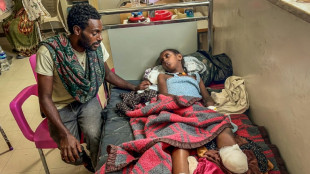
Visibly frail and malnourished children and women lay on rows of hospital beds, their bodies bearing the scars of six months of captivity deep in the Nigerian bush.
The patients were among 163 kidnapping victims from Woro, rescued earlier this month in the Kainji Lake National Park forest, after their village was attacked by suspected jihadists.
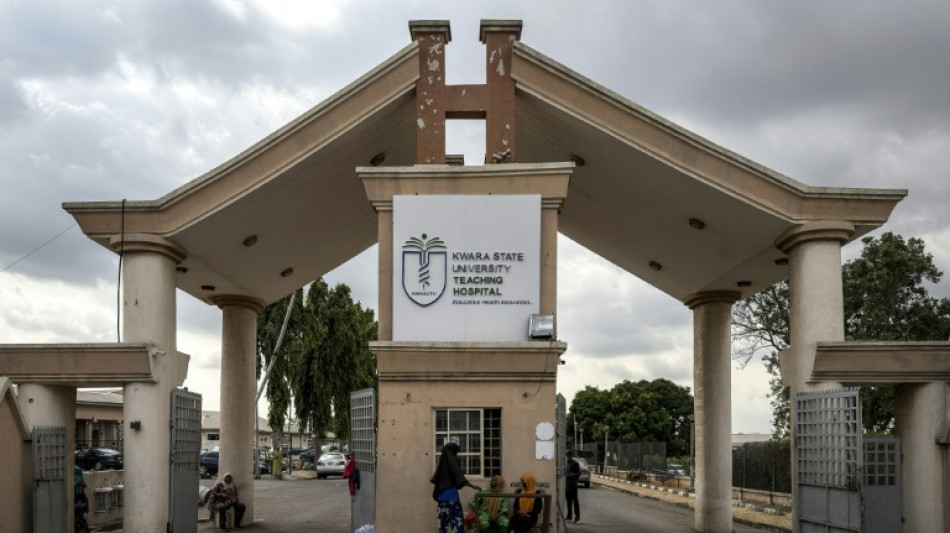
In total, 308 people were freed in what the government called the largest ever single day rescue operation -- though at the Kwara State University Teaching Hospital in Ilorin, where AFP visited recently, a long road to recovery lay ahead.
A child lay beneath a blue sheet, hooked to a respirator, with a team of doctors and nurses clustered around the bed.
A sobbing girl, no more than six years old, sat alone on a hospital bed, her family yet to visit.
"They are all responding to treatments," a nurse said, holding the tiny hand of a young boy about four years old. "Some of them still need blood."
Suspected jihadists attacked Woro, near the border with Benin, in February, killing upwards of 165 people and kidnapping scores.
Abductions for ransom have become a key moneymaker for criminal groups in Nigeria, especially among jihadists and non-ideological bandit groups across the north and centre of the country.
The victims were kept at a camp along with more than a hundred others seized from other villages, including Kasuwan Daji and Konkoso, both in Niger state, Woro village head Umar Bio Salihu told AFP.
Thirteen people from Woro died in captivity, he said, and 13 more remain in captivity.
- Kidnapping crisis -
Interviews with victims in the hospital were brief and stymied by officials who repeatedly bounced AFP journalists between different offices to seek approval.
While the government touted the rescue as a major success, it also underscores a crisis authorities are unable to stem: kidnappings raised some $1.66 million in ransom payments between July 2024 and June 2025, according to a tally by SBM Intelligence, a Lagos-based consultancy.
"We thank God we are out," a gaunt-looking victim, Hajara, said. "I do not wish that on even my enemies. It was like we just came back from hellfire."
While being held by the gunmen, the captives were fed tuwo, a thick, porridge-like meal made from guinea corn, and a "soup" made from a mixture of river water and salt. When they were lucky, their captors gave them seasoning cubes.
Once in a while, they got beef, from cattle they assume was rustled.
Those who ventured into the surrounding thickets to relieve themselves without the guards' permission were beaten, said 25-year-old nurse Amira Salihu, whose two brothers were killed during the February attack.
- Babies delivered by torchlight -
The daughter of the Woro village head's gentle smile belied the harrowing experience of the last six months as she spoke to AFP from a hotel -- guarded by police -- where some of the freed abductees were staying.
More than a dozen of the women at the camp were pregnant and went into labour while being held, Amira Salihu said.
With little visibility -- battery-powered torches being the only sources of light -- she helped to deliver the babies using her bare hands.
"I borrowed a razor blade to cut the placenta," she told AFP.
At the hotel, scores of the victims, mostly young children, noisily gathered around plastic tables in a hall for lunch.
"I am happy seeing them like this," Umar Bio Salihu, the village head, told AFP.
He has been shuttling between Woro and Ilorin, some 200 kilometres (124 miles) away, to check on the victims while they recover under government care in the state capital.
Despite the scale of the tragedy, Woro is coming back to life, a resident Isah Mogaji told AFP, with the village market in full swing.
"The community is very happy now," village head Salihu said. "They are waiting to receive their people."
W.Nelson--AT